![The author licensed this picture in a letter to the uploader as follows: "Ich lizensiere die Bilder [..] unter der GNU-FDL." (Translation: "I license the pictures [..] as GNU-FDL.") Drosera tokaiensis habit (Location typ](https://thumb.wikimedia.org/wikipedia/commons/thumb/c/c3/Drosera_spatulata_KansaiHabit.jpg/1280px-Drosera_spatulata_KansaiHabit.jpg)
Sundew
Drosera, family Droseraceae
Sticky-leaved carnivorous plants that trap insects with glistening dew-like drops
Sundews are a large group of carnivorous plants found on every continent except Antarctica. Their leaves are covered in sticky, dew-like glands that trap insects, which the plant digests to gain nutrients. Sundews vary widely in size and form, with flowers held high above the leaves and coming in shades of white, pink, red, yellow, orange, or violet.
- Sundews trap insects with sticky, dew-like glands on their leaves
- Found on every continent except Antarctica
- Flowers are usually white or pink, sometimes red, yellow, orange, or violet
- Charles Darwin studied sundews to prove plant carnivory
- Some species can live up to 50 years
What does Sundew look like?
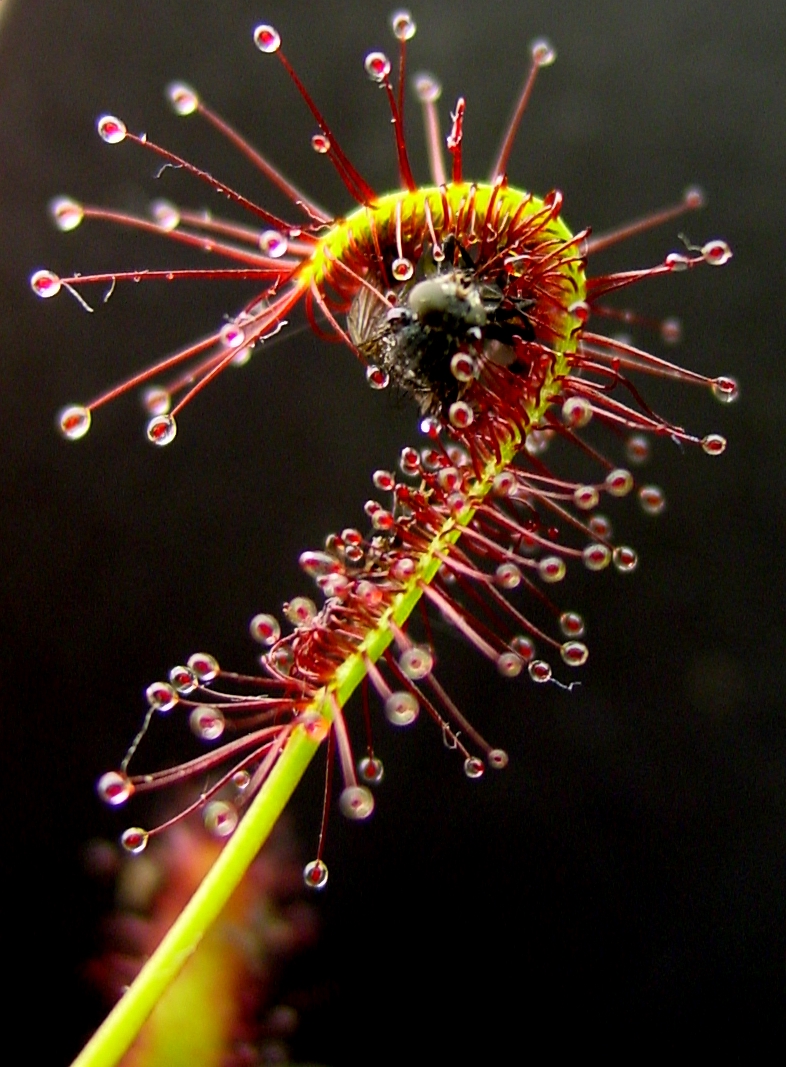
Sundews are herbaceous plants that can be small rosettes or tall, scrambling stems, with some species reaching up to 3 meters in length. Their leaves are covered in fine, stalked glands that secrete sticky mucilage, which looks like drops of dew. These sticky droplets attract and trap insects. The flowers, usually white or pink but sometimes red, yellow, orange, or violet, are held on long stems above the leaves and open one at a time, often only in direct sunlight.
Where does Sundew come from?
Drosera is found on every continent except Antarctica, with species adapted to a wide range of habitats from temperate to tropical regions. Many species are native to Australia, but they also occur in Africa, Europe, the Americas, and Asia. The name comes from the Greek word for dew, referring to the glistening drops on their leaves. Carl Linnaeus first described the genus in 1753. Charles Darwin studied Drosera extensively, confirming its carnivorous nature.
When and how Sundew blooms
Sundews grow in poor, often wet soils and rely on catching insects for nutrients. They can be perennial or annual, with some forming underground tubers or hibernacula to survive dry or cold periods. Flowers are produced on tall stems to avoid trapping pollinators. Sundews reproduce by seed, and some also form plantlets from roots or special structures like gemmae.



How Sundew is used
Sundews are grown by plant enthusiasts for their unusual appearance and insect-catching ability. They are kept in gardens and collections, especially by those interested in carnivorous plants. Their sticky leaves help control small insects, but they are not used in large-scale pest management. There is no mention of traditional medicinal or ceremonial use in the sources.
Kinds of Sundew
The genus includes nearly 200 species with a wide range of forms. Some, like pygmy sundews, are tiny and form dense mats, while others, like climbing or tuberous sundews from Australia, can grow much larger. Flower color and leaf shape vary greatly among species. Notable groups include temperate, subtropical, pygmy, tuberous, and Queensland sundews.
What Sundew means
Sundews are famous for their carnivorous habits and have been the subject of scientific study since Darwin’s time. Their name and common English term both refer to the dew-like appearance of their sticky glands. They are popular in botanical gardens and plant collections. The sources do not mention symbolic or religious meanings.
Where Sundew is used and seen

Traditions that use it
Questions people ask about Sundew
Where do sundews come from?
Sundews are native to every continent except Antarctica. They are especially diverse in Australia, but can also be found in Africa, Europe, Asia, and the Americas.
How do sundews catch insects?
Their leaves are covered in sticky glands that secrete mucilage. Insects are attracted to the droplets, become stuck, and the plant then digests them to absorb nutrients.
What do sundew flowers look like?
Sundew flowers are usually small, with five petals, and are held on long stems above the leaves. Most are white or pink, but some Australian species have red, yellow, orange, or violet flowers.
Are sundews grown as houseplants?
Yes, many people grow sundews in gardens or as part of carnivorous plant collections because of their unique appearance and insect-catching ability.
What does the sundew symbolize?
The sources do not mention any symbolic or religious meaning for sundews.
Good reading and sources
- Encyclopaedia BritannicaArticle
- USDA Plants DatabaseUS Department of Agriculture, Article
- Plants of the World OnlineRoyal Botanic Gardens, Kew, Plant database
- Where it has been recordedGBIF, Plant database
- Sightings and photos by naturalistsiNaturalist, Plant database
The facts on this page come from the Wikipedia article "Drosera", written by its contributors and used under the CC BY-SA 4.0 licence, and from its Wikidata record (CC0). Phool rewrote the text in its own words, with AI assistance, and compares every page with the article to make sure no passage is copied. It may be reused under the same CC BY-SA 4.0 licence with a link back.
It may contain mistakes. It is not medical or foraging advice: many flowers are poisonous, and traditional uses are reported, not recommended. If something is wrong, tell us. Last refreshed 2026-10-03.