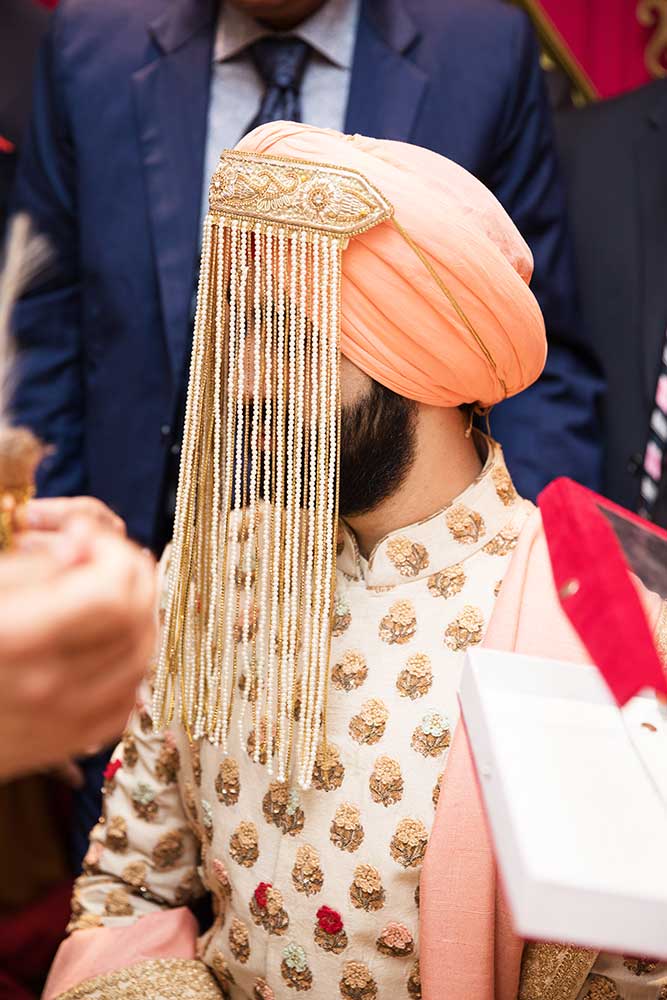
Sehra
In its own language: सेहरा
A forehead garland or veil worn by Indian brides and grooms at weddings
A sehra is a decorative garland or veil tied to the forehead of a bride or groom during weddings in the Indian subcontinent. Made from flowers or beads, it is attached to the turban and forms part of a ritual performed by female relatives, often with traditional songs.
- A sehra is a forehead garland or veil for Indian weddings.
- It is made from flowers or beads and tied to the turban.
- Female relatives perform the ritual of tying the sehra, called sehra bandi.
- Known by different names in various Indian languages.
- Also worn by Caribbean Hindu bridegrooms.
What is Sehra?
A sehra is a garland or veil worn across the forehead, usually by the groom and sometimes the bride, during weddings in the Indian subcontinent. It is tied to the turban or head covering and hangs down to partially cover the face. The sehra can be made from fresh flowers, such as jasmine or marigold, or from beads and decorative threads. Its appearance varies by region and family tradition, but it is always an ornamental piece that adds to the wedding attire.
Where does Sehra come from?
The word 'sehra' comes from the Sanskrit 'Śīrṣahāra', meaning a garland for the head. References to the sehra appear in Braj poetry by the Hindu Bhakti saint Suradāsa. The custom is found across the Indian subcontinent and is also practiced by Caribbean Hindus. Over time, the sehra has become a significant part of wedding rituals, with regional names and styles reflecting local languages and traditions.
How Sehra is made
A sehra is assembled either from strings of flowers or from beads and threads. It is tied to the groom’s turban or head covering, so that the strands fall over the face. The making of a floral sehra involves threading small flowers together, while a beaded sehra uses decorative beads and sometimes metallic threads. The choice of material and design often depends on family preference and regional custom.
When and where Sehra is used
The sehra is put on the groom or bride as part of the wedding ceremony. The ritual of tying the sehra, known as sehra bandi, is performed by female relatives such as sisters and sisters-in-law, often in a set order. During the ceremony, traditional wedding songs are sung. The sehra is worn as the groom leaves for the bride’s house, symbolizing good wishes and blessings.
Forms of Sehra
The sehra is known by different names in various regions: 'sehro' in Gujarati, 'sevrau' in Rajasthani, 'mundavalya' in Marathi, 'morrah' in Sindhi, and 'basikam' in Telugu. The materials and style also vary, with some families preferring floral garlands and others using beads. In some communities, brides also wear a version of the sehra.
What Sehra means
The sehra is a symbol of auspiciousness and protection in wedding ceremonies. It marks the transition of the groom or bride into married life and is associated with blessings from the family. The ritual of sehra bandi, performed by women, reinforces family bonds and tradition. The sehra’s mention in classical poetry highlights its cultural importance.
Questions people ask about Sehra
What is a sehra and who wears it?
A sehra is a decorative garland or veil tied to the forehead, usually worn by the groom and sometimes the bride during weddings in the Indian subcontinent.
Where does the sehra tradition come from?
The sehra tradition comes from the Indian subcontinent and is mentioned in Sanskrit and Braj poetry. It is practiced in India and among Caribbean Hindus.
How is a sehra made?
A sehra can be made from strings of fresh flowers or from beads and threads. It is tied to the turban or head covering so that it hangs over the face.
What is sehra bandi?
Sehra bandi is the ritual of tying the sehra on the groom's head, performed by female relatives in a set order, often with traditional songs.
What does the sehra symbolise?
The sehra symbolises good wishes, blessings, and protection for the groom or bride as they begin married life.
Good reading and sources
The facts on this page come from the Wikipedia article "Sehra (headdress)", written by its contributors and used under the CC BY-SA 4.0 licence, and from its Wikidata record (CC0). Phool rewrote the text in its own words, with AI assistance, and compares every page with the article to make sure no passage is copied. It may be reused under the same CC BY-SA 4.0 licence with a link back.
It may contain mistakes. If something is wrong, tell us. Last refreshed 2026-10-03.
More of the same kind
 Decoration
Laurel wreath
A head or neck wreath made from laurel leaves, symbolizing victory
🇬🇷 Greece and 4 more · Worn flowers
Decoration
Laurel wreath
A head or neck wreath made from laurel leaves, symbolizing victory
🇬🇷 Greece and 4 more · Worn flowers
 Decoration
Festoon
A hanging garland or carved ornament of flowers, foliage, or fruit
Garland or wreath
Decoration
Festoon
A hanging garland or carved ornament of flowers, foliage, or fruit
Garland or wreath
 Decoration
Corsage
A small bouquet worn on the dress or wrist for formal events
Garland or wreath
Decoration
Corsage
A small bouquet worn on the dress or wrist for formal events
Garland or wreath
 Decoration
Wreath
A ring-shaped decoration made from flowers, leaves, or other materials
🇬🇷 Greece and 7 more · Arrangement
Decoration
Wreath
A ring-shaped decoration made from flowers, leaves, or other materials
🇬🇷 Greece and 7 more · Arrangement
More from India
All the flowers of India Decoration
Varamalaवरमाला
A flower garland exchanged by bride and groom in Hindu weddings
🇮🇳 India · Garland or wreath
Decoration
Varamalaवरमाला
A flower garland exchanged by bride and groom in Hindu weddings
🇮🇳 India · Garland or wreath
 Decoration
Rangoliरंगोली
Indian floor art made with coloured powders, rice, or petals for festivals and daily welcome
🇮🇳 India and 1 more · Carpet or floor pattern
Decoration
Rangoliरंगोली
Indian floor art made with coloured powders, rice, or petals for festivals and daily welcome
🇮🇳 India and 1 more · Carpet or floor pattern
 Decoration
Onam
Kerala’s ten-day harvest festival with flower carpets, feasts and boat races
🇮🇳 India and 1 more · Custom, Aug to Sep
Decoration
Onam
Kerala’s ten-day harvest festival with flower carpets, feasts and boat races
🇮🇳 India and 1 more · Custom, Aug to Sep
 Decoration
Garland
A string or braid of flowers, leaves, or other materials for decoration or ceremony
🇮🇳 India and 3 more · Garland or wreath
Decoration
Garland
A string or braid of flowers, leaves, or other materials for decoration or ceremony
🇮🇳 India and 3 more · Garland or wreath