
Horse-chestnut
Aesculus hippocastanum, family Sapindaceae
A large flowering tree known for its white spring blooms and shiny brown conkers
The horse-chestnut is a tall, broad tree with white flowers in spring and spiky green fruits holding glossy brown seeds called conkers. Native to the Balkans, it is now planted widely in parks and streets across Europe and beyond, valued for its shade, flowers, and use in games and traditional remedies.
- Produces shiny brown seeds called conkers, used in a children's game
- Native to the Balkans but now common in parks across Europe
- Raw seeds and plant parts are toxic if eaten
- Symbol of Kyiv and mentioned in Anne Frank's diary
- Flowers are white with yellow or pink blotches and bloom in late spring
What does Horse-chestnut look like?
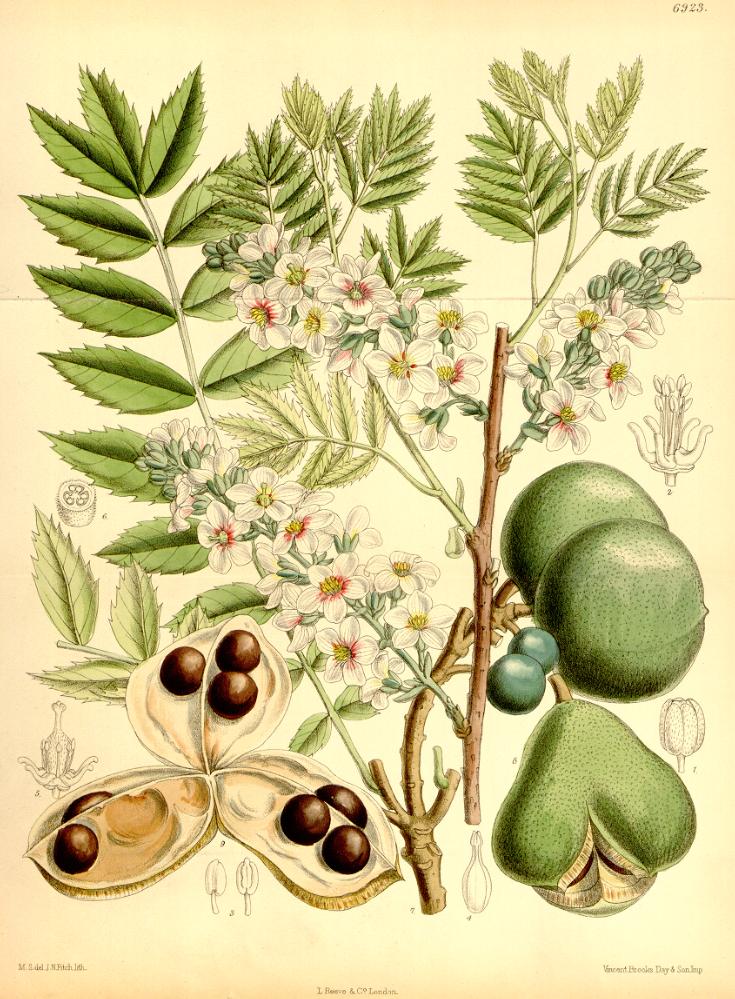
The horse-chestnut is a large, deciduous tree that can reach up to 39 meters tall, with a domed crown and thick branches. Its leaves are large, with five to seven leaflets spreading from a single point, and have a distinctive horseshoe-shaped scar when they fall. In late spring, upright clusters of white flowers appear, each with yellow or pink markings at the base. The tree produces spiky green capsules containing shiny brown seeds known as conkers.
Where does Horse-chestnut come from?
Aesculus hippocastanum is native to the Balkan Peninsula, mainly in Albania, Bulgaria, Greece, and North Macedonia, with some sources also including Turkey and Turkmenistan. Its wild populations are now limited and protected in places like Bulgaria's Preslav Mountain. The tree has been widely introduced and planted in temperate regions around the world, especially in Europe, where it is a common sight in parks and along streets.
When and how Horse-chestnut blooms
Horse-chestnut trees bloom in late spring, producing upright clusters of flowers. They grow best in temperate climates where summers are not too hot, and are often planted from seed. The trees are valued for their dense canopy and shallow roots, making them suitable for urban planting. They are also grown as bonsai.


How Horse-chestnut is used
People plant horse-chestnut trees in parks, streets, and gardens for their shade and flowers. The seeds, called conkers, are used in a traditional children's game in Britain and Ireland. In the past, the seeds were collected for industrial uses during wartime. Extracts from the seeds have been used in traditional medicine, though the raw parts of the plant are toxic and should not be eaten.
Kinds of Horse-chestnut
The species Aesculus hippocastanum is the main type grown, but the term 'buckeye' is more often used for related species in North America. Notable populations include the relict forests in Bulgaria, which are critically endangered. The tree is also a popular subject for bonsai.
What Horse-chestnut means
The horse-chestnut is a symbol of Kyiv, Ukraine, and features in local identity. A famous tree stood outside Anne Frank's hiding place in Amsterdam and its seedlings have been planted at memorial sites in the United States. The tree is central to the children's game 'conkers' in Britain and Ireland, and has a place in the history of beer gardens in Germany, where it was planted for shade.
Where Horse-chestnut is used and seen

Questions people ask about Horse-chestnut
Where does the horse-chestnut come from?
The horse-chestnut is native to the Balkan Peninsula, especially Albania, Bulgaria, Greece, and North Macedonia. It has been widely planted in parks and streets across Europe and other temperate regions.
What does the horse-chestnut tree look like?
It is a large, broad tree with a domed crown, palm-shaped leaves with 5–7 leaflets, and upright clusters of white flowers in late spring. Its fruits are spiky green capsules containing shiny brown seeds called conkers.
What are conkers and how are they used?
Conkers are the glossy brown seeds of the horse-chestnut. In Britain and Ireland, children use them in a traditional game called 'conkers,' where the seeds are threaded on strings and struck against each other.
Is the horse-chestnut tree poisonous?
Yes, all parts of the horse-chestnut, especially the seeds, leaves, bark, and flowers, are toxic if eaten due to compounds like aesculin and saponins. They should not be consumed by people or animals.
What does the horse-chestnut symbolise?
The horse-chestnut is a symbol of Kyiv, Ukraine, and is associated with local identity. It is also remembered for the tree mentioned in Anne Frank's diary and its seedlings planted at memorial sites.
Good reading and sources
- Encyclopaedia BritannicaArticle
- BBC Earth | Environment, Climate Change, AI, Food, Health, Social, & TechnologyBBC, Article
- Plants of the World OnlineRoyal Botanic Gardens, Kew, Plant database
- Where it has been recordedGBIF, Plant database
- Sightings and photos by naturalistsiNaturalist, Plant database
- Aesculus hippocastanum on WikipediaEncyclopedia
- More photos on Wikimedia CommonsPhotos
- Wikidata recordOpen data
The facts on this page come from the Wikipedia article "Aesculus hippocastanum", written by its contributors and used under the CC BY-SA 4.0 licence, and from its Wikidata record (CC0). Phool rewrote the text in its own words, with AI assistance, and compares every page with the article to make sure no passage is copied. It may be reused under the same CC BY-SA 4.0 licence with a link back.
It may contain mistakes. It is not medical or foraging advice: many flowers are poisonous, and traditional uses are reported, not recommended. If something is wrong, tell us. Last refreshed 2026-10-03.
More from Albania
All the flowers of Albania Poppy
Bright-petalled flowers grown for gardens, seeds, and remembrance
🇬🇧 United Kingdom and 7 more · Wildflower
Poppy
Bright-petalled flowers grown for gardens, seeds, and remembrance
🇬🇧 United Kingdom and 7 more · Wildflower
 Strawberry-treeArbutus unedo
An evergreen Mediterranean tree with white bell flowers and red, strawberry-like fruit
🇮🇹 Italy and 7 more · Flowering tree
Strawberry-treeArbutus unedo
An evergreen Mediterranean tree with white bell flowers and red, strawberry-like fruit
🇮🇹 Italy and 7 more · Flowering tree
 Common peonyPaeonia officinalis
A deep pink or red peony from the mountains of southern Europe
🇮🇹 Italy and 7 more · Wildflower
Common peonyPaeonia officinalis
A deep pink or red peony from the mountains of southern Europe
🇮🇹 Italy and 7 more · Wildflower
 Colchicum hungaricum
A rare early-spring flower of limestone slopes in Hungary and the Balkans
🇭🇺 Hungary and 5 more · Wildflower
Colchicum hungaricum
A rare early-spring flower of limestone slopes in Hungary and the Balkans
🇭🇺 Hungary and 5 more · Wildflower