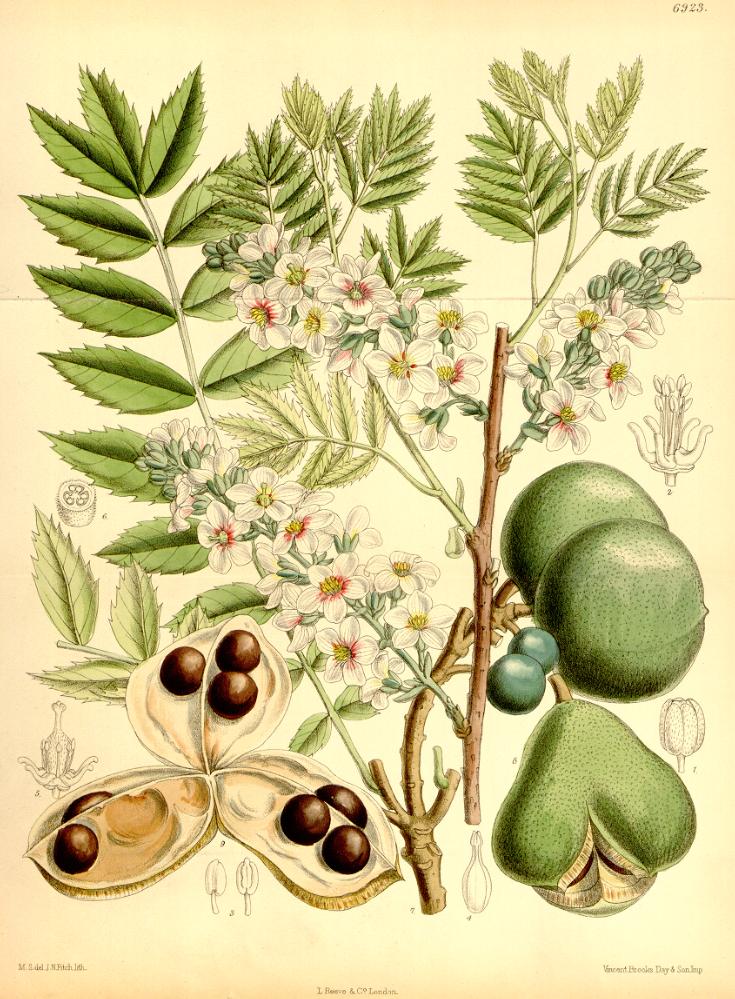
Yellowhorn
Xanthoceras sorbifolium, family Sapindaceae
In its own language: 天仙果
A hardy flowering tree from northern China with edible seeds and fragrant white blooms
Yellowhorn is a small tree or large shrub native to northern China, valued for its clusters of white flowers and edible seeds. It thrives in harsh climates, is grown for food, oil, and honey, and is planted in temple grounds as a sacred tree. Its flowers are fragrant and it is used in traditional medicine.
- Native to northern China and thrives in cold, dry regions
- Produces clusters of fragrant white flowers in spring
- Seeds and kernels are edible and taste like chestnuts
- Used in traditional Chinese, Mongolian, and Tibetan medicine
- Planted as a sacred tree in northern Chinese temples
What does Yellowhorn look like?
Yellowhorn is a deciduous plant that can grow as a shrub or small tree, reaching up to 8 meters tall. Its leaves are long and divided into many sharply toothed leaflets. In spring, upright clusters of white, five-petaled flowers appear, each about 2–3 cm across. The flowers are fragrant and attract bees. The fruit is a tough, oval capsule that splits open to reveal shiny black seeds, which look like small chestnuts.
Where does Yellowhorn come from?
Yellowhorn comes from northern China, where it grows wild in provinces like Gansu and Hebei. It is adapted to survive in cold and dry places, including the Gobi Desert. The tree has a long history in China, where it is sometimes planted in temple grounds, especially in the north. It was introduced to Russia in the 1800s and has since been cultivated in other regions. The name Xanthoceras means 'yellow horn', and the species name refers to its rowan-like leaves.
When and how Yellowhorn blooms
Yellowhorn blooms in mid-spring, producing clusters of white flowers. It is grown from seeds, which are protected by very hard shells. The plant tolerates drought and cold, making it suitable for tough environments. In recent years, growers in China have developed new varieties by cross-pollinating plants from different regions, resulting in some with flowers of various colors and higher fruit yields.


How Yellowhorn is used
People use nearly every part of the yellowhorn. The seeds and kernels are eaten raw or cooked, with a taste similar to chestnuts. The flowers are a good source of nectar for bees, leading to a unique honey. Leaves can be brewed as tea. In traditional Chinese, Mongolian, and Tibetan medicine, different parts are used for various remedies. The tree is also valued for its oil-rich seeds and as a hardy ornamental in gardens and temple grounds.
Kinds of Yellowhorn
Most yellowhorn trees have white flowers, but cross-breeding at research centers in China has led to plants with a range of flower colors. Some modern varieties have been selected for higher fruit production and better adaptability. The species is the only member of its genus.
What Yellowhorn means
Yellowhorn is seen as a sacred tree in northern Chinese temples, where other sacred species do not grow. It is known in Chinese herbal texts as 'Heavenly Fairy Fruit'. Its tough nature and many uses have made it a symbol of endurance and value in harsh climates. In recent decades, efforts to promote and cultivate yellowhorn have increased its profile and economic importance in China.
Questions people ask about Yellowhorn
Where does yellowhorn come from?
Yellowhorn is native to northern China, especially in provinces such as Gansu and Hebei. It is also grown in Russia and Mongolia, and can survive in cold, dry areas.
What does yellowhorn look like?
It is a shrub or small tree up to 8 meters tall, with long, divided leaves and clusters of white, fragrant flowers in spring. The fruit is a tough capsule containing shiny black seeds.
How is yellowhorn used?
Its seeds and kernels are eaten, the flowers provide nectar for honey, and the leaves can be made into tea. It is also used in traditional medicine and planted as an ornamental or sacred tree.
Is yellowhorn important in culture or religion?
Yes, it is planted as a sacred tree in northern Chinese temples and is mentioned in Chinese herbal texts. Its resilience and usefulness have made it a valued plant in its native region.
Are there different types of yellowhorn?
Most have white flowers, but breeding efforts in China have produced varieties with different flower colors and improved fruit yields.
Good reading and sources
- Xanthoceras sorbifoliumRoyal Horticultural Society, Article
- USDA Plants DatabaseUS Department of Agriculture, Article
- Plants of the World OnlineRoyal Botanic Gardens, Kew, Plant database
- Where it has been recordedGBIF, Plant database
- Sightings and photos by naturalistsiNaturalist, Plant database
The facts on this page come from the Wikipedia article "Xanthoceras", written by its contributors and used under the CC BY-SA 4.0 licence, and from its Wikidata record (CC0). Phool rewrote the text in its own words, with AI assistance, and compares every page with the article to make sure no passage is copied. It may be reused under the same CC BY-SA 4.0 licence with a link back.
It may contain mistakes. It is not medical or foraging advice: many flowers are poisonous, and traditional uses are reported, not recommended. If something is wrong, tell us. Last refreshed 2026-10-03.

More from China
All the flowers of China PeachPrunus persica
A flowering fruit tree from China, grown for its pink blossoms and sweet fruit
🇨🇳 China and 7 more · Flowering tree
PeachPrunus persica
A flowering fruit tree from China, grown for its pink blossoms and sweet fruit
🇨🇳 China and 7 more · Flowering tree
 Common sunflowerHelianthus annuus
A tall annual plant grown for its large yellow flower heads and edible seeds
🇨🇦 Canada and 4 more · Wildflower
Common sunflowerHelianthus annuus
A tall annual plant grown for its large yellow flower heads and edible seeds
🇨🇦 Canada and 4 more · Wildflower
 PomegranatePunica granatum
A shrub with bright red flowers and a fruit full of edible seeds
🇮🇷 Iran and 9 more · Flowering shrub
PomegranatePunica granatum
A shrub with bright red flowers and a fruit full of edible seeds
🇮🇷 Iran and 9 more · Flowering shrub
 BirchBetula
Slender trees with papery bark found across the northern world
🇨🇳 China and 7 more · Wildflower
BirchBetula
Slender trees with papery bark found across the northern world
🇨🇳 China and 7 more · Wildflower