Gentian
Gentiana, family Gentianaceae
Trumpet-shaped blue and yellow flowers of alpine meadows and temperate regions
Gentian is a large group of over 300 flowering plants known for their trumpet-shaped blooms, often in vivid blue or bright yellow. Native to alpine and temperate regions across Asia, Europe, the Americas, and parts of Africa and Oceania, gentians are used in gardens, as flavorings in drinks, and in traditional medicine.
- Over 300 species of gentian exist worldwide
- Flowers are mostly trumpet-shaped and often deep blue or bright yellow
- Gentian root flavors bitters and liqueurs like Suze and Aperol
- The Minamoto clan of Japan used gentian as their emblem
- Gentian is valued in gardens, especially rock and alpine gardens
What does Gentian look like?
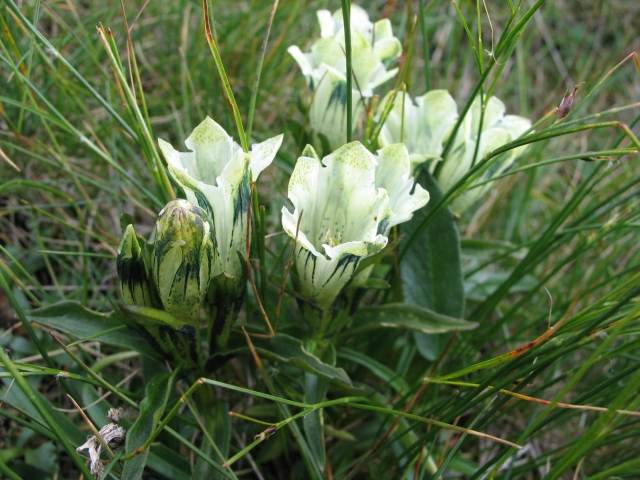
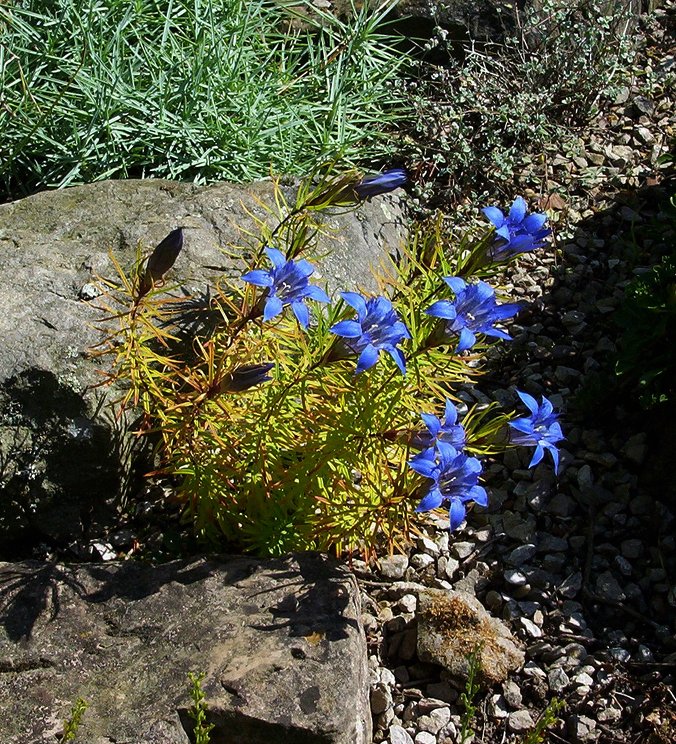
Gentian plants can be annual, biennial, or perennial, with some keeping their leaves year-round. Their leaves grow in pairs or as a rosette at the base. The flowers are usually trumpet-shaped, most often a deep blue or azure, but some species have yellow, white, cream, or red blooms. Most have five petals and sepals, with folds between the petals. Some species show a range of flower colors. The flowers are often large and striking, especially in blue-flowered types.
Where does Gentian come from?
Gentians grow wild in alpine and temperate zones of Asia, Europe, and the Americas, with some species in northwestern Africa, eastern Australia, and New Zealand. The genus includes more than 300 species, making it one of the larger groups in its family. The name Gentiana honors Gentius, an Illyrian king linked to the discovery of the plant’s tonic qualities. Over time, some plants once grouped as gentians have been reclassified into related genera.
When and how Gentian blooms
Gentians thrive in moist, humus-rich soils that drain well, with a neutral to acidic pH. They can grow in full sun or partial shade and are fully hardy. Many species are best suited to rock gardens and alpine settings. While some are difficult to grow outside their native habitat, several species and cultivars are available for gardeners, especially those with intense blue flowers.


How Gentian is used
Gentian roots are widely used to flavor bitters, liqueurs, and apéritifs, such as Gentian liqueur, Suze, and Aperol. The root is also used in soft drinks like Moxie and in bitters for cocktails. Some species have leaves or young plants that are edible when cooked, used as famine food. Gentian extracts are used in herbal medicine, mainly for digestive issues, and have limited use in perfumery.
Kinds of Gentian
The genus Gentiana includes over 300 species, with blue-flowered types common in the Northern Hemisphere and red-flowered ones in the Andes. White-flowered species are found throughout the range but are most common in New Zealand. Cultivars like 'Blue Silk', 'Shot Silk', and 'Strathmore' have been recognized for their garden value. Some related genera, such as Gentianella and Gentianopsis, were once included in Gentiana.
What Gentian means
Gentian flowers served as the emblem of Japan’s Minamoto clan and are the official flower of the German-speaking community of Belgium. Their intense blue color is especially prized in gardens and as a symbol in various cultures. Gentian is also known for its bitter taste, which has made it important in the production of traditional drinks and herbal remedies.
Where to see Gentian

Questions people ask about Gentian
Where do gentians come from?
Gentians are native to alpine and temperate regions across Asia, Europe, and the Americas, with some species found in northwestern Africa, eastern Australia, and New Zealand.
What do gentian flowers look like?
Gentian flowers are usually trumpet-shaped and can be deep blue, yellow, white, cream, or red. Most have five petals and are known for their striking color, especially blue.
How are gentians used?
Gentian roots are used to flavor bitters, liqueurs, and apéritifs. Some species are edible when cooked, and gentians are also grown in gardens and used in traditional medicine.
What does gentian symbolize?
Gentian flowers have served as emblems, such as for the Minamoto clan in Japan and the German-speaking community of Belgium.
Are all gentians blue?
No, while many gentians are blue, some species have yellow, white, cream, or red flowers. Flower color varies by species and region.
Good reading and sources
- Encyclopaedia BritannicaArticle
- Gentiana 'Blue Silk'Royal Horticultural Society, Article
- USDA Plants DatabaseUS Department of Agriculture, Article
- Plants of the World OnlineRoyal Botanic Gardens, Kew, Plant database
- Where it has been recordedGBIF, Plant database
- Sightings and photos by naturalistsiNaturalist, Plant database
The facts on this page come from the Wikipedia article "Gentiana", written by its contributors and used under the CC BY-SA 4.0 licence, and from its Wikidata record (CC0). Phool rewrote the text in its own words, with AI assistance, and compares every page with the article to make sure no passage is copied. It may be reused under the same CC BY-SA 4.0 licence with a link back.
It may contain mistakes. It is not medical or foraging advice: many flowers are poisonous, and traditional uses are reported, not recommended. If something is wrong, tell us. Last refreshed 2026-10-03.
Others in the family Gentianaceae
The whole family Gentiana scabra
A blue-flowered gentian native to East Asia, valued in traditional medicine
🇨🇳 China and 1 more · Wildflower
Gentiana scabra
A blue-flowered gentian native to East Asia, valued in traditional medicine
🇨🇳 China and 1 more · Wildflower
 Gentiana clusii
A blue gentian of European limestone mountains
Gentiana clusii · Wildflower
Gentiana clusii
A blue gentian of European limestone mountains
Gentiana clusii · Wildflower
 Hungarian gentianGentiana pannonica
A mountain wildflower with reddish-violet, spotted bell-shaped blooms
🇦🇹 Austria and 2 more · Wildflower
Hungarian gentianGentiana pannonica
A mountain wildflower with reddish-violet, spotted bell-shaped blooms
🇦🇹 Austria and 2 more · Wildflower
 LisianthusEustoma
A small gentian genus grown as the long-lasting cut flower lisianthus
🇺🇸 United States and 1 more · Cut flower
LisianthusEustoma
A small gentian genus grown as the long-lasting cut flower lisianthus
🇺🇸 United States and 1 more · Cut flower