
Nuytsia
Nuytsia floribunda, family Loranthaceae
In its own language: moojar
A parasitic Western Australian tree with blazing orange summer flowers
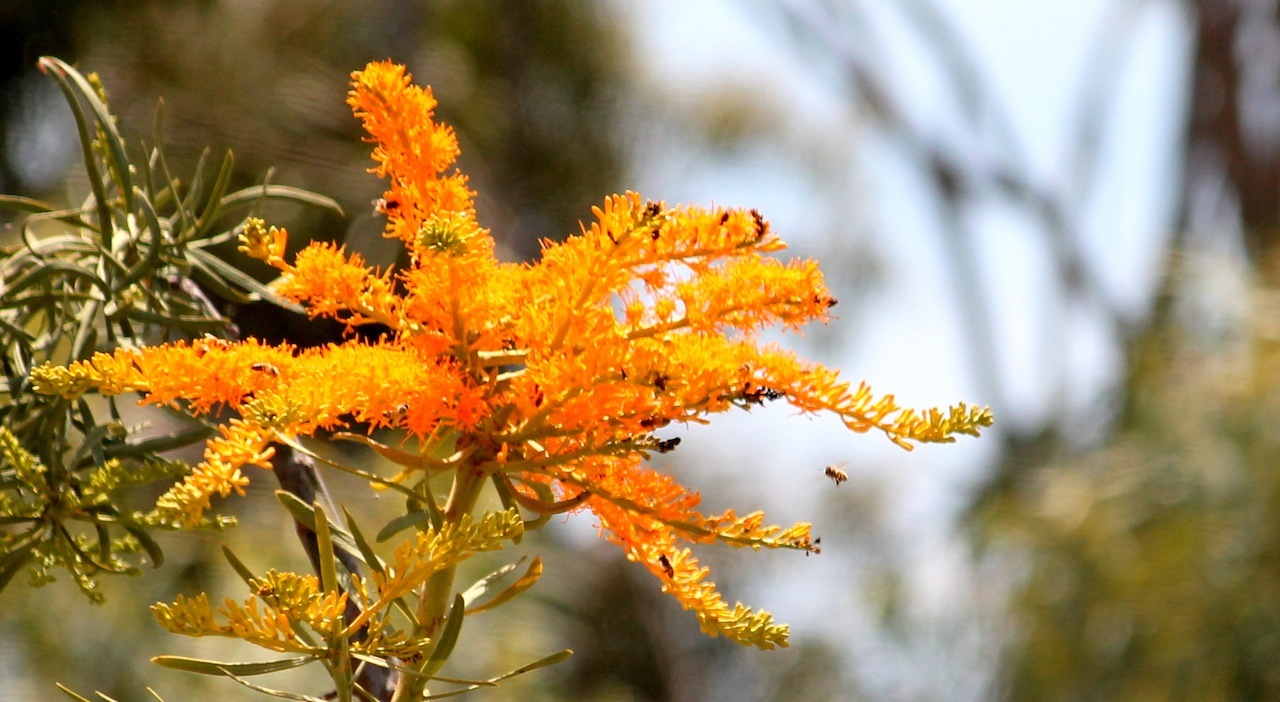
Nuytsia floribunda is a hemiparasitic tree or shrub native to Southwest Australia. It bears vivid yellow-orange flower spikes up to a metre long between October and January, earning it the name Western Australian Christmas tree. It draws water and nutrients from the roots of many nearby plants through an extensive underground network.
- Flowers October to January with metre-long orange spikes
- Roots can extend over 150 metres to parasitise other plants
- Sacred to Noongar people, who call it moojar
- Produces sweet edible gum and flower-based drinks
- Named after 17th-century Dutch explorer Pieter Nuyts
What does Nuytsia look like?
Nuytsia grows as a tree up to 10 metres tall or as a shrub, with rough grey-brown bark. Its most striking feature is the dense clusters of bright yellow-orange flowers that form spikes up to one metre long. The plant makes its own food through photosynthesis but taps into the roots of other plants for water and minerals using specialised structures called haustoria.
Where does Nuytsia come from?
First described in 1805 as Loranthus floribundus, it was later placed in its own genus, Nuytsia, named after Dutch explorer Pieter Nuyts. Though part of the mistletoe family, it grows in the ground rather than on branches. It has been known for millennia to the Noongar people of Southwest Australia, who call it moojar and associate its bloom with seasonal change.
When and how Nuytsia blooms
It flowers from October to January during the austral summer. Seedlings sprout easily but rarely survive to maturity outside their native range. The plant sends out rhizomes and roots that can stretch over 150 metres, connecting to countless host plants. These underground networks allow it to thrive even in cleared farmland, though urban development has reduced its presence near Perth.


How Nuytsia is used
The Noongar people collect its sweet gum and use the bark for shields. They brew a mead-like drink from the flowers during birak season. The tree is considered sacred: touching its parts is discouraged, and stories warn children against eating too much gum. Early colonists called it fire-tree or cabbage tree, but its wood has no commercial value.
What Nuytsia means
Known as moojar to the Noongar, this tree signals the start of birak, a hot, dry season. Its brilliant bloom was seen as a warning of coming fire. Revered in Noongar tradition, it features in stories about a night creature that feeds on its gum. The Western Australian Herbarium names its botanical journal Nuytsia in honour of this species.
Questions people ask about Nuytsia
Where does Nuytsia come from?
It is native to Southwest Australia, especially around Perth, Esperance, and the Geraldton Sandplains.
Why is it called the Christmas tree?
Its bright orange flowers bloom in the austral summer, around December, coinciding with the Christmas season.
How does Nuytsia get its nutrients?
It is a hemiparasite: it photosynthesises but also taps into the roots of many nearby plants for water and minerals.
Is Nuytsia used by Indigenous Australians?
Yes, the Noongar people use its bark for shields, eat its sweet gum, and make a drink from its flowers.
Can you grow Nuytsia in a garden?
It is very difficult to cultivate outside its natural habitat, and transplanting mature plants is usually unsuccessful.
Good reading and sources
- IUCN Red List of Threatened SpeciesIUCN Red List, Article
- Plants of the World OnlineRoyal Botanic Gardens, Kew, Plant database
- Where it has been recordedGBIF, Plant database
- Sightings and photos by naturalistsiNaturalist, Plant database
The facts on this page come from the Wikipedia article "Nuytsia", written by its contributors and used under the CC BY-SA 4.0 licence, and from its Wikidata record (CC0). Phool rewrote the text in its own words, with AI assistance, and compares every page with the article to make sure no passage is copied. It may be reused under the same CC BY-SA 4.0 licence with a link back.
It may contain mistakes. It is not medical or foraging advice: many flowers are poisonous, and traditional uses are reported, not recommended. If something is wrong, tell us. Last refreshed 2026-10-03.
More from Australia
All the flowers of Australia AlmondPrunus amygdalus
A Mediterranean tree grown for its fragrant spring flowers and edible seeds
🇮🇷 Iran and 6 more · Flowering tree
AlmondPrunus amygdalus
A Mediterranean tree grown for its fragrant spring flowers and edible seeds
🇮🇷 Iran and 6 more · Flowering tree
 FennelFoeniculum vulgare
A tall, aromatic herb with feathery leaves and yellow umbels, used for food and spice
🇨🇳 China and 7 more · Herb or useful flower
FennelFoeniculum vulgare
A tall, aromatic herb with feathery leaves and yellow umbels, used for food and spice
🇨🇳 China and 7 more · Herb or useful flower
 Eucalyptus
The tall, aromatic trees and shrubs known as gum trees or eucalypts
🇦🇺 Australia and 7 more · Flowering tree
Eucalyptus
The tall, aromatic trees and shrubs known as gum trees or eucalypts
🇦🇺 Australia and 7 more · Flowering tree
 Acacia
Shrubs and trees with golden or cream puffball flowers, native mostly to Australia
🇦🇺 Australia and 6 more · Wildflower
Acacia
Shrubs and trees with golden or cream puffball flowers, native mostly to Australia
🇦🇺 Australia and 6 more · Wildflower