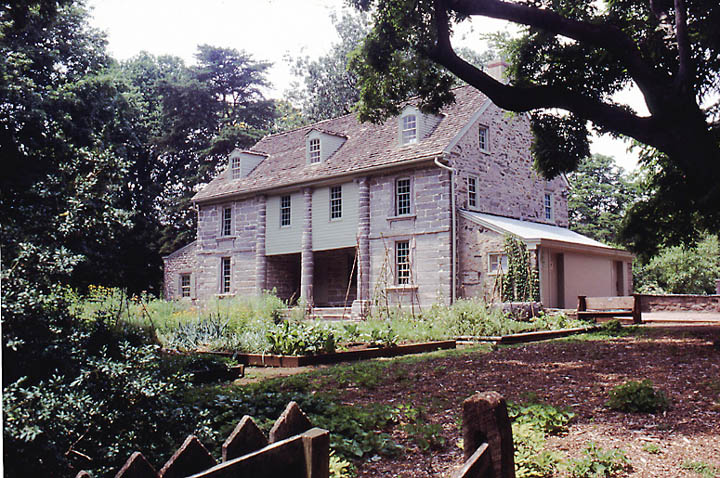
Bartram's Garden
America's oldest surviving botanical garden, on the Schuylkill River in Philadelphia
Bartram's Garden is a 45-acre public botanical garden on the Schuylkill River in Philadelphia, Pennsylvania. Established in 1728 by John Bartram, it features historic plant collections, notable old trees, and the original stone house, and serves as a center for education, community events, and art.
- Founded in 1728 by botanist John Bartram
- Home to the only surviving Franklinia trees
- Features the oldest ginkgo in North America
- 45 acres of gardens, meadows, and riverfront
- Hosts educational and community programs
What is Bartram's Garden?
Visitors to Bartram's Garden find a large riverside park filled with a wide range of native and introduced plants. The grounds include the original stone house built by John Bartram, a greenhouse from the 18th century, and several specimen trees such as the Franklinia, yellowwood, and a very old ginkgo. Trails wind through meadows, gardens, and wetlands, and there are spaces for art and learning. The garden is both a peaceful retreat and an educational resource, with access to the river and views of Philadelphia.
The history of Bartram's Garden
John Bartram, a pioneering botanist, started the garden in 1728 on his farm outside the city. He and his family collected and grew many North American plants, exchanging specimens with botanists in Europe and America. Over time, the Bartram family expanded the garden, making it a center for plant trade and study. After changing hands in the 19th century, the site was preserved as a public park. Today, the garden keeps much of its original layout and continues to highlight the history of botany and horticulture in the United States.
What there is to see
The garden is laid out with formal beds, meadows, and wooded areas, following the patterns set by John Bartram. Many of the plants grown here were listed in early Bartram family catalogues. The grounds are maintained by the John Bartram Association and Philadelphia Parks and Recreation. Notable features include the Ann Bartram Carr Garden, the Sankofa Community Farm, and restored historic buildings. Paths connect different parts of the garden, and there is access to the river and wetlands.


When to go
Bartram's Garden is open to the public for walking, learning, and community events. It serves as an outdoor classroom for local schools and groups, and hosts art installations and workshops. The library on site holds important documents about the garden's history and botany. The garden is also a venue for festivals and gatherings, and offers unique access to the tidal Schuylkill River for recreation.
Parts and collections
The plant collection includes rare and historic trees, such as the Franklinia alatamaha, which survives only in cultivation and was saved from extinction by the Bartram family. Other highlights are the yellowwood and the oldest known ginkgo in North America. The Ann Bartram Carr Garden is a restored 19th-century feature, and the Sankofa Community Farm focuses on crops from the African Diaspora.
Why Bartram's Garden matters
Bartram's Garden is recognized as a National Historic Landmark and is important for its role in the development of botany in America. It has hosted notable visitors, including members of the Continental Congress and President George Washington. The garden appears in literature and is valued for its preservation of native plants and its connection to Philadelphia's history.
Questions people ask about Bartram's Garden
Where is Bartram's Garden located?
Bartram's Garden is in Philadelphia, Pennsylvania, along the banks of the tidal Schuylkill River in the southwest part of the city.
What makes Bartram's Garden historically important?
It is the oldest surviving botanical garden in North America and was a major center for plant collection and exchange, shaping early American botany.
What can visitors see at Bartram's Garden?
Visitors can explore historic gardens, rare trees like the Franklinia and ginkgo, the original Bartram house, meadows, wetlands, and community farm areas.
Who founded Bartram's Garden?
The garden was established by John Bartram, a well-known colonial American botanist, in 1728.
Is Bartram's Garden open to the public?
Yes, the garden is open for public visits, educational activities, art events, and offers access to the river and trails.
Good reading and sources
- Official websiteOfficial site
- The Story of Bartram's GardenSmithsonian Magazine, Article
- NPGallery Asset DetailUS National Park Service, Article
- Bartram's Garden on WikipediaEncyclopedia
- More photos on Wikimedia CommonsPhotos
- Wikidata recordOpen data
The facts on this page come from the Wikipedia article "Bartram's Garden", written by its contributors and used under the CC BY-SA 4.0 licence, and from its Wikidata record (CC0). EveryPhool rewrote the text in its own words, with AI assistance, and compares every page with the article to make sure no passage is copied. It may be reused under the same CC BY-SA 4.0 licence with a link back.
It may contain mistakes. Opening times, prices and bloom dates change: check with the place before you travel. If something is wrong, tell us. Last refreshed 2026-10-03.
More of the same kind
 Place
Tropical Botanical Garden and Research Institute
A major botanical garden and research centre in Thiruvananthapuram, Kerala
Thiruvananthapuram, 🇮🇳 India · Botanical garden
Place
National Botanical Research Institute
A premier plant science and botanical research center in Lucknow
Lucknow, 🇮🇳 India · Botanical garden
Place
Tropical Botanical Garden and Research Institute
A major botanical garden and research centre in Thiruvananthapuram, Kerala
Thiruvananthapuram, 🇮🇳 India · Botanical garden
Place
National Botanical Research Institute
A premier plant science and botanical research center in Lucknow
Lucknow, 🇮🇳 India · Botanical garden
 Place
Baldha Gardenবলধা গার্ডেন
A historic botanical garden in Old Dhaka with hundreds of plant species
Dhaka, 🇧🇩 Bangladesh · Botanical garden
Place
Baldha Gardenবলধা গার্ডেন
A historic botanical garden in Old Dhaka with hundreds of plant species
Dhaka, 🇧🇩 Bangladesh · Botanical garden
 Place
Sim's Park, Coonoor
A century-old botanical garden in the Nilgiri hills of Tamil Nadu
Coonoor, 🇮🇳 India · Botanical garden, May
Place
Sim's Park, Coonoor
A century-old botanical garden in the Nilgiri hills of Tamil Nadu
Coonoor, 🇮🇳 India · Botanical garden, May
More from the United States
All the flowers of the United States Place
Dumbarton Oaks
A historic estate, garden, museum, and research center in Washington, D.C.
Washington, D.C., 🇺🇸 United States · Flower garden
Place
Dumbarton Oaks
A historic estate, garden, museum, and research center in Washington, D.C.
Washington, D.C., 🇺🇸 United States · Flower garden
 Place
Hillwood Estate, Museum & Gardens
A museum and garden estate in Washington, D.C. with historic interiors and formal gardens
Washington, D.C., 🇺🇸 United States · Flower garden
Place
Hillwood Estate, Museum & Gardens
A museum and garden estate in Washington, D.C. with historic interiors and formal gardens
Washington, D.C., 🇺🇸 United States · Flower garden
 Place
Longwood Gardens
A vast public garden with formal displays, woodlands, and meadows in Pennsylvania
Kennett Square, 🇺🇸 United States · Botanical garden
Place
Longwood Gardens
A vast public garden with formal displays, woodlands, and meadows in Pennsylvania
Kennett Square, 🇺🇸 United States · Botanical garden
 Place
Mount Auburn Cemetery
America's first rural garden cemetery and arboretum in Massachusetts
Cambridge, 🇺🇸 United States · Botanical garden
Place
Mount Auburn Cemetery
America's first rural garden cemetery and arboretum in Massachusetts
Cambridge, 🇺🇸 United States · Botanical garden