Viewing and flower tours
Lavender routes in Provence
Summer drives and walks through the purple lavender fields of upland Provence, timed for the weeks before the harvest.
Presented by ClearTrust Free for gardeners, florists, travellers and the curious.
From mid June to early August the plateaus of upper Provence are striped with lavender. Visitors follow signposted roads between fields, distilleries and hill villages, and the air smells of the crop. The fields are working farms grown for essential oil, and the harvest ends the show field by field. Similar summer routes exist in Hokkaido, central Spain and on the Croatian island of Hvar.

What it is
Two plants make up the fields. True or fine lavender is a small shrub that grows wild in the mountains and is farmed at altitude, roughly above 800 metres. Lavandin is a larger hybrid that gives far more oil of a sharper scent and fills the lower plateaus. The main areas are the Plateau de Valensole, the country around Sault below Mont Ventoux, the Luberon, and the Drôme further north. The abbey of Sénanque near Gordes has a much-photographed field.
Where it comes from
Shepherds and country people once gathered wild lavender on the hills and sold it to the perfume houses of Grasse. Planting in rows began in the early twentieth century, and lavandin spread widely from the 1920s and 1930s because it yielded more and could be cut by machine. Oil from fine lavender grown in the high country of Haute-Provence has a protected designation of origin. Most lavandin oil goes into soap, detergent and household scent.
How it works
Flowering starts in mid June on the low plateaus and reaches the higher fields in July. Harvest follows quickly: Valensole is usually cut from mid July, Sault and the high ground into August. Cut stems are steam distilled, often the same day, and distilleries on the route show the process. Sault holds a lavender festival in mid August. The best light for seeing the fields is early morning and the hour before sunset.
How to take part
- Go between late June and mid July for the widest choice of fields in flower.
- Hire a car or a bicycle. Public transport does not reach most fields.
- Stop at a distillery or a farm shop to see the oil being made and to buy direct.
- Carry water and a hat. The plateaus are hot and have little shade.
Good manners
- Walk only between the rows, at the field edge, and only where the farmer allows it.
- Do not cut stems. Bunches are sold cheaply at every farm stall.
- The fields are full of bees. Move slowly and do not wave them away.
The flowers
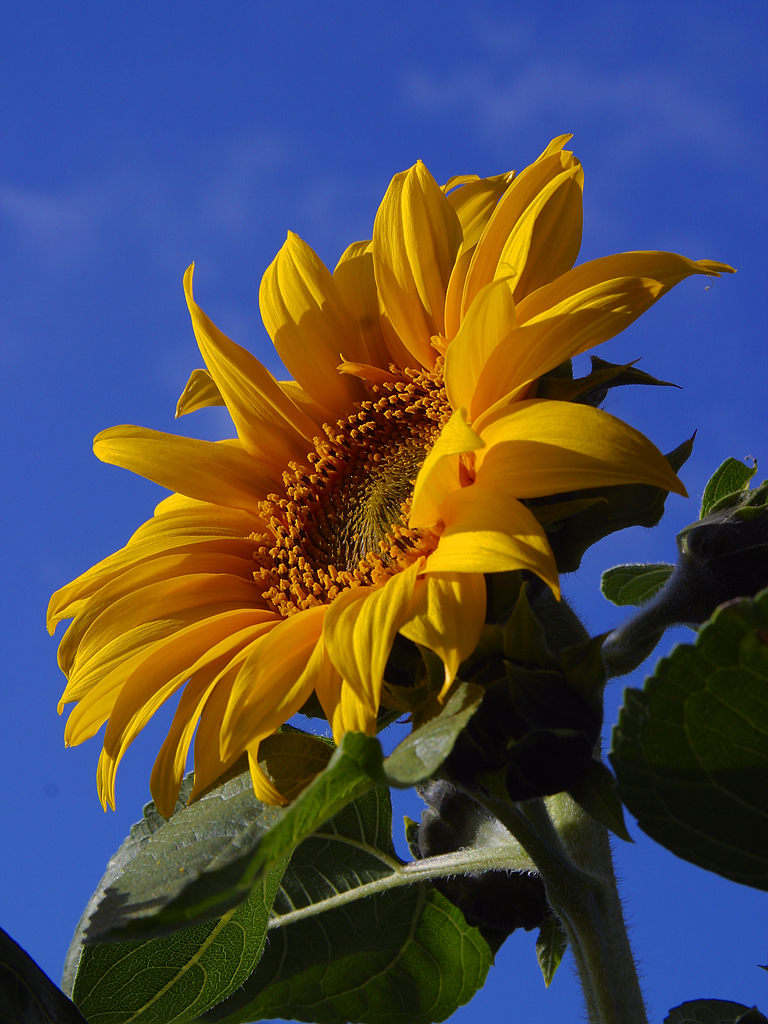 Common sunflowerA tall annual plant grown for its large yellow flower heads and edible seeds
 Clary sageA tall herb with aromatic leaves and pale lilac to white flower spikes
Also part of it, and being written: Lavandula, Lavandula angustifolia, Lavandula × intermedia.
Sources and further reading
Original text by the Phool desk, written with AI assistance. Customs vary from place to place. If we have something wrong, tell us.
Photo credits on this page
The small pictures above come from Wikimedia Commons under free licences. Some are cropped to fit.
- Clary sage: Nyttend, Public domain, source
- Common sunflower: Jon Sullivan, Public domain, source