
Caltha
Star-shaped yellow or white flowers of wet meadows and mountain streams
Caltha is a group of perennial plants in the buttercup family, found in moist places across temperate and cold regions of both hemispheres. Their star-like flowers, mainly yellow or white, grow in wetlands, alpine meadows, and along streams, and are known for their unique leaf shapes and lack of true petals.
- Caltha flowers have no true petals, only colored sepals
- Found in wetlands and alpine meadows of both hemispheres
- Caltha palustris is widely grown as a garden ornamental
- Plants contain toxic chemicals and are avoided by animals
What does Caltha look like?
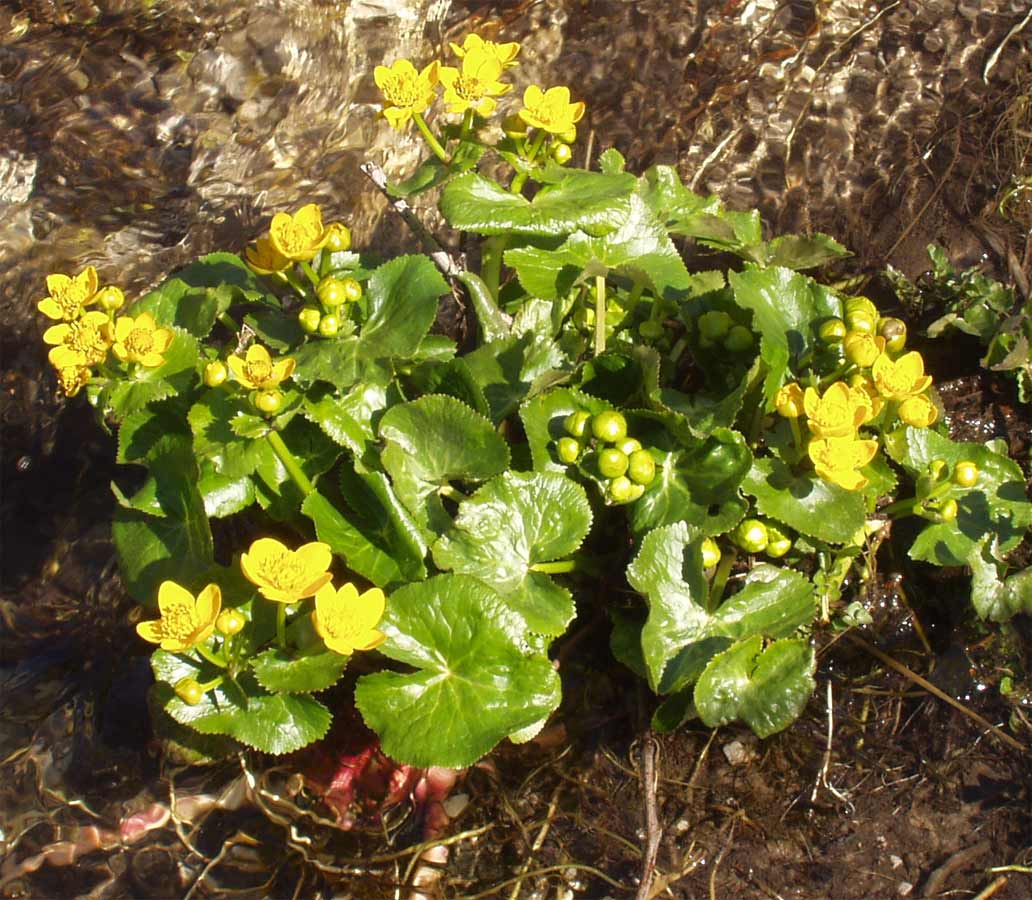
Caltha plants are hairless perennials, ranging from a few centimeters to 80 cm tall. Their leaves can be heart-shaped, kidney-shaped, arrowhead-like, or spade-shaped, often with unique lobes or appendages. The flowers are star-shaped, usually yellow but sometimes white, orange, red, pink, or magenta, with 4 to 13 colored sepals instead of petals. Flowers are single or in small clusters, and the plant produces small, light brown to black seeds.
Where does Caltha come from?
The genus Caltha likely began in the Northern Hemisphere and spread to South America, then to New Zealand and Australia. It grows wild in cold and temperate regions, especially in moist soils, wetlands, and alpine areas. The name 'Caltha' comes from the Greek word for 'goblet', referring to the flower's shape. Caltha palustris, the best-known species, has a wide range and is also grown in gardens.
When and how Caltha blooms
Caltha species flower in spring or early summer, depending on the region. Most grow in moist soils, wet meadows, or along streams, with one species (C. natans) floating on water. They grow from rhizomes and can be started from seed, which germinates better after a cold period. Some species are adapted to snow cover, opening flowers as soon as snow melts.


How Caltha is used
Caltha palustris is sometimes grown as an ornamental in temperate gardens, especially in wet spots. The plants are not widely used in decoration or ritual, and their toxicity means they are generally avoided by animals and not used in food or medicine. Their bright flowers are valued for naturalizing in wild gardens and wetland restoration.
Kinds of Caltha
There are about ten species of Caltha, including C. palustris (marsh marigold), C. leptosepala, C. sagittata, C. appendiculata, C. dionaeifolia, C. natans, C. scaposa, C. introloba, C. novae-zelandiae, and C. obtusa. Some species and varieties differ in flower color, leaf shape, and habitat, with certain forms adapted to alpine or aquatic environments.
What Caltha means
Caltha is not strongly tied to symbolism or ritual, but C. palustris is a familiar wildflower in many regions and sometimes used in gardens. The genus contains toxic chemicals, which protect it from grazing animals. Its star-shaped flowers and early blooming make it a sign of spring in wet meadows and mountain areas.
Questions people ask about Caltha
Where does Caltha come from?
Caltha species are native to cold and temperate regions around the world, including parts of North and South America, Europe, Asia, Australia, and New Zealand. They grow in moist soils, wetlands, and alpine meadows.
What does Caltha look like?
Caltha plants are low to medium-sized perennials with heart, kidney, or arrow-shaped leaves. Their star-shaped flowers are usually yellow or white, but can also be orange, red, pink, or magenta, and lack true petals.
Is Caltha poisonous?
Yes, Caltha species contain toxic chemicals such as anemonin, which makes them unpalatable to animals and unsuitable for food or medicinal use.
How is Caltha used by people?
Caltha palustris is sometimes grown in gardens for its bright flowers, especially in wet areas. The genus is not widely used for decoration, food, or medicine due to its toxicity.
What does Caltha symbolize?
Caltha is not strongly associated with symbolism or ritual, but its early spring flowers are a familiar sight in wet meadows and are sometimes seen as a sign of the season.
Good reading and sources
- Lady Bird Johnson Wildflower CenterLady Bird Johnson Wildflower Center, Article
- USDA Plants DatabaseUS Department of Agriculture, Article
- Plants of the World OnlineRoyal Botanic Gardens, Kew, Plant database
- Where it has been recordedGBIF, Plant database
- Sightings and photos by naturalistsiNaturalist, Plant database
The facts on this page come from the Wikipedia article "Caltha", written by its contributors and used under the CC BY-SA 4.0 licence, and from its Wikidata record (CC0). Phool rewrote the text in its own words, with AI assistance, and compares every page with the article to make sure no passage is copied. It may be reused under the same CC BY-SA 4.0 licence with a link back.
It may contain mistakes. It is not medical or foraging advice: many flowers are poisonous, and traditional uses are reported, not recommended. If something is wrong, tell us. Last refreshed 2026-10-03.
Others in the family Ranunculaceae
The whole family ButtercupRanunculus
A widespread group of bright, often shiny-petalled wild and garden flowers
Ranunculus · Wildflower
ButtercupRanunculus
A widespread group of bright, often shiny-petalled wild and garden flowers
Ranunculus · Wildflower
 Anemone
Perennial wildflowers with colorful, petal-like sepals known as windflowers
Anemone · Wildflower
Anemone
Perennial wildflowers with colorful, petal-like sepals known as windflowers
Anemone · Wildflower
 MonkshoodAconitum
Tall, hooded wildflowers of mountain meadows, known for beauty and deadly poison
Aconitum · Wildflower
MonkshoodAconitum
Tall, hooded wildflowers of mountain meadows, known for beauty and deadly poison
Aconitum · Wildflower
 Clematis
A climbing vine with showy flowers, prized in gardens worldwide
Clematis · Wildflower
Clematis
A climbing vine with showy flowers, prized in gardens worldwide
Clematis · Wildflower