
Indian shot
Canna indica, family Cannaceae
A tall tropical plant with red or yellow flowers and starchy rhizomes
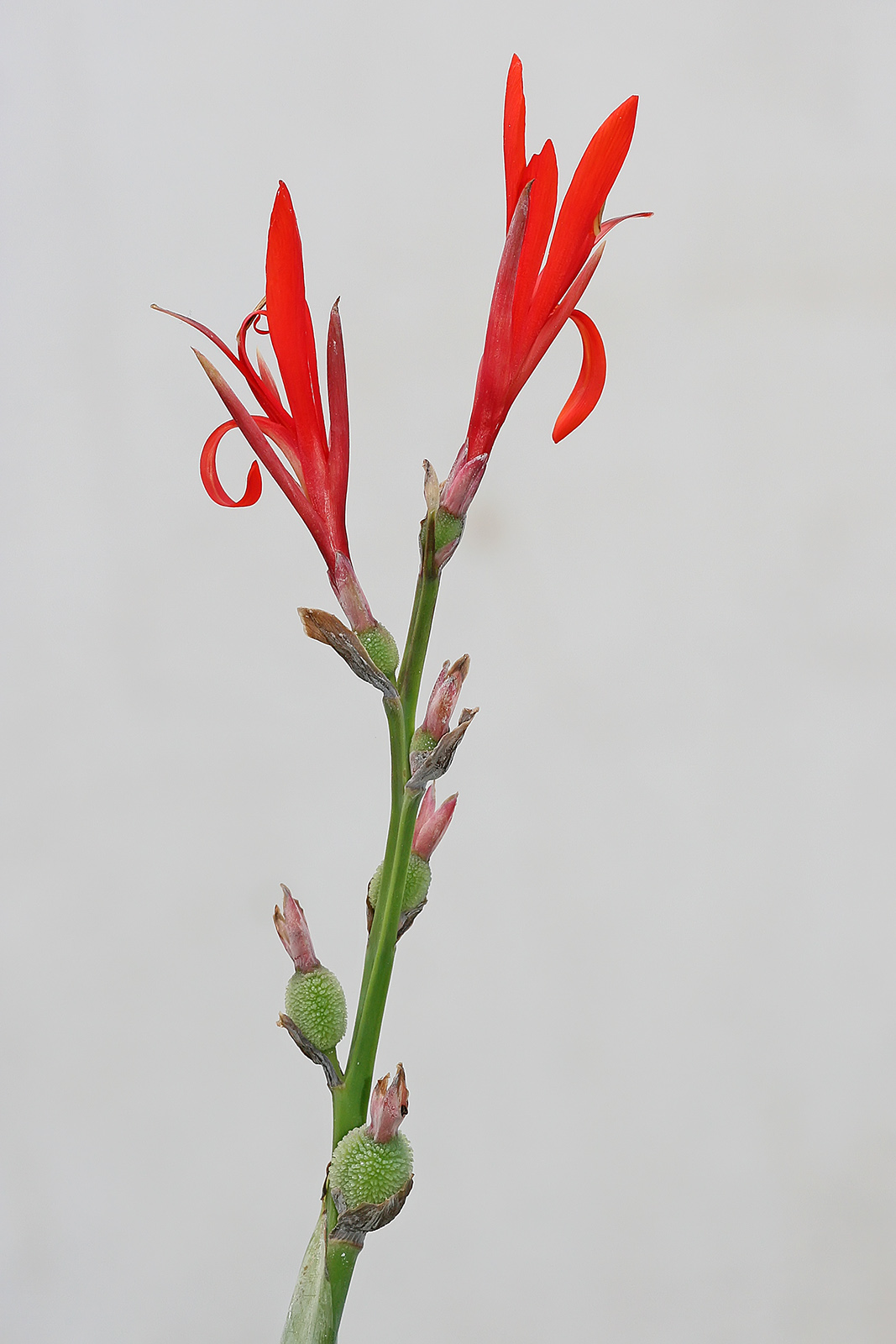
Indian shot is a perennial plant native to the Americas, growing up to 2.5 metres tall with large green or violet-green leaves. It bears red or yellow-orange zygomorphic flowers from August to October and produces hard black seeds that resemble shotgun pellets.
- Hard black seeds resemble shotgun pellets, giving the plant its common name
- Rhizomes contain visible starch grains and are a traditional food source
- Flowers bloom from August to October in its native range
- Naturalized on every inhabited continent outside its native Americas
- Listed as invasive in South Africa, Australia and Pacific Islands
What does Indian shot look like?
Indian shot grows upright on unbranched stems reaching 0.5 to 2.5 metres. Its leaves are very large, arranged alternately or in two rows, with blades 30–60 cm long and 10–25 cm wide. The flowers are hermaphrodite, zygomorphic, and appear in shades of red, yellow, or orange. They sit on short stalks and have fused petals and staminodes forming a column. The fruit is a warty, chestnut-coloured capsule containing hard, black, globular seeds.
Where does Indian shot come from?
Canna indica originates from tropical America, with archaeological evidence showing cultivation as early as 3000 BCE in coastal Ecuador and 2000 BCE in coastal Peru. Though not native to these arid zones, it was likely brought from more humid regions. The Cauca River valley in Colombia was an early centre of domestication. Over time, it spread widely and became naturalized across Asia, Africa, Europe, and Oceania.
When and how Indian shot blooms
This plant thrives between 1,000 and 2,000 metres elevation in temperate to subtropical mountain climates, though it tolerates sea level to 2,700 m. It prefers well-drained, light sandy-loamy soils and a mean temperature of 14–27°C. Rhizomes are planted 10 cm deep after the last frost. While it withstands dry spells, occasional watering improves yield. Seeds require soaking before germination.


How Indian shot is used
The rhizomes of Indian shot are valued as a source of edible starch. Traditionally, they have been used in food and possibly in folk medicine. The plant is also grown ornamentally in gardens for its bold foliage and colourful blooms. In some regions, it serves as a decorative element in home landscapes due to its striking appearance.
Kinds of Indian shot
Several botanical varieties are recognised. Canna indica var. flava has yellow flowers. Var. maculata shows yellow blooms with red spots and green petals. Var. sanctae rosea is smaller with pink flowers and white-margined leaves. Var. warszewiczii features purple-red leaf margins, purple fruits, and recurved staminodes, differing from typical forms in flower size and chromosome count.
What Indian shot means
Indian shot has been cultivated for millennia by Indigenous peoples of the Americas for its starchy rhizomes. Known as achira, it was grown in ancient cultures from Ecuador to Peru. Today, it is considered invasive in parts of Africa, Australia, and the Pacific due to its ability to displace native vegetation, especially in wetlands. Despite this, it remains a useful crop and ornamental plant.
Where Indian shot is used and seen

Questions people ask about Indian shot
Where does Indian shot come from originally?
It is native to much of South America, Central America, and the West Indies, with early cultivation in coastal Ecuador and Peru dating back to 3000 BCE.
What is Indian shot used for?
Its rhizomes are a source of edible starch, and it is grown ornamentally for its large leaves and red or yellow flowers in gardens and landscapes.
Why is it called Indian shot?
The small, dense, black seeds look like shotgun pellets and are hard enough to pierce wood, inspiring the common name.
Is Indian shot invasive?
Yes, it is listed as invasive in South Africa, parts of Australia, and several Pacific islands because it outcompetes native plants, especially in wet areas.
When does it flower?
In its natural habitat, Indian shot blooms from August to October, producing red, yellow, or orange zygomorphic flowers.
Good reading and sources
- BBC Two - How to Grow a Planet, The Power of Flowers, Seeds fired from a shotgunBBC, Article
- USDA Plants DatabaseUS Department of Agriculture, Article
- Plants of the World OnlineRoyal Botanic Gardens, Kew, Plant database
- Where it has been recordedGBIF, Plant database
- Sightings and photos by naturalistsiNaturalist, Plant database
The facts on this page come from the Wikipedia article "Canna indica", written by its contributors and used under the CC BY-SA 4.0 licence, and from its Wikidata record (CC0). Phool rewrote the text in its own words, with AI assistance, and compares every page with the article to make sure no passage is copied. It may be reused under the same CC BY-SA 4.0 licence with a link back.
It may contain mistakes. It is not medical or foraging advice: many flowers are poisonous, and traditional uses are reported, not recommended. If something is wrong, tell us. Last refreshed 2026-10-03.
More from Colombia
All the flowers of Colombia BromeliadsBromeliaceae
A family of tropical flowering plants from the Americas, including the pineapple
🇨🇱 Chile and 7 more · Wildflower
BromeliadsBromeliaceae
A family of tropical flowering plants from the Americas, including the pineapple
🇨🇱 Chile and 7 more · Wildflower
 Flamingo FlowerAnthurium andraeanum
A tropical plant with heart-shaped leaves and vivid red or pink spathes
🇨🇴 Colombia and 2 more · Garden flower
Flamingo FlowerAnthurium andraeanum
A tropical plant with heart-shaped leaves and vivid red or pink spathes
🇨🇴 Colombia and 2 more · Garden flower
 Black-eyed Susan vineThunbergia alata
A fast-growing climbing plant with bright flowers and a dark centre
🇨🇳 China and 7 more · Garden flower
Black-eyed Susan vineThunbergia alata
A fast-growing climbing plant with bright flowers and a dark centre
🇨🇳 China and 7 more · Garden flower
 Browallia
A small genus of blue and violet-flowered plants from the Americas
🇨🇴 Colombia and 3 more · Wildflower
Browallia
A small genus of blue and violet-flowered plants from the Americas
🇨🇴 Colombia and 3 more · Wildflower