
Bromeliads
Bromeliaceae, family Bromeliaceae
A family of tropical flowering plants from the Americas, including the pineapple
Bromeliads are a family of about 80 genera and 3,700 species of flowering plants, mostly native to the tropical and subtropical Americas. They range from tiny air plants to large tank-forming species, and include both epiphytes and terrestrial plants. People grow them for their striking forms, colourful bracts, and, in the case of pineapple, for food.
- Bromeliads include about 3,700 species in 80 genera
- Most are native to the tropical Americas, with one species in Africa
- The pineapple is the only bromeliad grown as a major food crop
- Some bromeliads form 'tanks' that hold water and support small animal communities
- Bromeliads can be epiphytes, terrestrials, or even air plants
What does Bromeliads look like?
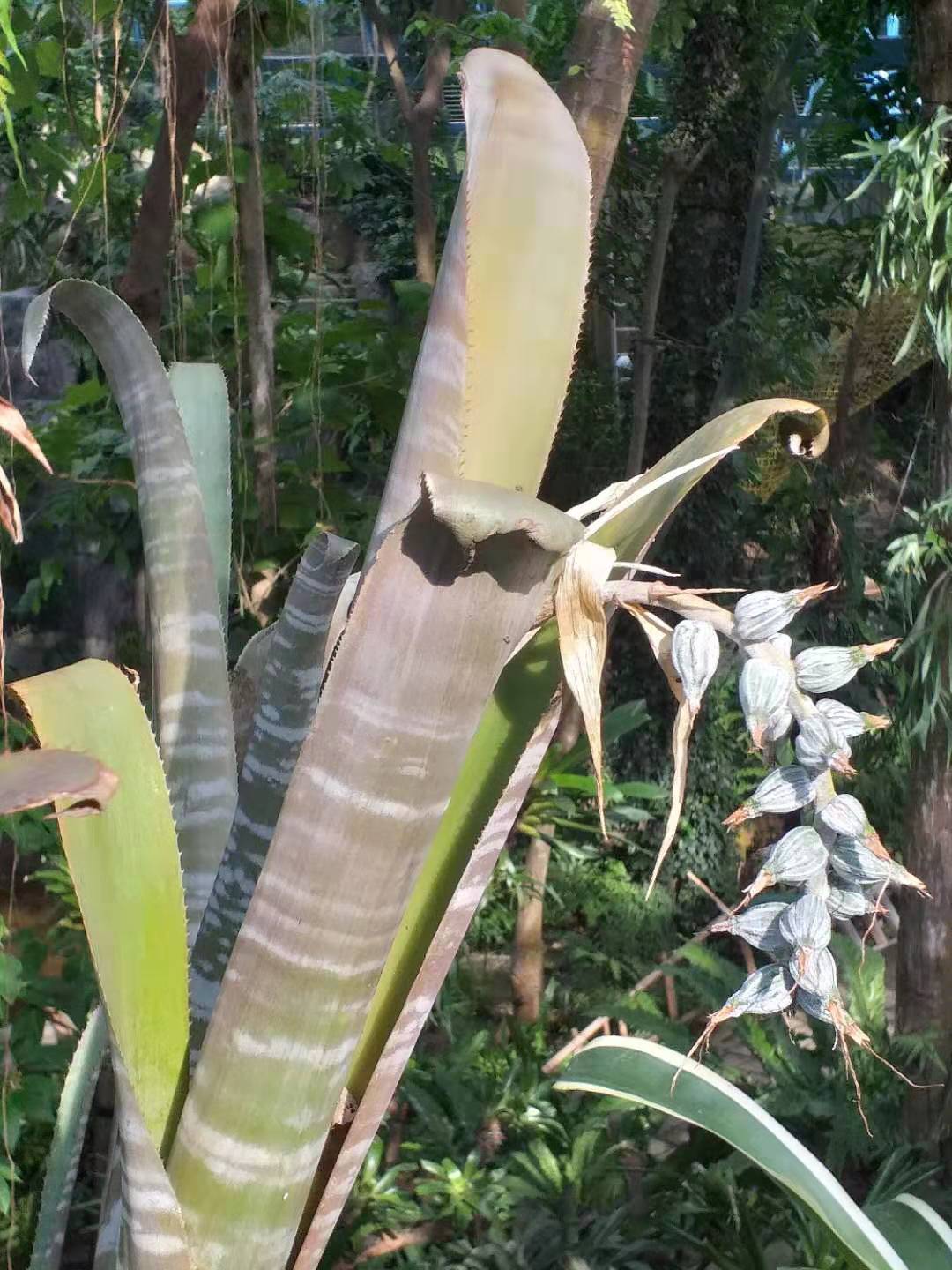
Bromeliads are mostly perennial herbs, though some have a tree-like shape. Many have thick, often spiny leaves arranged in a rosette, forming a central 'tank' that can hold water. Flowers are grouped in various types of inflorescences, with three sepals and three petals, often surrounded by colourful bracts. Some species are tiny air plants with greyish leaves, while others, like Puya raimondii, can grow several metres tall. Leaf colour and flower bracts can be vivid, ranging from red and pink to blue, yellow, or multi-coloured.
Where does Bromeliads come from?
Bromeliads originated in the tepuis, or table-top mountains, of the Guiana Shield in South America about 100 million years ago. Most species are native to the tropical and subtropical Americas, from the southern United States to Chile and Argentina, with one species (Pitcairnia feliciana) found in West Africa. The family diversified as the Andes and other mountain ranges formed, adapting to a wide range of habitats from rainforests to deserts. Today, they are found from sea level up to high mountains.
When and how Bromeliads blooms
Bromeliads grow in many environments: some are rooted in soil, others cling to trees or rocks, and a few hang in the air. Many form water-holding rosettes, while others absorb moisture through leaf scales called trichomes. They flower at different times depending on the species, producing inflorescences that may last for weeks or months. Most are grown from seed or by dividing offsets, and some, like pineapple, are cultivated as crops.


How Bromeliads is used
People have used bromeliads for thousands of years, especially in the Americas. The pineapple is the best-known edible bromeliad, valued worldwide. Other species are grown as ornamental plants for their unusual shapes and bright bracts, both indoors and outdoors. Some cultures have used bromeliads for fibre, food, and in ceremonies. In gardens and homes, they are popular for their ability to thrive in containers and as air plants.
Kinds of Bromeliads
The family includes about 80 genera, such as Tillandsia (air plants), Guzmania, Aechmea, Vriesea, and Puya. Some, like Spanish moss (Tillandsia usneoides), are well-known epiphytes, while others, like Puya raimondii, are giant terrestrial species. Pineapple (Ananas comosus) is the only bromeliad widely grown for food. Hybrid genera and many cultivated varieties exist, especially in horticulture.
What Bromeliads means
Bromeliads are important in the cultures of the Americas, used by the Incas, Aztecs, and Maya for food, fibre, and ritual. The pineapple became a symbol of hospitality in Europe after its introduction. Bromeliads are also valued for their ecological role, creating habitats for insects, frogs, and other animals in their water tanks. Some are national or regional emblems.
Where to see Bromeliads
 🇨🇷 Cartago · All yearOrchids at the Lankester Botanical GardenA university research garden near Cartago with one of the most important orchid collections in the American tropics.
 🇲🇶 Fort-de-France · All yearThe Balata garden above Fort-de-FranceA hillside tropical garden in Martinique, thick with anthuriums, heliconias and torch ginger, and busy with hummingbirds.
🇨🇴 Medellín · All yearThe Orquideorama at Medellín's botanical gardenA city garden with free entry, known for a tall honeycomb canopy of wood and steel that shelters its orchid displays.
🇪🇨 Quito · All yearOrchid houses of the Quito Botanical GardenA compact garden in La Carolina park that walks you through Ecuador's ecosystems and into two houses full of orchids.
🇧🇷 Rio de Janeiro · All yearThe Jardim Botânico of Rio de JaneiroA botanic garden founded in 1808 at the foot of Corcovado, with an avenue of royal palms, an orchid house and giant waterlilies.
🇲🇶 Fort-de-France · All yearThe Balata garden above Fort-de-FranceA hillside tropical garden in Martinique, thick with anthuriums, heliconias and torch ginger, and busy with hummingbirds.
🇨🇴 Medellín · All yearThe Orquideorama at Medellín's botanical gardenA city garden with free entry, known for a tall honeycomb canopy of wood and steel that shelters its orchid displays.
🇪🇨 Quito · All yearOrchid houses of the Quito Botanical GardenA compact garden in La Carolina park that walks you through Ecuador's ecosystems and into two houses full of orchids.
🇧🇷 Rio de Janeiro · All yearThe Jardim Botânico of Rio de JaneiroA botanic garden founded in 1808 at the foot of Corcovado, with an avenue of royal palms, an orchid house and giant waterlilies.Questions people ask about Bromeliads
Where do bromeliads come from?
Bromeliads are mainly native to the tropical and subtropical regions of the Americas, from the southern United States to Argentina and Chile. Only one species, Pitcairnia feliciana, is found outside the Americas, in West Africa.
What are bromeliads used for?
Bromeliads are grown for their ornamental value, with many species kept as houseplants or in gardens for their colourful bracts and unusual forms. The pineapple is grown as a food crop, and some species have been used for fibre, food, and ceremony by indigenous peoples.
How do bromeliads grow?
Bromeliads can grow on the ground, on trees (as epiphytes), or even in the air. Many form leaf rosettes that collect water, while others absorb moisture through special leaf scales. They flower at different times, depending on the species.
What do bromeliad flowers look like?
Bromeliad flowers are grouped in inflorescences, often with brightly coloured bracts. Each flower has three sepals and three petals. The colours and shapes vary widely among species, from subtle to very vivid.
What do bromeliads symbolise?
The pineapple, a bromeliad, became a symbol of hospitality in Europe. In the Americas, bromeliads have been used in ceremonies and as emblems, but specific symbolic meanings vary by culture and species.
Good reading and sources
- Encyclopaedia BritannicaArticle
- Pineapple DreamsThe New York Times, Article
- Plants of the World OnlineRoyal Botanic Gardens, Kew, Plant database
- Where it has been recordedGBIF, Plant database
- Sightings and photos by naturalistsiNaturalist, Plant database
The facts on this page come from the Wikipedia article "Bromeliaceae", written by its contributors and used under the CC BY-SA 4.0 licence, and from its Wikidata record (CC0). Phool rewrote the text in its own words, with AI assistance, and compares every page with the article to make sure no passage is copied. It may be reused under the same CC BY-SA 4.0 licence with a link back.
It may contain mistakes. It is not medical or foraging advice: many flowers are poisonous, and traditional uses are reported, not recommended. If something is wrong, tell us. Last refreshed 2026-10-03.
More from Chile
All the flowers of Chile CactusCactaceae
Succulent plants with spines, native to the Americas
🇲🇽 Mexico and 7 more · Wildflower
CactusCactaceae
Succulent plants with spines, native to the Americas
🇲🇽 Mexico and 7 more · Wildflower
 PoinsettiaEuphorbia pulcherrima
The red-bracted shrub of Christmas displays, native to Mexico and Central America
🇲🇽 Mexico and 8 more · Wildflower
PoinsettiaEuphorbia pulcherrima
The red-bracted shrub of Christmas displays, native to Mexico and Central America
🇲🇽 Mexico and 8 more · Wildflower
 MarigoldTagetes
A group of bright annual and perennial flowers known worldwide as marigolds
🇲🇽 Mexico and 7 more · Wildflower
MarigoldTagetes
A group of bright annual and perennial flowers known worldwide as marigolds
🇲🇽 Mexico and 7 more · Wildflower
 PassionflowerPassiflora
A vine with intricate flowers and edible fruits, grown worldwide
🇺🇸 United States and 7 more · Wildflower
PassionflowerPassiflora
A vine with intricate flowers and edible fruits, grown worldwide
🇺🇸 United States and 7 more · Wildflower