
Costus
Tropical plants with coiled stems and edible or medicinal flowers
Costus is a group of herbaceous perennials found across tropical Asia, Africa, and the Americas. Known for their spiraling stems, some species bear edible blooms, while others feature in traditional remedies or national symbols.
- Stems grow in a distinctive spiral pattern
- Flowers of some species are edible
- National floral emblem of Nigeria
- Used in folk remedies for animal snakebites
- Often confused with true ginger but not closely related
What does Costus look like?
Plants in the Costus genus grow as leafy perennials with upright, twisting stems that coil as they rise. Their flowers vary by species but can be yellow or multi-coloured. Some blooms are safe to eat, and the whole plant lacks the sharp spice of true ginger despite a distant relation.
Where does Costus come from?
First described by Linnaeus in 1753, Costus belongs to the Costaceae family and thrives across warm zones of Asia, Africa, and the Americas. Over time, many plants once grouped under Costus have been moved to other genera like Cheilocostus or Renealmia based on closer study.
When and how Costus blooms
These plants grow naturally in humid, tropical climates and can reproduce through natural hybridization. Gardeners also cultivate selected hybrids. They emerge from rhizomes and develop tall, spiral-shaped stems topped with showy flowers during their growing season.


How Costus is used
In Nigeria, Costus spectabilis appears as the national floral emblem, though its coat of arms shows it in red instead of its true yellow. In Trinidad and Tobago, juice from Costus scaber mixed with berries treats snakebites in dogs. Several species offer edible flowers.
Kinds of Costus
Over 100 species are currently accepted, including Costus spectabilis, Costus productus, and Costus guanaiensis. The name 'spiral gingers' sometimes refers to the whole genus or just to Costus barbatus. Many former members now belong to separate genera.
What Costus means
Costus spectabilis holds symbolic value as Nigeria’s national flower. Its depiction on the country’s coat of arms uses an incorrect red hue rather than the actual yellow. Traditional veterinary practices in the Caribbean also incorporate certain Costus species.
Questions people ask about Costus
Where does Costus come from?
It grows wild across tropical and subtropical parts of Asia, Africa, and the Americas.
Is Costus the same as ginger?
No. Though related, Costus is in the Costaceae family, not Zingiberaceae like true ginger, and lacks its strong spice.
What is Costus used for?
Some species have edible flowers; others are used in traditional medicine. Costus spectabilis is Nigeria’s national flower.
Why are Costus stems special?
They grow in a tight spiral, which helps distinguish them from similar-looking plants like ginger.
Are all Costus flowers yellow?
Not all, but Costus spectabilis, the Nigerian emblem, is yellow, though it is shown in red on the national coat of arms.
Good reading and sources
- NParksNational Parks Board, Singapore, Article
- USDA Plants DatabaseUS Department of Agriculture, Article
- Plants of the World OnlineRoyal Botanic Gardens, Kew, Plant database
- Where it has been recordedGBIF, Plant database
- Sightings and photos by naturalistsiNaturalist, Plant database
The facts on this page come from the Wikipedia article "Costus", written by its contributors and used under the CC BY-SA 4.0 licence, and from its Wikidata record (CC0). Phool rewrote the text in its own words, with AI assistance, and compares every page with the article to make sure no passage is copied. It may be reused under the same CC BY-SA 4.0 licence with a link back.
It may contain mistakes. It is not medical or foraging advice: many flowers are poisonous, and traditional uses are reported, not recommended. If something is wrong, tell us. Last refreshed 2026-10-03.
More from Nigeria
All the flowers of Nigeria WaterlilyNymphaea
Floating aquatic flowers found in ponds and lakes worldwide
🇪🇬 Egypt and 7 more · Water flower
WaterlilyNymphaea
Floating aquatic flowers found in ponds and lakes worldwide
🇪🇬 Egypt and 7 more · Water flower
 Bleeding glory-bowerClerodendrum thomsoniae
A climbing plant with white and red flowers grown for decoration
🇨🇲 Cameroon and 4 more · Garden flower
Bleeding glory-bowerClerodendrum thomsoniae
A climbing plant with white and red flowers grown for decoration
🇨🇲 Cameroon and 4 more · Garden flower
 Calla lilyZantedeschia
Showy funnel-shaped flowers from southern Africa, grown worldwide as ornamentals
🇿🇦 South Africa and 7 more · Garden flower
Calla lilyZantedeschia
Showy funnel-shaped flowers from southern Africa, grown worldwide as ornamentals
🇿🇦 South Africa and 7 more · Garden flower
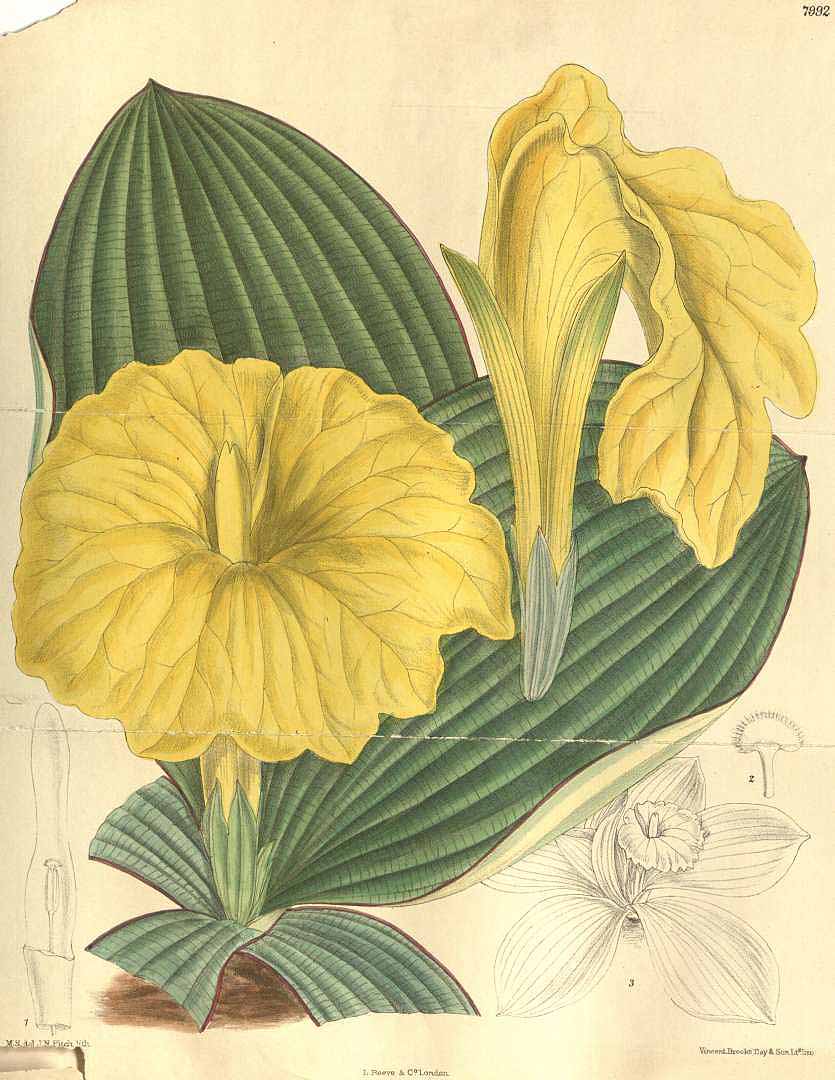 Costus spectabilis
A bright yellow ground-hugging flower from tropical Africa
🇳🇬 Nigeria and 7 more · Wildflower
Costus spectabilis
A bright yellow ground-hugging flower from tropical Africa
🇳🇬 Nigeria and 7 more · Wildflower