
Calla lily
Zantedeschia, family Araceae
Showy funnel-shaped flowers from southern Africa, grown worldwide as ornamentals
Zantedeschia, known as calla or arum lilies, is a group of perennial flowering plants native to southern and central Africa. They are valued for their large, funnel-shaped spathes in white, yellow, pink, and other colours, and are widely grown as garden and cut flowers around the world.
- Native to southern and central Africa, from South Africa to Malawi and Nigeria
- Flowers come in white, yellow, pink, orange, purple, and more
- All parts of the plant are toxic if eaten
- Widely grown as garden and cut flowers worldwide
- Symbolic as the 'Easter lily' in Ireland
What does Calla lily look like?
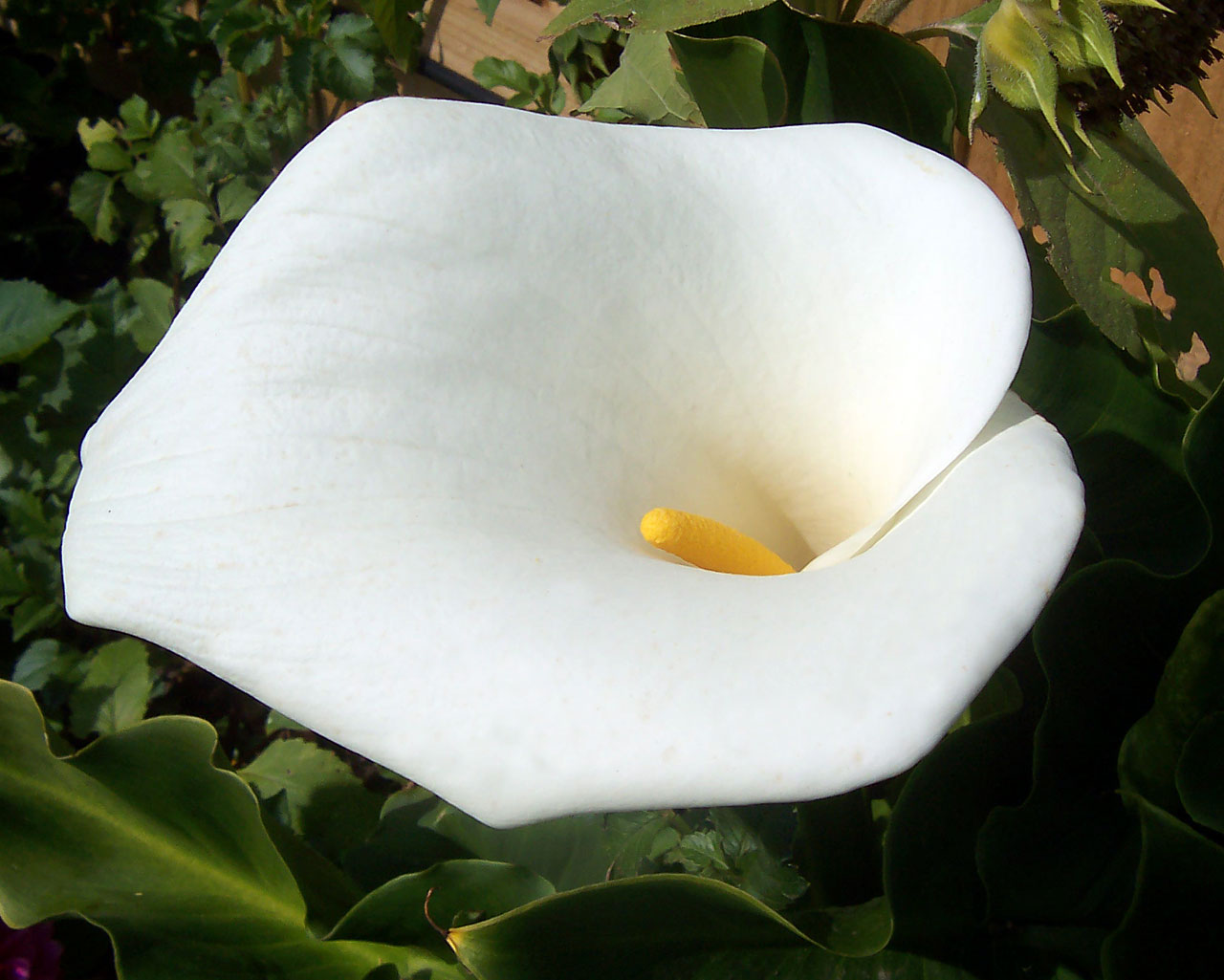
Calla lilies are perennial herbs with thick underground stems, either rhizomes or tubers. They grow in clumps, with some species reaching up to 1.2 meters tall. The leaves are dark green, often large and shaped like spears, hearts, or ovals, sometimes with white spots. Each plant produces a single showy spathe—a funnel-shaped bract—in white, yellow, pink, orange, or purple, surrounding a central yellow spadix. The real flowers are tiny and sit on the spadix. The plant forms orange or red berries after flowering.
Where does Calla lily come from?
Zantedeschia is native to southern and central Africa, from South Africa up to Malawi, Nigeria, and Tanzania. The genus was named by Kurt Sprengel in honour of Giovanni Zantedeschi. Zantedeschia aethiopica, the best-known species, was introduced to Europe in the 1600s and quickly spread as an ornamental. Today, calla lilies have been introduced to every continent except Antarctica and are naturalised or grown in gardens worldwide. In some areas, especially parts of Australia, they have become invasive and are considered pests.
When and how Calla lily blooms
Calla lilies grow from rhizomes or tubers, depending on the species. The hardy types, like Z. aethiopica, can survive mild frosts and flower from late winter to late spring, sometimes keeping their leaves year-round. The more tender, colourful types flower in summer and lose their leaves in winter. They thrive in moist, rich soils and are often grown for their cut flowers. Commercial production is strong in places like California, New Zealand, Kenya, and Colombia.



How Calla lily is used
Calla lilies are popular as ornamental plants in gardens and as cut flowers for bouquets and arrangements. Their striking appearance makes them a favourite for weddings and gifts. In Ireland, the calla lily is worn as the 'Easter lily' to commemorate Irish republicans. The plant is also a common subject in art, notably in works by Diego Rivera and Georgia O'Keeffe. All parts of the plant are toxic if eaten.
Kinds of Calla lily
There are eight recognised species, including Z. aethiopica (white arum lily), Z. elliottiana (yellow calla), Z. rehmannii (pink calla), and Z. albomaculata (spotted arum lily). Many garden varieties are hybrids, bred for a range of spathe colours from white to deep purple. Some cultivars are especially hardy, while others are grown mainly for their colourful flowers.
What Calla lily means
Calla lilies are symbols of purity and remembrance in many cultures. In Ireland, they are closely linked to the memory of republican dead and are worn at Easter. The flowers are widely used in art and have inspired painters such as Georgia O'Keeffe and Diego Rivera. Though beautiful, they are toxic and can cause irritation if touched or eaten.
Where Calla lily is used and seen


Days and festivals
Questions people ask about Calla lily
Where do calla lilies come from?
Calla lilies, or Zantedeschia, are native to southern and central Africa, including South Africa, Malawi, Nigeria, and Tanzania. They have been introduced and grown in gardens around the world.
What do calla lilies look like?
Calla lilies have large, dark green leaves and produce a single funnel-shaped spathe in colours like white, yellow, pink, orange, or purple, with a central yellow spadix. The leaves may be spotted or plain.
Are calla lilies poisonous?
Yes, all parts of the calla lily plant are poisonous due to calcium oxalate crystals. Eating them can cause irritation, burning in the mouth, and sometimes vomiting or diarrhea.
What are calla lilies used for?
Calla lilies are widely used as ornamental garden plants and as cut flowers in bouquets and arrangements. They are also popular in weddings and are worn as a symbol of remembrance in Ireland at Easter.
What do calla lilies symbolise?
In Ireland, the calla lily is a symbol of Irish republican remembrance, especially during Easter. In art and culture, it is often associated with purity and beauty.
Good reading and sources
- How to grow zantedeschia / RHS Growing GuideRoyal Horticultural Society, Article
- Plants of the World OnlineRoyal Botanic Gardens, Kew, Plant database
- Where it has been recordedGBIF, Plant database
- Sightings and photos by naturalistsiNaturalist, Plant database
The facts on this page come from the Wikipedia article "Zantedeschia", written by its contributors and used under the CC BY-SA 4.0 licence, and from its Wikidata record (CC0). Phool rewrote the text in its own words, with AI assistance, and compares every page with the article to make sure no passage is copied. It may be reused under the same CC BY-SA 4.0 licence with a link back.
It may contain mistakes. It is not medical or foraging advice: many flowers are poisonous, and traditional uses are reported, not recommended. If something is wrong, tell us. Last refreshed 2026-10-03.
Others in the family Araceae
The whole family Anthurium
A tropical plant with glossy leaves and a colorful, often heart-shaped spathe
Anthurium · Garden flower
Anthurium
A tropical plant with glossy leaves and a colorful, often heart-shaped spathe
Anthurium · Garden flower
 Amorphophallus
Tropical tuber plants with striking, sometimes giant, unusual flowers
Amorphophallus · Wildflower
Amorphophallus
Tropical tuber plants with striking, sometimes giant, unusual flowers
Amorphophallus · Wildflower
 Asian skunk cabbageLysichiton camtschatcensis
A white-flowered wetland plant from northern Japan and the Russian Far East
🇯🇵 Japan and 1 more · Wildflower
Asian skunk cabbageLysichiton camtschatcensis
A white-flowered wetland plant from northern Japan and the Russian Far East
🇯🇵 Japan and 1 more · Wildflower
 Titan arumAmorphophallus titanum
A giant rainforest flower with a strong scent of decay
🇮🇩 Indonesia · Wildflower
Titan arumAmorphophallus titanum
A giant rainforest flower with a strong scent of decay
🇮🇩 Indonesia · Wildflower
More from South Africa
All the flowers of South Africa AmaranthAmaranthus
A tall, colourful plant grown for its flowers, leaves and edible seeds
🇲🇽 Mexico and 7 more · Wildflower
AmaranthAmaranthus
A tall, colourful plant grown for its flowers, leaves and edible seeds
🇲🇽 Mexico and 7 more · Wildflower
 Acacia
Shrubs and trees with golden or cream puffball flowers, native mostly to Australia
🇦🇺 Australia and 6 more · Wildflower
Acacia
Shrubs and trees with golden or cream puffball flowers, native mostly to Australia
🇦🇺 Australia and 6 more · Wildflower
 Sensitive PlantMimosa pudica
A touch-sensitive plant whose leaves fold up when disturbed
🇧🇷 Brazil and 8 more · Wildflower
Sensitive PlantMimosa pudica
A touch-sensitive plant whose leaves fold up when disturbed
🇧🇷 Brazil and 8 more · Wildflower
 Prickly pearOpuntia
Cactus with flat pads and edible fruit, native to the Americas
🇲🇽 Mexico and 7 more · Wildflower
Prickly pearOpuntia
Cactus with flat pads and edible fruit, native to the Americas
🇲🇽 Mexico and 7 more · Wildflower