
Cyclamen rohlfsianum
A rare autumn-blooming cyclamen found only in Libya
Cyclamen rohlfsianum is a perennial flowering plant that grows wild in Libya, often in rocky limestone areas. Its pink flowers and broad, lobed leaves appear in autumn, and it is grown by collectors for its unusual form and seasonal blooms.
- Found only in Libya's limestone shrublands
- Blooms in autumn with pink, upswept flowers
- Tuber becomes irregular and multi-pointed with age
- Leaves are broad with pointed lobes and strong veins
What does Cyclamen rohlfsianum look like?
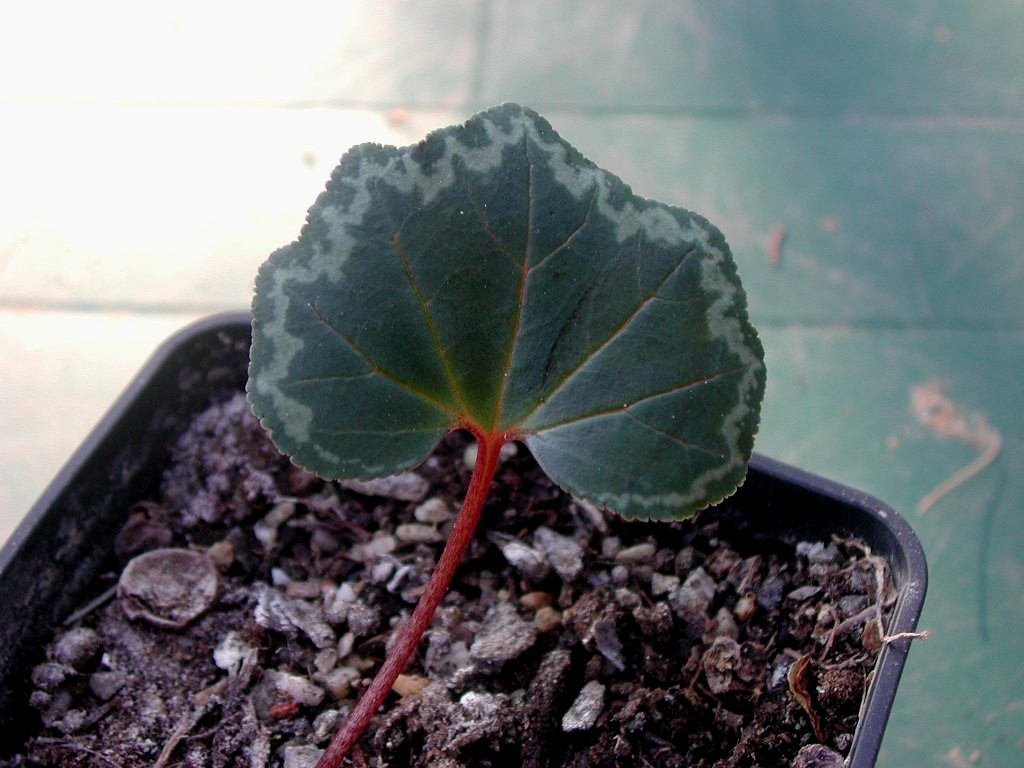
Cyclamen rohlfsianum is a perennial plant that grows from a tuber, which starts out round but becomes uneven and develops several growth points as it ages. Its leaves are large, broader than they are long, with pointed lobes and clear veins. In autumn, the plant produces flowers with five petals that curve upwards. The petals are pale pink with a darker center, and the flower parts extend below the petal base, giving them a look similar to shooting stars.
Where does Cyclamen rohlfsianum come from?
This species is native only to Libya, where it grows in the wild among shrubs and in cracks of limestone rocks, up to 450 meters above sea level. It was first collected in the late 19th century and named to honor Friedrich Gerhard Rohlfs, the explorer who found it. The formal naming was done by Paul Friedrich August Ascherson in 1897.
When and how Cyclamen rohlfsianum blooms
Cyclamen rohlfsianum grows from a tuber and is adapted to survive dry summers by remaining dormant. It thrives in rocky, sunny places and starts to grow and flower when autumn arrives. The plant is best suited to warm climates and is considered delicate compared to other cyclamen. Gardeners usually grow it from tubers and provide a dry summer rest to encourage flowering.

How Cyclamen rohlfsianum is used
This cyclamen is mainly grown by plant enthusiasts and collectors, especially those interested in rare or unusual species. It is valued for its distinctive leaves and autumn flowers but is not widely used in decoration or traditional practices. Its rarity and specific growing needs make it a specialty plant.
Kinds of Cyclamen rohlfsianum
There are no widely recognized varieties or cultivars of Cyclamen rohlfsianum. It is sometimes compared to other species like Cyclamen graecum and Cyclamen africanum, which share similar growth habits and seasonal cycles. Its tuber shape and leaf form set it apart from related species.
What Cyclamen rohlfsianum means
Cyclamen rohlfsianum does not have a known role in local customs, symbolism, or religious practice. Its main significance lies in its limited natural range and its appeal to collectors. The plant is notable for being found only in Libya, making it of interest for conservation and botanical study.
Questions people ask about Cyclamen rohlfsianum
Where does Cyclamen rohlfsianum come from?
Cyclamen rohlfsianum is native to Libya, where it grows in rocky shrubland, especially in limestone crevices up to 450 meters above sea level.
What does Cyclamen rohlfsianum look like?
It has large, broad leaves with pointed lobes and clear veins. Its autumn flowers have five upswept, pale pink petals with a darker center, and the flower parts extend below the petals.
How is Cyclamen rohlfsianum grown?
The plant grows from a tuber and prefers warm, sunny conditions with a dry summer rest. It blooms best after a hot summer and is usually grown by collectors in suitable climates.
Is Cyclamen rohlfsianum used in any traditions or ceremonies?
There are no known traditional or ceremonial uses for this species. It is mainly valued by plant collectors and enthusiasts.
Does Cyclamen rohlfsianum have any special meaning or symbolism?
No specific symbolism or cultural meaning is associated with this plant. Its main significance is its rarity and its status as a Libyan endemic species.
Good reading and sources
- Plants of the World OnlineRoyal Botanic Gardens, Kew, Plant database
- Where it has been recordedGBIF, Plant database
- Sightings and photos by naturalistsiNaturalist, Plant database
- Cyclamen rohlfsianum on WikipediaEncyclopedia
- More photos on Wikimedia CommonsPhotos
- Wikidata recordOpen data
The facts on this page come from the Wikipedia article "Cyclamen rohlfsianum", written by its contributors and used under the CC BY-SA 4.0 licence, and from its Wikidata record (CC0). Phool rewrote the text in its own words, with AI assistance, and compares every page with the article to make sure no passage is copied. It may be reused under the same CC BY-SA 4.0 licence with a link back.
It may contain mistakes. It is not medical or foraging advice: many flowers are poisonous, and traditional uses are reported, not recommended. If something is wrong, tell us. Last refreshed 2026-10-03.
Others in the family Primulaceae
The whole family Primula
A large genus of spring-blooming wild and garden flowers from cool and mountain regions
🇨🇳 China and 5 more · Wildflower
Primula
A large genus of spring-blooming wild and garden flowers from cool and mountain regions
🇨🇳 China and 5 more · Wildflower
 Cyclamen
Tubered Mediterranean flowers with upswept petals and patterned leaves
Cyclamen · Wildflower
Cyclamen
Tubered Mediterranean flowers with upswept petals and patterned leaves
Cyclamen · Wildflower
 Japanese primrosePrimula japonica
A spring-flowering primrose from damp places in Japan
🇯🇵 Japan · Wildflower
Japanese primrosePrimula japonica
A spring-flowering primrose from damp places in Japan
🇯🇵 Japan · Wildflower
 SowbreadCyclamen hederifolium
A hardy Mediterranean cyclamen with ivy-shaped, patterned leaves and autumn blooms
🇫🇷 France and 2 more · Wildflower
SowbreadCyclamen hederifolium
A hardy Mediterranean cyclamen with ivy-shaped, patterned leaves and autumn blooms
🇫🇷 France and 2 more · Wildflower
