
Wild tulip
Tulipa sylvestris, family Liliaceae
A wild yellow tulip with a light scent, found from Portugal to western China
The wild tulip is a bulb-forming perennial with yellow, lightly scented flowers, native to a wide area from Portugal and Morocco through the Mediterranean and Central Asia to western China. It grows in dry grasslands and woodlands, and is sometimes cultivated as a garden plant or found naturalized in parts of Europe and North America.
- Native from Portugal and Morocco to western China
- Yellow flowers with a light scent bloom in spring
- Grows in dry grasslands and woodland copses
- Rarely produces seed; spreads mainly by bulbs
- Naturalized in parts of Europe since the 17th century
What does Wild tulip look like?
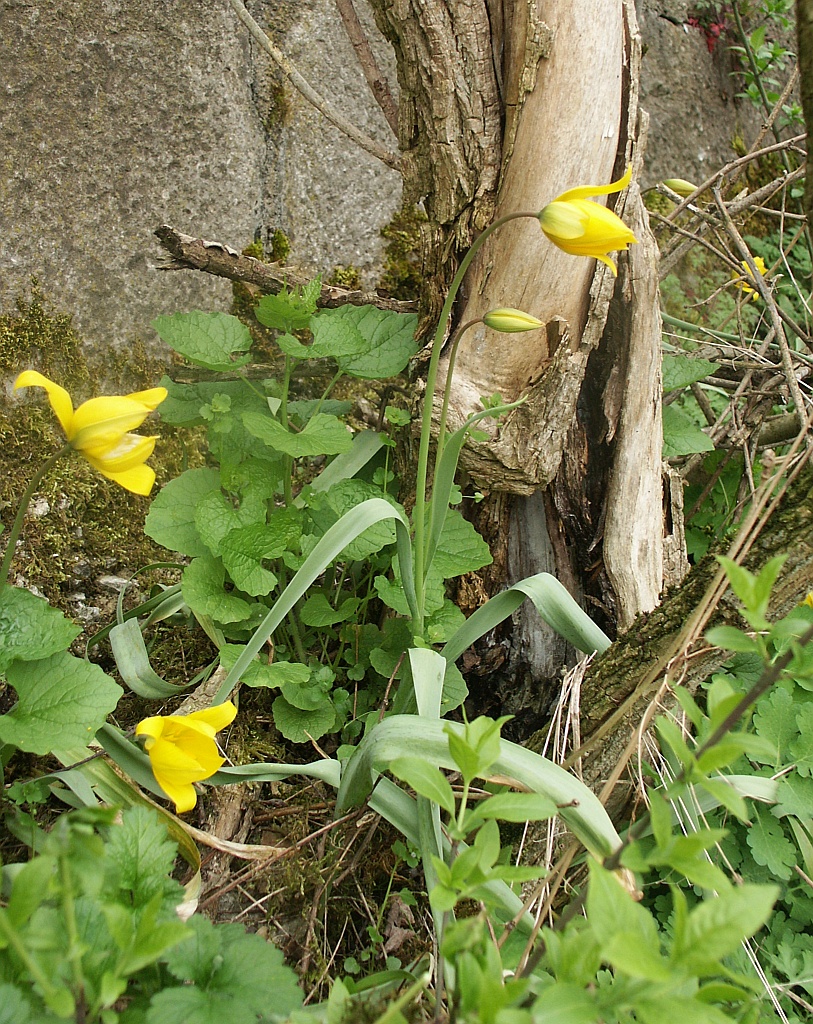
The wild tulip is a perennial plant that grows from a bulb. Its stems can reach up to 50 cm tall and carry one or two flowers each. The leaves are narrow and blue-grey. The flowers are yellow, sometimes with a red tinge on the outside, and have a light scent. Blooms appear in spring, usually from April to May.
Where does Wild tulip come from?
Tulipa sylvestris is native to a broad region stretching from Portugal and Morocco across the Mediterranean and Black Sea areas, through Central Asia to western China. It has also become naturalized in parts of central and northern Europe, and in a few places in North America. The plant was first recorded as naturalized in Britain in the late 1600s.
When and how Wild tulip blooms
This tulip grows from a bulb and prefers dry, grassy places and woodland copses. It blooms in spring, with flowers opening between April and May. The plant is pollinated by small insects and rarely produces seed, relying mostly on bulbs for spreading. It is sometimes grown as an ornamental in gardens.

How Wild tulip is used
People grow the wild tulip in gardens for its delicate yellow flowers and light scent. It is also found in the wild in its native range and in places where it has naturalized. The plant is not noted for use in ceremonies or as a symbol, but is valued for its appearance in gardens and natural settings.
Kinds of Wild tulip
There are three subspecies: Tulipa sylvestris subsp. australis, found from Portugal and Morocco to Xinjiang; subsp. primulina, in Algeria and Morocco; and subsp. sylvestris, in Italy and Libya. Tulipa australis is also present in a small area on Malta.
What Wild tulip means
The wild tulip does not have a strong cultural or symbolic role, but it is appreciated as a wildflower and garden plant. Its presence in naturalized areas of Europe dates back several centuries. The plant contains unique biochemicals called tuliposides.
Where Wild tulip is used and seen
 BouquetA creative arrangement of flowers, given or displayed for many occasions
 Indira Gandhi Memorial Tulip GardenAsia’s largest tulip garden on the slopes above Dal Lake in Srinagar
 KeukenhofA vast Dutch flower garden famous for its spring tulip displays
 FloristryThe craft and trade of arranging and selling flowers
 TulipiereA pottery vessel with spouts for growing tulip bulbs indoors
 Cut flowersFresh flowers and buds trimmed for decoration and display
 Flower gardenA garden space planted and arranged for flowering plants and seasonal blooms
 Bedding (horticulture)Seasonal displays of flowering plants in beds, borders, and containers
Questions people ask about Wild tulip
Where does the wild tulip come from?
The wild tulip is native to a broad area from Portugal and Morocco across the Mediterranean and Black Sea regions, through Central Asia to western China.
What does the wild tulip look like?
It has narrow blue-grey leaves and stems up to 50 cm tall, usually bearing one or two yellow flowers that may be tinged red on the outside and have a light scent.
When does the wild tulip flower?
The wild tulip blooms in spring, with flowers appearing between April and May.
How is the wild tulip used?
It is grown as an ornamental plant in gardens and is valued for its yellow, lightly scented flowers. It is also found naturalized in some regions.
Are there different types of wild tulip?
Yes, there are three subspecies found in different parts of its range, including areas in Portugal, Morocco, Algeria, Italy, Libya, and China.
Good reading and sources
- USDA Plants DatabaseUS Department of Agriculture, Article
- Plants of the World OnlineRoyal Botanic Gardens, Kew, Plant database
- Where it has been recordedGBIF, Plant database
- Sightings and photos by naturalistsiNaturalist, Plant database
- Tulipa sylvestris on WikipediaEncyclopedia
- More photos on Wikimedia CommonsPhotos
- Wikidata recordOpen data
The facts on this page come from the Wikipedia article "Tulipa sylvestris", written by its contributors and used under the CC BY-SA 4.0 licence, and from its Wikidata record (CC0). Phool rewrote the text in its own words, with AI assistance, and compares every page with the article to make sure no passage is copied. It may be reused under the same CC BY-SA 4.0 licence with a link back.
It may contain mistakes. It is not medical or foraging advice: many flowers are poisonous, and traditional uses are reported, not recommended. If something is wrong, tell us. Last refreshed 2026-10-03.
Others in the family Liliaceae
The whole family TulipTulipa
Spring-blooming bulbs with showy, cup-shaped flowers in many colours
🇳🇱 Netherlands and 7 more · Wildflower
TulipTulipa
Spring-blooming bulbs with showy, cup-shaped flowers in many colours
🇳🇱 Netherlands and 7 more · Wildflower
 LilyLilium
Tall bulb flowers with large, colourful blooms in many gardens and cultures
Lilium · Wildflower
LilyLilium
Tall bulb flowers with large, colourful blooms in many gardens and cultures
Lilium · Wildflower
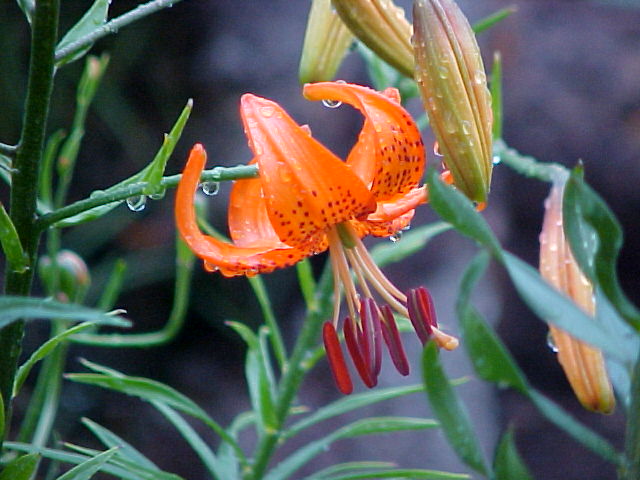 Lilium davidii
A tall Asian lily with edible bulbs and orange recurved flowers
🇨🇳 China and 1 more · Wildflower
Lilium davidii
A tall Asian lily with edible bulbs and orange recurved flowers
🇨🇳 China and 1 more · Wildflower
 Chinese LilyLilium brownii
A wild and cultivated lily from China with edible bulbs
🇨🇳 China and 3 more · Wildflower
Chinese LilyLilium brownii
A wild and cultivated lily from China with edible bulbs
🇨🇳 China and 3 more · Wildflower
More from Portugal
All the flowers of Portugal RosemarySalvia rosmarinus
A fragrant evergreen shrub with needle-like leaves and purple, blue, or white flowers
🇪🇸 Spain and 5 more · Flowering shrub
RosemarySalvia rosmarinus
A fragrant evergreen shrub with needle-like leaves and purple, blue, or white flowers
🇪🇸 Spain and 5 more · Flowering shrub
 Eucalyptus
The tall, aromatic trees and shrubs known as gum trees or eucalypts
🇦🇺 Australia and 7 more · Flowering tree
Eucalyptus
The tall, aromatic trees and shrubs known as gum trees or eucalypts
🇦🇺 Australia and 7 more · Flowering tree
 Narcissus
Spring-flowering bulbs with trumpet-shaped blooms in white, yellow, and orange
🇬🇧 United Kingdom and 7 more · Wildflower
Narcissus
Spring-flowering bulbs with trumpet-shaped blooms in white, yellow, and orange
🇬🇧 United Kingdom and 7 more · Wildflower
 OleanderNerium oleander
A showy, evergreen shrub with clusters of pink, white or red flowers
🇲🇦 Morocco and 8 more · Flowering shrub
OleanderNerium oleander
A showy, evergreen shrub with clusters of pink, white or red flowers
🇲🇦 Morocco and 8 more · Flowering shrub