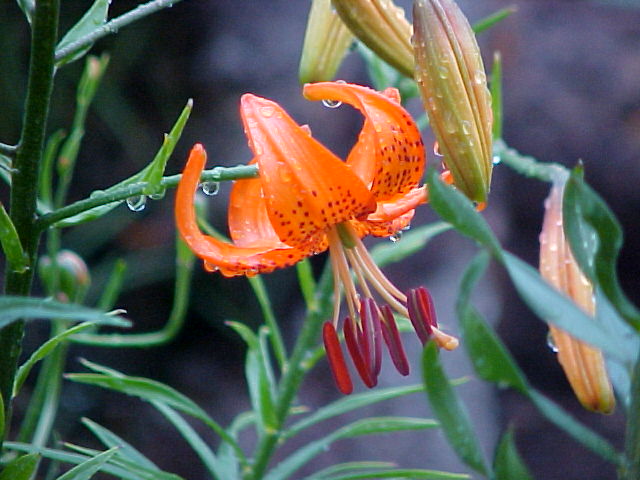
Lilium davidii
A tall Asian lily with edible bulbs and orange recurved flowers
Lilium davidii is a lily from the mountains of China, Tibet, Bhutan, and northeast India. It grows up to 1.5 meters tall and produces up to 20 orange or reddish-orange flowers with petals that curve back. The plant is also grown for its edible bulb.
- Native to mountain regions of China, Tibet, Bhutan, and northeast India
- Grows up to 1.5 meters tall with up to 20 orange or reddish-orange flowers
- Flowers have recurved tepals and no scent
- Cultivated for its edible bulb
What does Lilium davidii look like?
Lilium davidii is a tall lily that can reach up to 1.5 meters in height. Its stem is upright and bears many narrow leaves. Each plant can produce up to about 20 flowers, which are orange or reddish-orange. The flowers have tepals (petal-like parts) that bend sharply backwards, giving them a recurved look. The flowers do not have a scent. The plant also forms bulbils, which are small bulbs along the stem.
Where does Lilium davidii come from?
This lily is native to mountainous regions of China, Tibet, Bhutan, and the northeastern states of India such as Assam, Manipur, and Arunachal Pradesh. It was named after Armand David, a French missionary and naturalist who worked in China during the 19th century. The plant has long been found in the wild in these regions and is also cultivated for its edible bulb.
When and how Lilium davidii blooms
Lilium davidii blooms in summer, mainly from July to August. It grows from a bulb and sends up a tall stem each year. The plant prefers mountain climates and is adapted to grow in well-drained soils. It produces adventitious roots above the bulb, which help anchor the plant and take up nutrients. Bulbils may form along the stem, allowing the plant to spread.

How Lilium davidii is used
The main use of Lilium davidii is for its edible bulb, which is cultivated and eaten in some regions. The flowers are not known for scent or ornamental use in the sources, but the plant is valued for its food use. It is not tied to any particular festival or religious practice in the sources.
Kinds of Lilium davidii
No named varieties or cultivars are mentioned in the sources. The species may show some natural variation in flower color, ranging from orange to reddish-orange, and in the number of flowers per stem.
What Lilium davidii means
Lilium davidii is named after Armand David, who contributed to the study of Chinese plants. The plant is grown for its edible bulb, but the sources do not mention any symbolic meaning, festival, or emblem status. It is part of the local food tradition in some areas.
Questions people ask about Lilium davidii
Where does Lilium davidii come from?
Lilium davidii is native to mountainous areas in China, Tibet, Bhutan, and the northeastern parts of India, including Assam, Manipur, and Arunachal Pradesh.
What does the flower of Lilium davidii look like?
The plant produces up to about 20 orange or reddish-orange flowers per stem. The flowers have petals that curve sharply backward and do not have a scent.
Is Lilium davidii used for anything?
Yes, it is cultivated for its edible bulb, which is eaten in some regions. The sources do not mention other uses.
When does Lilium davidii flower?
It blooms in summer, mainly from July to August in its native range.
Does Lilium davidii have any special meaning or symbolism?
The sources do not mention any symbolic meaning or cultural significance for Lilium davidii.
Good reading and sources
- Plants of the World OnlineRoyal Botanic Gardens, Kew, Plant database
- Where it has been recordedGBIF, Plant database
- Sightings and photos by naturalistsiNaturalist, Plant database
- Lilium davidii on WikipediaEncyclopedia
- More photos on Wikimedia CommonsPhotos
- Wikidata recordOpen data
The facts on this page come from the Wikipedia article "Lilium davidii", written by its contributors and used under the CC BY-SA 4.0 licence, and from its Wikidata record (CC0). Phool rewrote the text in its own words, with AI assistance, and compares every page with the article to make sure no passage is copied. It may be reused under the same CC BY-SA 4.0 licence with a link back.
It may contain mistakes. It is not medical or foraging advice: many flowers are poisonous, and traditional uses are reported, not recommended. If something is wrong, tell us. Last refreshed 2026-10-03.
Others in the family Liliaceae
The whole family TulipTulipa
Spring-blooming bulbs with showy, cup-shaped flowers in many colours
🇳🇱 Netherlands and 7 more · Wildflower
TulipTulipa
Spring-blooming bulbs with showy, cup-shaped flowers in many colours
🇳🇱 Netherlands and 7 more · Wildflower
 LilyLilium
Tall bulb flowers with large, colourful blooms in many gardens and cultures
Lilium · Wildflower
LilyLilium
Tall bulb flowers with large, colourful blooms in many gardens and cultures
Lilium · Wildflower
 Chinese LilyLilium brownii
A wild and cultivated lily from China with edible bulbs
🇨🇳 China and 3 more · Wildflower
Chinese LilyLilium brownii
A wild and cultivated lily from China with edible bulbs
🇨🇳 China and 3 more · Wildflower
 Tulipa linifolia
A small red tulip with flax-like leaves from Central Asia
🇹🇯 Tajikistan and 3 more · Wildflower
Tulipa linifolia
A small red tulip with flax-like leaves from Central Asia
🇹🇯 Tajikistan and 3 more · Wildflower
More from China
All the flowers of China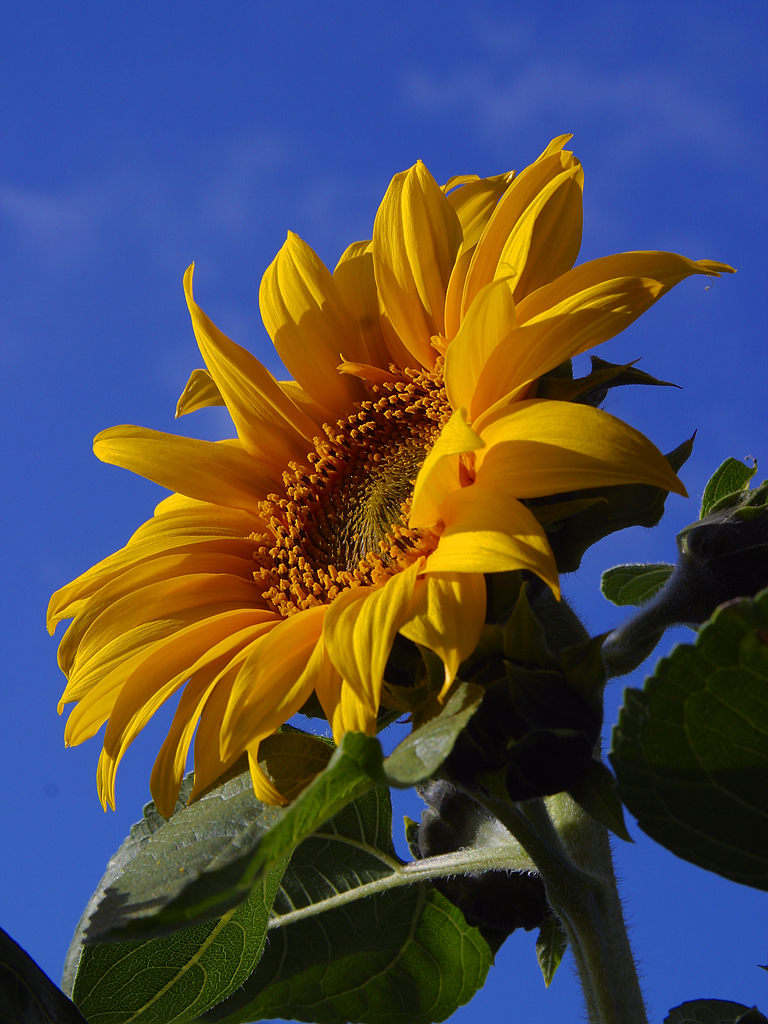 Common sunflowerHelianthus annuus
A tall annual plant grown for its large yellow flower heads and edible seeds
🇨🇦 Canada and 4 more · Wildflower
Common sunflowerHelianthus annuus
A tall annual plant grown for its large yellow flower heads and edible seeds
🇨🇦 Canada and 4 more · Wildflower
 BirchBetula
Slender trees with papery bark found across the northern world
🇨🇳 China and 7 more · Wildflower
BirchBetula
Slender trees with papery bark found across the northern world
🇨🇳 China and 7 more · Wildflower
 FennelFoeniculum vulgare
A tall, aromatic herb with feathery leaves and yellow umbels, used for food and spice
🇨🇳 China and 7 more · Herb or useful flower
FennelFoeniculum vulgare
A tall, aromatic herb with feathery leaves and yellow umbels, used for food and spice
🇨🇳 China and 7 more · Herb or useful flower
 Common flaxLinum usitatissimum
The slender blue-flowered plant grown for linen and linseed
🇨🇳 China and 7 more · Wildflower
Common flaxLinum usitatissimum
The slender blue-flowered plant grown for linen and linseed
🇨🇳 China and 7 more · Wildflower