
Tulipa linifolia
A small red tulip with flax-like leaves from Central Asia
Tulipa linifolia is a short tulip species from Tajikistan, Uzbekistan, northern Iran, and Afghanistan. It has red, bowl-shaped flowers with dark bases and narrow, wavy-edged leaves, and is grown in gardens for its early spring bloom.
- Native to Tajikistan, Uzbekistan, northern Iran, and Afghanistan
- Grows up to 20 cm tall with sword-shaped, wavy leaves
- Red bowl-shaped flowers with dark bases bloom in early spring
- Cultivated varieties come in red, yellow, apricot, and salmon
- Known as the flax-leaved or Bokhara tulip
What does Tulipa linifolia look like?
Tulipa linifolia is a small tulip, reaching about 20 centimeters tall. Its leaves are narrow and shaped like swords, with wavy edges and red margins. The flowers are cup-shaped and usually bright red, each petal showing a dark mark near the base. Some cultivated forms come in yellow, apricot, or salmon shades. The plant grows from a bulb and blooms early to mid-spring.
Where does Tulipa linifolia come from?
This tulip species comes from Central Asia, specifically Tajikistan, Uzbekistan, northern Iran, and Afghanistan. The name linifolia refers to its flax-like leaves. There has been some confusion in its classification, with horticulturists sometimes grouping it with Tulipa batalinii or calling it the Batalinii Group. It has been introduced to gardens outside its native area for ornamental use.
When and how Tulipa linifolia blooms
Tulipa linifolia grows from bulbs planted in well-drained soil. It thrives in climates with cold winters and blooms in early to mid-spring. Gardeners often choose cultivars for their range of flower colors. The plant is usually grown in borders, rock gardens, or containers, and needs a sunny spot to flower well.


How Tulipa linifolia is used
People grow Tulipa linifolia mainly for its decorative value in gardens. Its bright flowers add color to spring displays. Several cultivated varieties are popular among gardeners for their unique shades and early flowering. It is not mentioned as being used in ceremonies, food, or medicine.
Kinds of Tulipa linifolia
There are several named varieties and groups within Tulipa linifolia, such as the Batalinii Group. Cultivars include 'Bronze Charm', 'Bright Gem', 'Red Gem', 'Salmon Gem', 'Apricot Jewel', 'Yellow Jewel', and 'Red Hunter', offering a palette from red to yellow and apricot.
What Tulipa linifolia means
Tulipa linifolia is valued by gardeners for its early spring flowers and compact size. It is not linked in the sources to any particular symbolism, national emblem, or religious use. Its cultivars are recognized for their garden performance and are often featured in horticultural collections.
Questions people ask about Tulipa linifolia
Where does Tulipa linifolia come from?
Tulipa linifolia is native to Central Asia, specifically Tajikistan, Uzbekistan, northern Iran, and Afghanistan.
What does the flax-leaved tulip look like?
It is a small tulip with narrow, wavy-edged leaves and bowl-shaped red flowers. The petals have dark markings at the base, and some varieties show yellow, apricot, or salmon colors.
How is Tulipa linifolia used?
This tulip is mainly grown in gardens for its colorful spring flowers. It is not reported as being used in food, medicine, or ceremonies.
Are there different forms of Tulipa linifolia?
Yes, there are several cultivated varieties, including groups like 'Batalinii' and named selections such as 'Bright Gem' and 'Red Hunter', which offer a range of flower colors.
Does Tulipa linifolia have any special meaning or symbolism?
The sources do not mention any particular symbolism or cultural meaning for this species.
Good reading and sources
- Tulipa linifolia (Batalinii Group) 'Bright Gem' (15)Royal Horticultural Society, Article
- USDA Plants DatabaseUS Department of Agriculture, Article
- Plants of the World OnlineRoyal Botanic Gardens, Kew, Plant database
- Where it has been recordedGBIF, Plant database
- Sightings and photos by naturalistsiNaturalist, Plant database
- Tulipa linifolia on WikipediaEncyclopedia
- More photos on Wikimedia CommonsPhotos
- Wikidata recordOpen data
The facts on this page come from the Wikipedia article "Tulipa linifolia", written by its contributors and used under the CC BY-SA 4.0 licence, and from its Wikidata record (CC0). Phool rewrote the text in its own words, with AI assistance, and compares every page with the article to make sure no passage is copied. It may be reused under the same CC BY-SA 4.0 licence with a link back.
It may contain mistakes. It is not medical or foraging advice: many flowers are poisonous, and traditional uses are reported, not recommended. If something is wrong, tell us. Last refreshed 2026-10-03.
Others in the family Liliaceae
The whole family TulipTulipa
Spring-blooming bulbs with showy, cup-shaped flowers in many colours
🇳🇱 Netherlands and 7 more · Wildflower
TulipTulipa
Spring-blooming bulbs with showy, cup-shaped flowers in many colours
🇳🇱 Netherlands and 7 more · Wildflower
 LilyLilium
Tall bulb flowers with large, colourful blooms in many gardens and cultures
Lilium · Wildflower
LilyLilium
Tall bulb flowers with large, colourful blooms in many gardens and cultures
Lilium · Wildflower
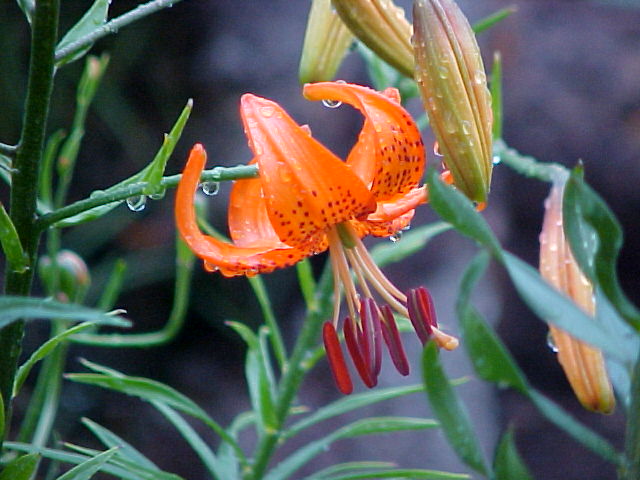 Lilium davidii
A tall Asian lily with edible bulbs and orange recurved flowers
🇨🇳 China and 1 more · Wildflower
Lilium davidii
A tall Asian lily with edible bulbs and orange recurved flowers
🇨🇳 China and 1 more · Wildflower
 Chinese LilyLilium brownii
A wild and cultivated lily from China with edible bulbs
🇨🇳 China and 3 more · Wildflower
Chinese LilyLilium brownii
A wild and cultivated lily from China with edible bulbs
🇨🇳 China and 3 more · Wildflower
More from Tajikistan
All the flowers of Tajikistan Eremurus
Tall spiked flowers from Central Asia, known as foxtail lilies or desert candles
🇹🇯 Tajikistan and 7 more · Wildflower
Eremurus
Tall spiked flowers from Central Asia, known as foxtail lilies or desert candles
🇹🇯 Tajikistan and 7 more · Wildflower
 Crocus alatavicus
A white-flowered crocus from the mountains of Central Asia and Xinjiang
🇰🇿 Kazakhstan and 3 more · Wildflower
Crocus alatavicus
A white-flowered crocus from the mountains of Central Asia and Xinjiang
🇰🇿 Kazakhstan and 3 more · Wildflower
 Tulipa fosteriana
A wild tulip from Central Asia with large red spring flowers
🇦🇫 Afghanistan and 3 more · Wildflower
Tulipa fosteriana
A wild tulip from Central Asia with large red spring flowers
🇦🇫 Afghanistan and 3 more · Wildflower
 Allium giganteum
A tall Asian onion grown for its large purple globe-shaped blooms
🇦🇫 Afghanistan and 4 more · Garden flower
Allium giganteum
A tall Asian onion grown for its large purple globe-shaped blooms
🇦🇫 Afghanistan and 4 more · Garden flower