
Tulipa fosteriana
A wild tulip from Central Asia with large red spring flowers
Tulipa fosteriana is a tulip species native to the Pamir Mountains and surrounding areas in Afghanistan, Tajikistan, Kyrgyzstan, and Uzbekistan. It grows on rocky slopes, reaching up to 55 cm tall, and is valued in gardens for its bold red blooms in early to mid-spring. Many garden tulip varieties have been bred from this species.
- Native to the Pamir Mountains in Central Asia
- Blooms in early to mid-spring with large red flowers
- Grows on rocky hillsides at high elevations
- Parent to many popular garden tulip varieties
What does Tulipa fosteriana look like?
Tulipa fosteriana is a perennial bulbous plant that stands between 40 and 55 cm tall. It has a sturdy stem and three to five broad, blue-green leaves. The flowers are large, usually bright red, and may show black markings inside. They open wide or form a cup shape. The inner parts include dark violet anthers that are noticeably longer than the stamens.
Where does Tulipa fosteriana come from?
This tulip species grows naturally in the Pamir Mountains and nearby areas of Afghanistan, Tajikistan, Kyrgyzstan, and Uzbekistan. It thrives on rocky hillsides and stony slopes at elevations around 1,500 meters. First described in 1906 by botanist Walter Irving, the species name honors Michael Foster, a British iris expert. DNA studies have grouped it with other closely related tulips in the same subgenus.
When and how Tulipa fosteriana blooms
Tulipa fosteriana blooms in early to mid-spring, typically from March to April, and sometimes into May in cooler climates. It prefers sunny spots and can adapt to a range of garden soils. The plant can be grown from bulbs or seeds and is hardy in temperate zones. It is often used in mixed borders or bedding displays and can naturalize, returning each year.


How Tulipa fosteriana is used
Gardeners value Tulipa fosteriana for its striking red flowers and its ability to return for several seasons. It has been used in breeding to create many popular garden tulip varieties. Some cultivars are grown for their unique flower colors or leaf patterns. In the wild, it is part of the natural landscape of Central Asia's mountains.
Kinds of Tulipa fosteriana
Several cultivars have been developed from Tulipa fosteriana. 'Juan' is known for its red-orange flowers with yellow centers and patterned leaves. 'Zombie' features large blooms and blue-green leaves. 'Red Emperor' is another well-known variety. These cultivars can differ in height and leaf markings, but all share the species' large, bowl-shaped flowers.
What Tulipa fosteriana means
Tulipa fosteriana is important in horticulture as a parent of many modern garden tulips. Its wild populations are part of Central Asia's mountain flora. The species is recognized for its resilience and for contributing to the diversity of tulip forms seen in gardens today. Its name commemorates a figure in British botany.
Questions people ask about Tulipa fosteriana
Where does Tulipa fosteriana come from?
It is native to the Pamir Mountains and nearby regions in Afghanistan, Tajikistan, Kyrgyzstan, and Uzbekistan, where it grows on rocky slopes.
What does Tulipa fosteriana look like?
This tulip grows up to 55 cm tall, with broad blue-green leaves and large red flowers that open wide or form a cup. The inside of the flower often has dark markings.
When does Tulipa fosteriana bloom?
It flowers in early to mid-spring, usually from March to April, and in May in cooler places like St. Petersburg.
How is Tulipa fosteriana used?
It is grown in gardens for its showy spring flowers and has been used to breed many modern tulip varieties. It can also naturalize and return each year.
Are there different varieties of Tulipa fosteriana?
Yes, cultivars like 'Juan', 'Zombie', and 'Red Emperor' have been bred for their unique flower colors and leaf patterns, all sharing the species' large blooms.
Good reading and sources
- Tulipa 'Juan' (13)Royal Horticultural Society, Article
- IUCN Red List of Threatened SpeciesIUCN Red List, Article
- Plants of the World OnlineRoyal Botanic Gardens, Kew, Plant database
- Where it has been recordedGBIF, Plant database
- Sightings and photos by naturalistsiNaturalist, Plant database
- Tulipa fosteriana on WikipediaEncyclopedia
- More photos on Wikimedia CommonsPhotos
- Wikidata recordOpen data
The facts on this page come from the Wikipedia article "Tulipa fosteriana", written by its contributors and used under the CC BY-SA 4.0 licence, and from its Wikidata record (CC0). Phool rewrote the text in its own words, with AI assistance, and compares every page with the article to make sure no passage is copied. It may be reused under the same CC BY-SA 4.0 licence with a link back.
It may contain mistakes. It is not medical or foraging advice: many flowers are poisonous, and traditional uses are reported, not recommended. If something is wrong, tell us. Last refreshed 2026-10-03.
Others in the family Liliaceae
The whole family TulipTulipa
Spring-blooming bulbs with showy, cup-shaped flowers in many colours
🇳🇱 Netherlands and 7 more · Wildflower
TulipTulipa
Spring-blooming bulbs with showy, cup-shaped flowers in many colours
🇳🇱 Netherlands and 7 more · Wildflower
 LilyLilium
Tall bulb flowers with large, colourful blooms in many gardens and cultures
Lilium · Wildflower
LilyLilium
Tall bulb flowers with large, colourful blooms in many gardens and cultures
Lilium · Wildflower
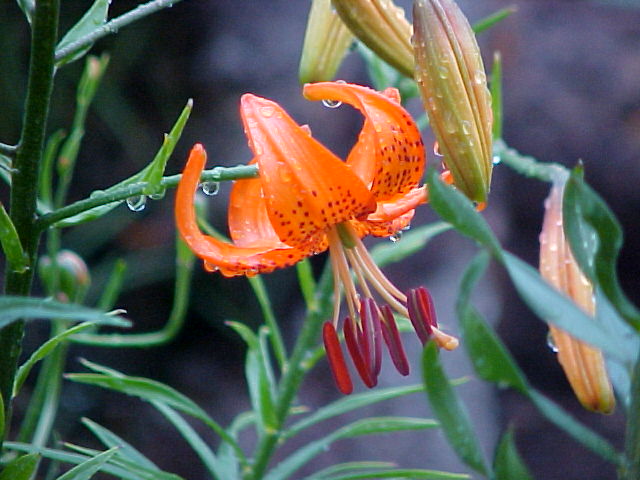 Lilium davidii
A tall Asian lily with edible bulbs and orange recurved flowers
🇨🇳 China and 1 more · Wildflower
Lilium davidii
A tall Asian lily with edible bulbs and orange recurved flowers
🇨🇳 China and 1 more · Wildflower
 Chinese LilyLilium brownii
A wild and cultivated lily from China with edible bulbs
🇨🇳 China and 3 more · Wildflower
Chinese LilyLilium brownii
A wild and cultivated lily from China with edible bulbs
🇨🇳 China and 3 more · Wildflower
More from Afghanistan
All the flowers of Afghanistan PomegranatePunica granatum
A shrub with bright red flowers and a fruit full of edible seeds
🇮🇷 Iran and 9 more · Flowering shrub
PomegranatePunica granatum
A shrub with bright red flowers and a fruit full of edible seeds
🇮🇷 Iran and 9 more · Flowering shrub
 FennelFoeniculum vulgare
A tall, aromatic herb with feathery leaves and yellow umbels, used for food and spice
🇨🇳 China and 7 more · Herb or useful flower
FennelFoeniculum vulgare
A tall, aromatic herb with feathery leaves and yellow umbels, used for food and spice
🇨🇳 China and 7 more · Herb or useful flower
 Crocus
Small corm-grown flowers in white, yellow, orange or purple
🇹🇷 Turkey and 7 more · Wildflower
Crocus
Small corm-grown flowers in white, yellow, orange or purple
🇹🇷 Turkey and 7 more · Wildflower
 Datura
A group of trumpet-shaped, highly toxic flowering plants in the nightshade family
🇲🇽 Mexico and 7 more · Wildflower
Datura
A group of trumpet-shaped, highly toxic flowering plants in the nightshade family
🇲🇽 Mexico and 7 more · Wildflower