
Oleander
Nerium oleander, family Apocynaceae
A showy, evergreen shrub with clusters of pink, white or red flowers
Oleander is an evergreen shrub or small tree native from the Mediterranean to southern Asia, including Morocco, Portugal, India, Myanmar, and parts of China. It grows 2–6 metres tall, with leathery, narrow leaves and clusters of pink, white, or red flowers, often sweet-scented. Widely planted for ornament, it is highly toxic if ingested.
- All parts of oleander are highly toxic if ingested
- Native from the Mediterranean to southern Asia, including Morocco and China
- Flowers can be pink, white, or red and grow in clusters
- Widely planted as an ornamental shrub in warm climates
- Galveston, Texas, is known as 'Oleander City'
What does Oleander look like?
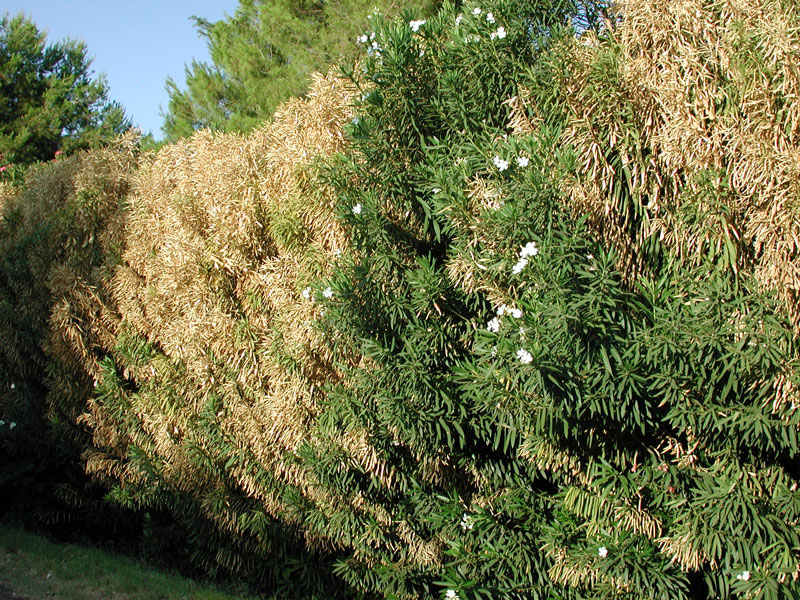
Oleander is a dense, evergreen shrub or small tree, reaching 2 to 6 metres in height. Its leaves are thick, leathery, and dark green, arranged in pairs or whorls of three, and shaped like narrow lances. The flowers grow in clusters at the branch tips and are usually pink in wild plants, but cultivated forms can be white, dark red, or double-flowered. Flowers are 2.5–5 cm across, with five fringed lobes, and may have a sweet scent. The fruit is a long, narrow pod that splits to release downy seeds.
Where does Oleander come from?
Oleander is native to a wide region from northwest Africa and the Mediterranean through southern Asia, including Morocco, Portugal, India, Myanmar, and Yunnan in China. It grows wild in dry, sunny places near stream beds, tolerating both drought and flooding. The name 'Nerium' comes from Greek, referring to its watery habitats. Oleander has been grown for thousands of years, known to ancient Greeks, Romans, and Egyptians, and was popular in Roman gardens. Its name and associations have shifted across languages and cultures.
When and how Oleander blooms
Oleander blooms mainly in warm, sunny climates and is grown as an ornamental shrub in gardens and along roadsides. It is drought-tolerant and can survive temporary flooding, but not prolonged frost. In cultivation, it is often grown from cuttings or seeds. Gardeners prune it to maintain shape or train it as a small tree. In some regions, it is planted in large numbers for landscaping, such as along highways and in public gardens.



How Oleander is used
People plant oleander widely for its showy flowers and evergreen foliage, especially in Mediterranean-style gardens, parks, and along roadsides. It is a feature of city plantings in places like Galveston, Texas, where it is celebrated in local festivals. Though beautiful, all parts of the plant are highly toxic, so it is not used for food or medicine today. In ancient times, it was sometimes mentioned in remedies, but its toxicity is now well known.
Kinds of Oleander
Cultivated oleanders come in many forms, with flowers ranging from white to deep red and single or double petals. Some are bred for larger blooms or more compact growth. Wild plants are typically pink-flowered. There are also regional differences in hardiness and size, with some forms better suited to cooler climates.
What Oleander means
Oleander has a long history in Mediterranean and Asian cultures, appearing in ancient Greek, Roman, and Egyptian texts and art. It is often depicted in Roman murals and was planted in ancient gardens. In Galveston, Texas, it is so widely grown that the city is nicknamed 'Oleander City' and hosts an annual festival. Despite its beauty, its poisonous nature is well known and has shaped its reputation.
Where Oleander is used and seen


Traditions that use it
Where to see Oleander
 🇮🇳 Chennai · All yearKoyambedu wholesale flower marketThe flower block of Chennai's vast Koyambedu wholesale complex, busiest before sunrise.
 🇮🇳 Madurai · All yearMadurai malli at the Mattuthavani flower marketThe wholesale market that sets the daily price of Madurai malli, the jasmine the city is famous for.
 🇮🇳 Nagercoil · All yearThovalai flower marketA village flower market near the southern tip of India that supplies Kerala, above all at Onam.
 🇪🇸 Granada · Apr to OctThe Generalife gardens above the AlhambraThe summer estate of Granada's Nasrid rulers, where water channels run between roses, myrtle, jasmine and orange trees.
Questions people ask about Oleander
Where does oleander come from?
Oleander is native to a broad region from the Mediterranean, including Morocco and Portugal, east through southern Asia to India, Myanmar, and parts of China such as Yunnan.
What does oleander look like?
It is an evergreen shrub or small tree with narrow, leathery leaves and clusters of showy flowers, usually pink, but also white or red in cultivated forms. The flowers are 2.5–5 cm across and may be sweet-scented.
Is oleander poisonous?
Yes, all parts of the oleander plant are highly toxic if eaten. Its bitterness usually prevents accidental poisoning, but ingestion can cause serious symptoms and even be fatal.
How is oleander used?
It is mainly grown as an ornamental plant in gardens, parks, and along roadsides for its attractive flowers and evergreen leaves. It is not used for food or medicine due to its toxicity.
What does oleander symbolise?
Oleander has appeared in ancient art and literature, especially in the Mediterranean region, but the sources do not give a specific symbolic meaning beyond its ornamental value and its reputation for toxicity.
Good reading and sources
- The Mughal rulers, especially Jahangir, had considerable literary skillsThe Hindu, Article
- Plants of the World OnlineRoyal Botanic Gardens, Kew, Plant database
- Where it has been recordedGBIF, Plant database
- Sightings and photos by naturalistsiNaturalist, Plant database
The facts on this page come from the Wikipedia article "Nerium", written by its contributors and used under the CC BY-SA 4.0 licence, and from its Wikidata record (CC0). Phool rewrote the text in its own words, with AI assistance, and compares every page with the article to make sure no passage is copied. It may be reused under the same CC BY-SA 4.0 licence with a link back.
It may contain mistakes. It is not medical or foraging advice: many flowers are poisonous, and traditional uses are reported, not recommended. If something is wrong, tell us. Last refreshed 2026-10-03.
Others in the family Apocynaceae
The whole family Plumeria
Fragrant tropical tree with waxy, five-petaled flowers in many colours
🇲🇽 Mexico and 6 more · Flowering tree
Plumeria
Fragrant tropical tree with waxy, five-petaled flowers in many colours
🇲🇽 Mexico and 6 more · Flowering tree
 Pinwheel flowerTabernaemontana divaricata
A fragrant white-flowered shrub native to South and Southeast Asia
🇲🇲 Myanmar and 2 more · Flowering shrub
Pinwheel flowerTabernaemontana divaricata
A fragrant white-flowered shrub native to South and Southeast Asia
🇲🇲 Myanmar and 2 more · Flowering shrub
 Plumeria alba
A small tree with white, fragrant flowers and yellow centers
🇵🇷 Puerto Rico and 6 more · Flowering tree
Plumeria alba
A small tree with white, fragrant flowers and yellow centers
🇵🇷 Puerto Rico and 6 more · Flowering tree
 Mandevilla
A tropical vine with large trumpet-shaped blooms in vivid colours
🇧🇷 Brazil and 2 more · Climber
Mandevilla
A tropical vine with large trumpet-shaped blooms in vivid colours
🇧🇷 Brazil and 2 more · Climber
More from Morocco
All the flowers of Morocco Wild cherryPrunus avium
A tall flowering tree native to Europe, grown for its sweet fruit and spring blossom
🇮🇹 Italy and 6 more · Flowering tree
Wild cherryPrunus avium
A tall flowering tree native to Europe, grown for its sweet fruit and spring blossom
🇮🇹 Italy and 6 more · Flowering tree
 Narcissus
Spring-flowering bulbs with trumpet-shaped blooms in white, yellow, and orange
🇬🇧 United Kingdom and 7 more · Wildflower
Narcissus
Spring-flowering bulbs with trumpet-shaped blooms in white, yellow, and orange
🇬🇧 United Kingdom and 7 more · Wildflower
 Bay laurelLaurus nobilis
Evergreen tree with aromatic leaves used as bay leaf in cooking
🇬🇷 Greece and 9 more · Flowering tree
Bay laurelLaurus nobilis
Evergreen tree with aromatic leaves used as bay leaf in cooking
🇬🇷 Greece and 9 more · Flowering tree
 ColtsfootTussilago farfara
A yellow spring-flowering herb once used in traditional remedies
🇨🇳 China and 4 more · Wildflower
ColtsfootTussilago farfara
A yellow spring-flowering herb once used in traditional remedies
🇨🇳 China and 4 more · Wildflower