
Wild cherry
Prunus avium, family Rosaceae
A tall flowering tree native to Europe, grown for its sweet fruit and spring blossom
Wild cherry is a deciduous tree from Europe and western Asia, known for its white spring flowers and sweet red to dark purple fruit. It is widely grown for its fruit, as an ornamental tree, and valued for its wood, but all parts except the ripe fruit are slightly toxic.
- Native to Europe, Anatolia, Maghreb, and western Asia
- Produces clusters of white flowers in early spring
- Ripe fruit is sweet to slightly bitter and edible
- All parts except ripe fruit are slightly toxic
- Valued for its wood in furniture and musical instruments
What does Wild cherry look like?
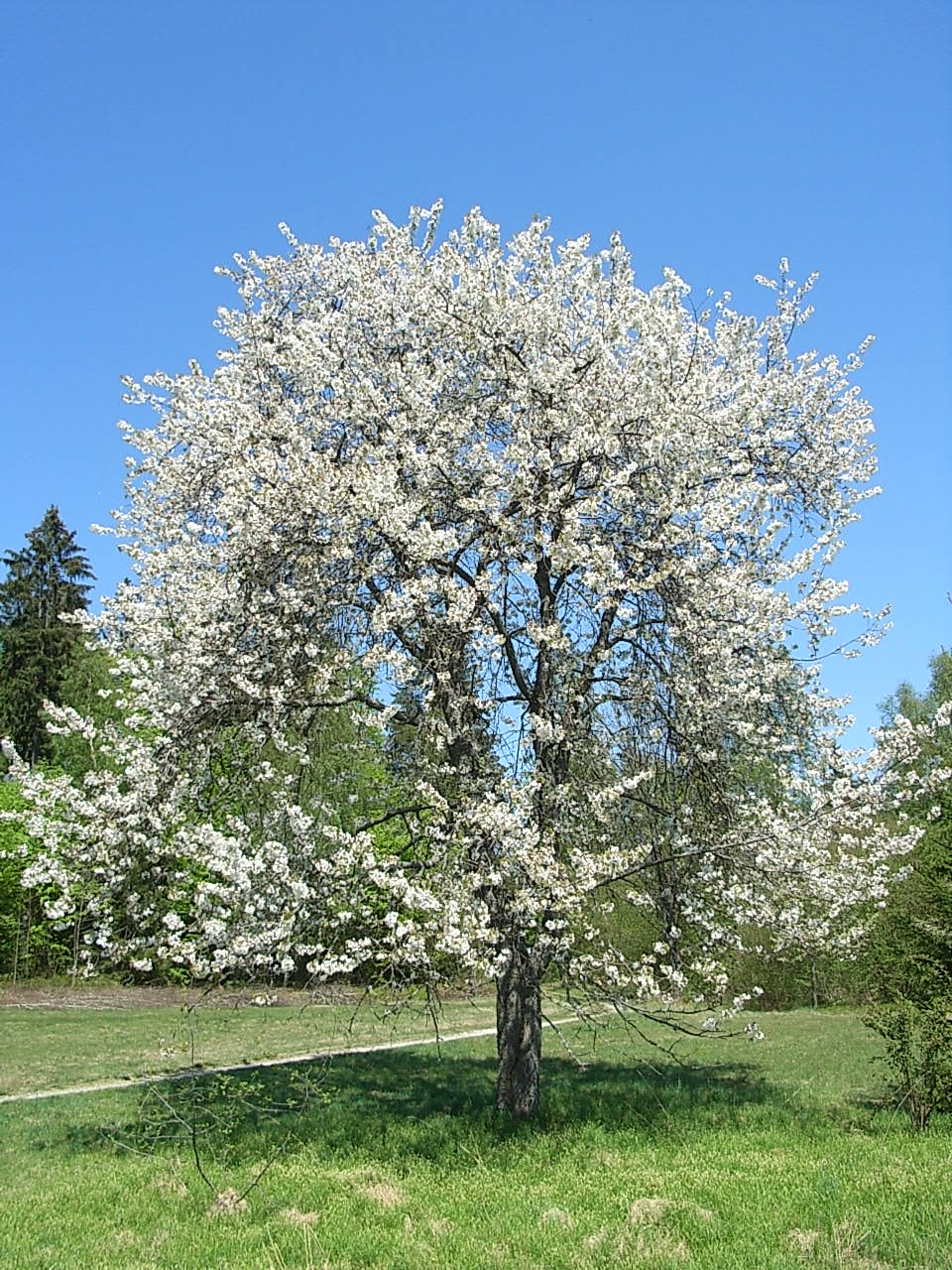
Wild cherry is a large deciduous tree, reaching 5 to 25 metres tall, with a straight trunk and a crown that becomes rounded with age. Its bark is smooth and reddish-brown on young trees, turning darker and fissured as it matures. The leaves are oval, finely toothed, and turn orange, pink, or red in autumn. In early spring, clusters of white flowers with five petals and yellowish stamens appear alongside new leaves. The fruit is a red to dark purple drupe, sweet to slightly bitter, about 1–2.5 cm across, each with a hard stone inside.
Where does Wild cherry come from?
Wild cherry is native to Europe, Anatolia, the Maghreb, and western Asia, with its range stretching from the British Isles to Morocco, Norway, the Caucasus, and northern Iran. Archaeological finds show people ate its fruit in Europe as far back as the Bronze Age. By 800 BCE, it was cultivated in Asia Minor and Greece. The tree has become naturalized in places like North America, New Zealand, and Australia. It is one of the parent species of the cultivated sweet cherry and has a long history of use for both fruit and timber.
When and how Wild cherry blooms
Wild cherry flowers in early spring, with blossoms appearing at the same time as new leaves. It prefers temperate climates and is often planted in parks and large gardens, less so as a street or small garden tree due to its size. The double-flowered 'Plena' form is popular in cultivation. Trees are grown from seed or grafted onto rootstocks, and many cultivars exist for fruit production. The fruit ripens in midsummer and is harvested when fully coloured.


How Wild cherry is used
The ripe fruit of wild cherry has been eaten by people for thousands of years and is one of the main ancestors of cultivated sweet cherries. Its hard, reddish-brown wood is used for furniture, musical instruments, and smoking foods. The gum from bark wounds can be chewed, and the stalks have been used in traditional medicine. The tree is also valued for wildlife, amenity planting, and gene conservation. All parts except the ripe fruit are slightly toxic.
Kinds of Wild cherry
There are many cultivated forms of wild cherry, including the double-flowered 'Plena', which is often grown as an ornamental tree. The term 'mazzard' refers to self-fertile varieties used as rootstocks, especially in North Devon, UK. Wild cherry has also been crossed with other Prunus species to create hybrids like P. × schmittii and P. × fontenesiana, both grown for ornamental purposes.
What Wild cherry means
Wild cherry has a long cultural history in Europe and western Asia. Its fruit was eaten in prehistoric times, and it was cultivated in ancient Greece and Asia Minor. The tree is sometimes used in afforestation and as an emblem in some regions. The wood is prized for its quality. The name 'wild cherry' can refer to other species in English, but Prunus avium is the main ancestor of cultivated sweet cherries. All parts except the ripe fruit are toxic.
Where Wild cherry is used and seen

Where to see Wild cherry

Questions people ask about Wild cherry
Where does wild cherry come from?
Wild cherry is native to Europe, Anatolia, the Maghreb, and western Asia, with its range stretching from the British Isles to Morocco, Norway, the Caucasus, and northern Iran.
What does wild cherry look like?
It is a tall deciduous tree with smooth reddish-brown bark when young, oval leaves that turn bright colours in autumn, clusters of white spring flowers, and red to dark purple sweet fruit.
Is wild cherry fruit edible?
Yes, the ripe fruit is edible and has been eaten for thousands of years, but all other parts of the plant are slightly toxic.
What is wild cherry used for?
Wild cherry is used for its edible fruit, as an ornamental tree, and for its hard wood in furniture and musical instruments. Its gum and stalks have also been used traditionally.
Does wild cherry have any cultural significance?
Wild cherry has a long history in Europe and western Asia, being eaten since the Bronze Age and cultivated in ancient Greece and Asia Minor. It is also valued for its wood and as a parent of cultivated cherries.
Good reading and sources
- Encyclopaedia BritannicaArticle
- IUCN Red List of Threatened SpeciesIUCN Red List, Article
- Prunus avium 'Plena' (d)Royal Horticultural Society, Article
- Plants of the World OnlineRoyal Botanic Gardens, Kew, Plant database
- Where it has been recordedGBIF, Plant database
- Sightings and photos by naturalistsiNaturalist, Plant database
The facts on this page come from the Wikipedia article "Prunus avium", written by its contributors and used under the CC BY-SA 4.0 licence, and from its Wikidata record (CC0). Phool rewrote the text in its own words, with AI assistance, and compares every page with the article to make sure no passage is copied. It may be reused under the same CC BY-SA 4.0 licence with a link back.
It may contain mistakes. It is not medical or foraging advice: many flowers are poisonous, and traditional uses are reported, not recommended. If something is wrong, tell us. Last refreshed 2026-10-03.
Others in the family Rosaceae
The whole family RoseRosa
Woody perennial plants with showy, often fragrant flowers in many colours
Rosa · Wildflower
RoseRosa
Woody perennial plants with showy, often fragrant flowers in many colours
Rosa · Wildflower
 ApricotPrunus armeniaca
A small fruit tree with early white to pink blossoms and golden-orange fruit
🇨🇳 China and 6 more · Flowering tree
ApricotPrunus armeniaca
A small fruit tree with early white to pink blossoms and golden-orange fruit
🇨🇳 China and 6 more · Flowering tree
 HawthornCrataegus
A thorny shrub or tree with white or pink spring flowers and small edible fruits
🇮🇪 Ireland and 7 more · Wildflower
HawthornCrataegus
A thorny shrub or tree with white or pink spring flowers and small edible fruits
🇮🇪 Ireland and 7 more · Wildflower
 Malus
The genus of apples and crabapples with spring blossoms and autumn fruit
Malus · Flowering tree
Malus
The genus of apples and crabapples with spring blossoms and autumn fruit
Malus · Flowering tree
More from Italy
All the flowers of Italy PeachPrunus persica
A flowering fruit tree from China, grown for its pink blossoms and sweet fruit
🇨🇳 China and 7 more · Flowering tree
PeachPrunus persica
A flowering fruit tree from China, grown for its pink blossoms and sweet fruit
🇨🇳 China and 7 more · Flowering tree
 AlmondPrunus amygdalus
A Mediterranean tree grown for its fragrant spring flowers and edible seeds
🇮🇷 Iran and 6 more · Flowering tree
AlmondPrunus amygdalus
A Mediterranean tree grown for its fragrant spring flowers and edible seeds
🇮🇷 Iran and 6 more · Flowering tree
 Chrysanthemum菊花
Autumn-blooming flower with thousands of varieties, cherished in East Asia and beyond
🇨🇳 China and 6 more · Wildflower
Chrysanthemum菊花
Autumn-blooming flower with thousands of varieties, cherished in East Asia and beyond
🇨🇳 China and 6 more · Wildflower
 Narcissus
Spring-flowering bulbs with trumpet-shaped blooms in white, yellow, and orange
🇬🇧 United Kingdom and 7 more · Wildflower
Narcissus
Spring-flowering bulbs with trumpet-shaped blooms in white, yellow, and orange
🇬🇧 United Kingdom and 7 more · Wildflower