
White avalanche-lily
Erythronium montanum, family Liliaceae
A white-flowered lily blooming as the snow recedes in Pacific Northwest mountains
White avalanche-lily is a mountain wildflower found in the Pacific Northwest of North America. It grows in moist alpine and subalpine meadows, producing white blooms with yellow centers soon after snowmelt, often forming large patches near lingering snowfields.
- Blooms soon after snowmelt in mountain meadows
- Flowers are white with yellow bases and curve back
- Found in the Pacific Northwest's alpine and subalpine zones
- Often forms large patches near melting snowfields
What does White avalanche-lily look like?
White avalanche-lily is a perennial plant with slender, unmottled leaves shaped like narrow lances. Its flowers have six white, petal-like tepals that curve back, each with a yellow base. The plant often grows in groups, creating a carpet of white blooms in open meadows or near melting snow. The flowers appear on slender stems and the plant is low-growing, blending with other mountain wildflowers.
Where does White avalanche-lily come from?
This species grows naturally in the mountains of the Pacific Northwest, including areas in Washington, Oregon, and coastal British Columbia. It is found above the treeline in alpine and subalpine zones, where snow lingers late into spring. The plant has adapted to bloom quickly after snowmelt, taking advantage of the short growing season in these high-elevation habitats.
When and how White avalanche-lily blooms
White avalanche-lily emerges from a bulb soon after the snow clears in late spring. It prefers moist soils in open woodlands and grassy meadows at high elevations. The plant spreads both by seed and by bulb division, often forming dense patches. Flowering can continue into early summer, especially near the edges of melting snowfields.
How White avalanche-lily is used
There is no record of this plant being widely used in gardens or for decoration. It is mainly enjoyed by hikers and botanists who encounter its blooms during mountain walks in late spring and early summer. The plant is a natural part of the mountain meadow ecosystem.
Kinds of White avalanche-lily
Erythronium montanum is closely related to Erythronium grandiflorum, which grows in some of the same regions but has yellow flowers instead of white. The two species can sometimes be found near each other, especially where their ranges overlap at different elevations.
What White avalanche-lily means
White avalanche-lily does not have known symbolic meanings or cultural associations. Its main significance is as a sign of spring in mountain landscapes, where its early blooming marks the retreat of snow and the start of the short alpine growing season.
Where White avalanche-lily is used and seen

Where to see White avalanche-lily

Questions people ask about White avalanche-lily
Where does the white avalanche-lily grow?
It grows in the mountains of the Pacific Northwest, including parts of Washington, Oregon, and coastal British Columbia, in alpine and subalpine meadows and woodlands.
What does the flower look like?
The plant has white, backward-curving flowers with a yellow center and narrow, unmottled leaves. It often grows in groups, creating a white carpet in mountain meadows.
When does the white avalanche-lily bloom?
It blooms in late spring, shortly after the snow melts, and can continue into midsummer near snowfields.
Is the white avalanche-lily used for any special purpose?
There is no record of it being used in gardens or ceremonies; it is mainly admired in its wild mountain habitat.
Are there similar species to the white avalanche-lily?
Yes, Erythronium grandiflorum is similar but has yellow flowers and sometimes grows in the same regions.
Good reading and sources
- USDA Plants DatabaseUS Department of Agriculture, Article
- Plants of the World OnlineRoyal Botanic Gardens, Kew, Plant database
- Where it has been recordedGBIF, Plant database
- Sightings and photos by naturalistsiNaturalist, Plant database
- Erythronium montanum on WikipediaEncyclopedia
- More photos on Wikimedia CommonsPhotos
- Wikidata recordOpen data
The facts on this page come from the Wikipedia article "Erythronium montanum", written by its contributors and used under the CC BY-SA 4.0 licence, and from its Wikidata record (CC0). Phool rewrote the text in its own words, with AI assistance, and compares every page with the article to make sure no passage is copied. It may be reused under the same CC BY-SA 4.0 licence with a link back.
It may contain mistakes. It is not medical or foraging advice: many flowers are poisonous, and traditional uses are reported, not recommended. If something is wrong, tell us. Last refreshed 2026-10-03.
Others in the family Liliaceae
The whole family TulipTulipa
Spring-blooming bulbs with showy, cup-shaped flowers in many colours
🇳🇱 Netherlands and 7 more · Wildflower
TulipTulipa
Spring-blooming bulbs with showy, cup-shaped flowers in many colours
🇳🇱 Netherlands and 7 more · Wildflower
 LilyLilium
Tall bulb flowers with large, colourful blooms in many gardens and cultures
Lilium · Wildflower
LilyLilium
Tall bulb flowers with large, colourful blooms in many gardens and cultures
Lilium · Wildflower
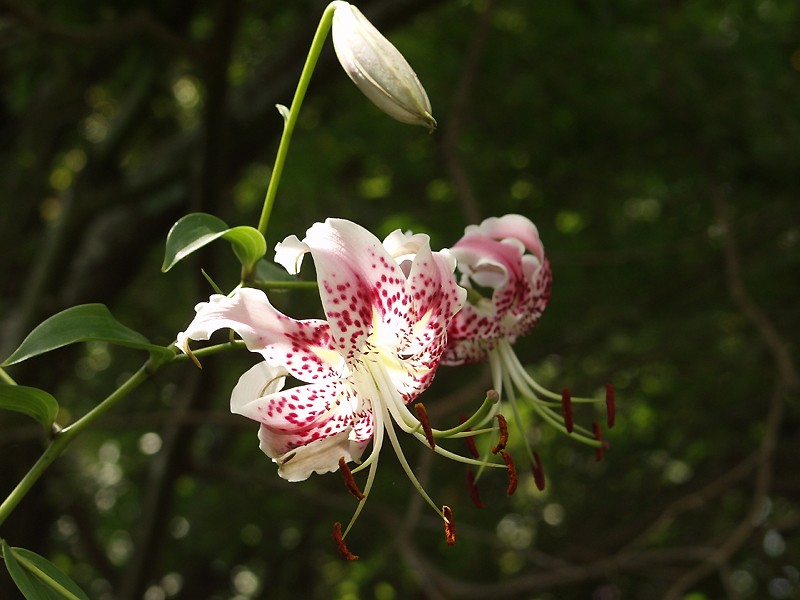 Lilium speciosum
A late-summer lily with fragrant white to pink flowers from East Asia
🇯🇵 Japan and 2 more · Wildflower
Lilium speciosum
A late-summer lily with fragrant white to pink flowers from East Asia
🇯🇵 Japan and 2 more · Wildflower
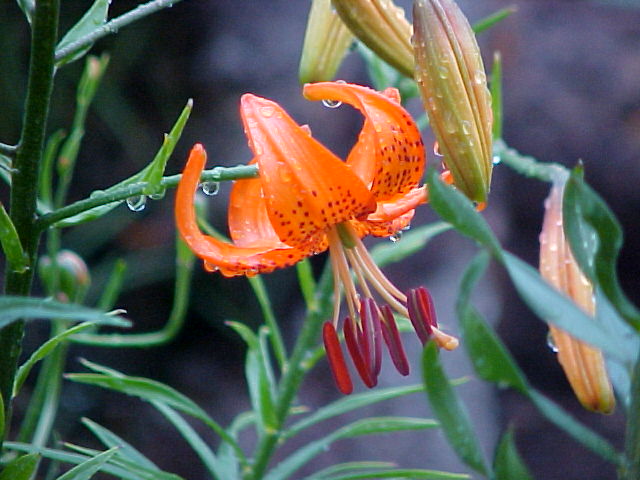 Lilium davidii
A tall Asian lily with edible bulbs and orange recurved flowers
🇨🇳 China and 1 more · Wildflower
Lilium davidii
A tall Asian lily with edible bulbs and orange recurved flowers
🇨🇳 China and 1 more · Wildflower