
Common jasmine
Jasminum officinale, family Oleaceae
A climbing plant with white, fragrant flowers grown in gardens and for perfume
Common jasmine is a climbing shrub with clusters of white, star-shaped flowers that give off a strong scent, especially in summer evenings. Native to parts of Central and South Asia, it is widely grown in gardens and used for its essential oil in perfumes and aromatherapy.
- National flower of Pakistan
- Flowers are picked at night for their scent
- Used in perfumes and aromatherapy
- Grown in gardens worldwide
- White, star-shaped, fragrant flowers
What does Common jasmine look like?
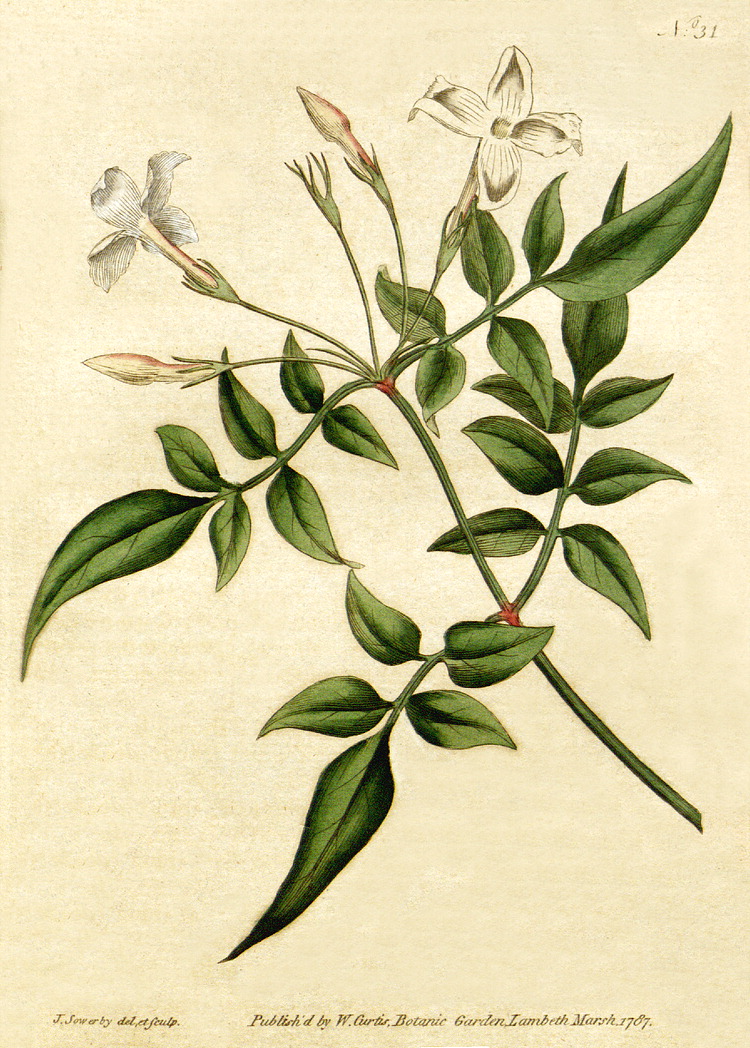
Common jasmine grows as a fast, twining climber with slender stems and leaves made up of 5 to 9 pointed leaflets. In summer, it produces clusters of pure white, star-like flowers that are highly fragrant, especially in the evening. The plant can cover walls or trellises and is often grown for its scent and attractive appearance.
Where does Common jasmine come from?
This jasmine comes from regions in Central and South Asia, including Tibet and the foothills stretching through Iran, Afghanistan, Pakistan, India, Nepal, Tajikistan, and western China. It has been grown for so long that its exact origin is uncertain. Jasmine was known in China by the third century CE and later spread to Europe, likely through Sicily. Over time, it became naturalized in many countries and is now found in gardens across temperate regions.
When and how Common jasmine blooms
Jasmine blooms in summer, with flowers opening in the evening when their scent is strongest. It grows best in mild climates and is often planted near walls or fences for support. Flowers are picked at night for essential oil extraction, as this is when their fragrance peaks. Gardeners also grow it for its decorative foliage and white blossoms.



How Common jasmine is used
The plant is popular in gardens for its scent and climbing habit. Its flowers are harvested for essential oil, which is used in perfumes and aromatherapy. Jasmine is also recognized as the national flower of Pakistan. In some places, the flowers are used to make scented water or as decoration in homes and gardens.
Kinds of Common jasmine
Many garden varieties exist, including some with leaves edged in cream or white, such as 'Argenteovariegatum', which has received awards for its ornamental value. Double-flowered forms were especially prized in earlier centuries. Some cultivars are chosen for their unique foliage as well as their flowers.
What Common jasmine means
Jasmine holds cultural importance as the national flower of Pakistan. It has appeared in literature, such as in Boccaccio's Decameron, and has been valued in gardens since ancient times. Its scent is a key ingredient in perfumery. The plant is considered safe as a food ingredient, though allergic reactions are possible.
Traditions that use it
Questions people ask about Common jasmine
Where does common jasmine come from?
Common jasmine is native to parts of Central and South Asia, including Tibet, Iran, Afghanistan, Pakistan, India, Nepal, Tajikistan, and western China. It has been grown in gardens for centuries and is now naturalized in many other countries.
What does common jasmine look like?
It is a climbing plant with slender stems, leaves made up of several pointed leaflets, and clusters of pure white, star-shaped flowers. The flowers are known for their strong, sweet fragrance.
What is common jasmine used for?
Common jasmine is grown in gardens for its beauty and scent. Its flowers are used to produce essential oil for perfumes and aromatherapy. It is also the national flower of Pakistan and sometimes used for decoration and scented water.
When does common jasmine flower?
It blooms in summer, producing its most fragrant flowers in the evenings during this season.
Does common jasmine have any cultural significance?
Yes, it is the national flower of Pakistan and has been mentioned in literature and garden history for centuries. Its scent is highly valued in perfumery.
Good reading and sources
- Encyclopaedia BritannicaArticle
- Jasminum officinale 'Argenteovariegatum' (v)Royal Horticultural Society, Article
- USDA Plants DatabaseUS Department of Agriculture, Article
- Plants of the World OnlineRoyal Botanic Gardens, Kew, Plant database
- Where it has been recordedGBIF, Plant database
- Sightings and photos by naturalistsiNaturalist, Plant database
- Jasminum officinale on WikipediaEncyclopedia
- More photos on Wikimedia CommonsPhotos
- Wikidata recordOpen data
The facts on this page come from the Wikipedia article "Jasminum officinale", written by its contributors and used under the CC BY-SA 4.0 licence, and from its Wikidata record (CC0). Phool rewrote the text in its own words, with AI assistance, and compares every page with the article to make sure no passage is copied. It may be reused under the same CC BY-SA 4.0 licence with a link back.
It may contain mistakes. It is not medical or foraging advice: many flowers are poisonous, and traditional uses are reported, not recommended. If something is wrong, tell us. Last refreshed 2026-10-03.
Others in the family Oleaceae
The whole family LilacSyringa
Fragrant spring-flowering shrubs and small trees grown for their showy clusters
Syringa · Flowering shrub
LilacSyringa
Fragrant spring-flowering shrubs and small trees grown for their showy clusters
Syringa · Flowering shrub
 Star jasmineJasminum multiflorum
A white, scentless jasmine used in Indian weddings and worship
🇮🇳 India and 6 more · Wildflower
Star jasmineJasminum multiflorum
A white, scentless jasmine used in Indian weddings and worship
🇮🇳 India and 6 more · Wildflower
 Common LilacSyringa vulgaris
A spring-flowering shrub with fragrant purple or white blooms
🇷🇸 Serbia and 4 more · Garden flower
Common LilacSyringa vulgaris
A spring-flowering shrub with fragrant purple or white blooms
🇷🇸 Serbia and 4 more · Garden flower
 Forsythia连翘
A yellow-flowered shrub that signals early spring in gardens and parks
🇨🇳 China and 3 more · Flowering shrub
Forsythia连翘
A yellow-flowered shrub that signals early spring in gardens and parks
🇨🇳 China and 3 more · Flowering shrub
More from Pakistan
All the flowers of Pakistan PomegranatePunica granatum
A shrub with bright red flowers and a fruit full of edible seeds
🇮🇷 Iran and 9 more · Flowering shrub
PomegranatePunica granatum
A shrub with bright red flowers and a fruit full of edible seeds
🇮🇷 Iran and 9 more · Flowering shrub
 JasmineJasminum
A group of fragrant shrubs and vines with white or yellow star-shaped flowers
🇵🇰 Pakistan and 7 more · Wildflower
JasmineJasminum
A group of fragrant shrubs and vines with white or yellow star-shaped flowers
🇵🇰 Pakistan and 7 more · Wildflower
 BaelAegle marmelos
A spiny tree with fragrant yellow-green flowers and hard-shelled aromatic fruit
🇮🇳 India and 6 more · Flowering tree
BaelAegle marmelos
A spiny tree with fragrant yellow-green flowers and hard-shelled aromatic fruit
🇮🇳 India and 6 more · Flowering tree
 Brown mustardBrassica juncea
A leafy mustard plant grown for greens, seeds, and oil across Asia and beyond
🇨🇳 China and 7 more · Wildflower
Brown mustardBrassica juncea
A leafy mustard plant grown for greens, seeds, and oil across Asia and beyond
🇨🇳 China and 7 more · Wildflower