
Magnolia liliiflora
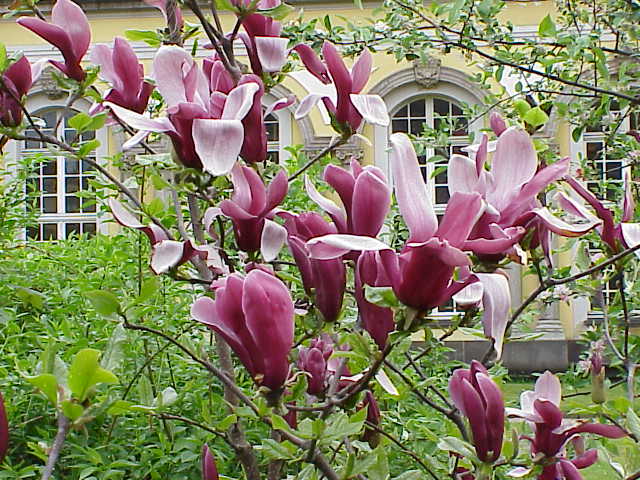
A small Chinese magnolia with large pink-purple spring flowers
Magnolia liliiflora is a deciduous shrub or small tree from southern China, grown for its striking pink to purple blooms that appear in early spring before the leaves. Though native to China, it has long been cultivated in Japan and is now found in gardens across North America and Europe.
- Native to southern China, especially Sichuan and Yunnan
- Blooms with large pink to purple flowers before the leaves appear
- Grows as a small shrub or tree, up to 4 meters tall
- Cultivated in China, Japan, North America, and Europe
- 'Nigra' cultivar has especially deep-colored flowers
What does Magnolia liliiflora look like?
This plant grows as a shrub or, less often, a small tree, usually reaching up to 4 meters tall. Its flowers are large, shaped like tulips or lilies, and range from pink to deep purple. The blossoms open before the leaves emerge, creating a striking display early in the spring. The plant is smaller than most other magnolias and is known for its abundant flowers.
Where does Magnolia liliiflora come from?
Magnolia liliiflora comes from southern China, especially the Sichuan and Yunnan regions. It has been grown in Chinese and Japanese gardens for centuries. Although it is not native to Japan, it was introduced to English-speaking countries from Japanese-grown plants, which led to the name Japanese magnolia. Today, it is also grown in North America and Europe as an ornamental shrub.
When and how Magnolia liliiflora blooms
The plant blooms early in spring, with flowers appearing before the leaves. It grows slowly, adding about 15 to 30 centimeters each year when young. Magnolia liliiflora prefers acidic or neutral soil and does best in full sun or light shade. It is usually grown from nursery plants rather than seed.



How Magnolia liliiflora is used
Magnolia liliiflora is mainly planted for its decorative value in gardens and landscapes. Its showy flowers make it a popular choice for home gardens, especially in areas where spring blooms are valued. It is less commonly grown than some hybrid magnolias but is still appreciated for its unique appearance.
Kinds of Magnolia liliiflora
The 'Nigra' cultivar is notable for its much darker flowers compared to the typical species. This variety has been recognized for its garden performance. Magnolia liliiflora is also one of the parent species of the widely grown saucer magnolia hybrid, Magnolia × soulangeana.
What Magnolia liliiflora means
While Magnolia liliiflora is not a national or state emblem, it is valued in gardens for its early and colorful flowers. Its long history in Chinese and Japanese horticulture has led to many local names. The plant is mostly appreciated for its beauty rather than for symbolic or religious reasons.
Where Magnolia liliiflora is used and seen
 Hong Kong Zoological and Botanical GardensA historic garden and zoo in Central, Hong Kong with themed plant collections
 Kórnik ArboretumPoland’s oldest and largest collection of trees and shrubs, near Kórnik Castle
 Holden ArboretumA vast botanical garden and arboretum in Kirtland, Ohio
 New Orleans Botanical GardenA public garden in City Park with themed plant collections and art deco features
 Powell GardensA 970-acre botanical garden near Kansas City, Missouri
 Mendocino Coast Botanical GardensA coastal garden in Mendocino County, California with ocean views and diverse plantings
 South China National Botanical GardenA major botanical garden in Guangzhou with diverse plant collections and research focus
 Sim's Park, CoonoorA century-old botanical garden in the Nilgiri hills of Tamil Nadu
Questions people ask about Magnolia liliiflora
Where does Magnolia liliiflora come from?
It is native to southern China, particularly the Sichuan and Yunnan regions, and has been grown in gardens there and in Japan for centuries.
What does Magnolia liliiflora look like?
It is a small shrub or tree with large, tulip-shaped flowers that are pink to purple. The flowers appear in early spring before the leaves.
How is Magnolia liliiflora used?
It is mainly grown as an ornamental plant in gardens and landscapes for its attractive spring flowers.
Is Magnolia liliiflora related to other magnolias?
Yes, it is one of the parent species of the popular saucer magnolia hybrid, Magnolia × soulangeana.
Does Magnolia liliiflora have any special cultural meaning?
It is mainly valued for its beauty in gardens and does not have a strong symbolic or religious role.
Good reading and sources
- Encyclopaedia BritannicaArticle
- Magnolia liliiflora 'Nigra'Royal Horticultural Society, Article
- IUCN Red List of Threatened SpeciesIUCN Red List, Article
- Plants of the World OnlineRoyal Botanic Gardens, Kew, Plant database
- Where it has been recordedGBIF, Plant database
- Sightings and photos by naturalistsiNaturalist, Plant database
- Magnolia liliiflora on WikipediaEncyclopedia
- More photos on Wikimedia CommonsPhotos
- Wikidata recordOpen data
The facts on this page come from the Wikipedia article "Magnolia liliiflora", written by its contributors and used under the CC BY-SA 4.0 licence, and from its Wikidata record (CC0). Phool rewrote the text in its own words, with AI assistance, and compares every page with the article to make sure no passage is copied. It may be reused under the same CC BY-SA 4.0 licence with a link back.
It may contain mistakes. It is not medical or foraging advice: many flowers are poisonous, and traditional uses are reported, not recommended. If something is wrong, tell us. Last refreshed 2026-10-03.
Others in the family Magnoliaceae
The whole family Magnolia sieboldii
A summer-blooming magnolia with white, cup-shaped flowers from East Asia
🇨🇳 China and 3 more · Flowering tree
Magnolia sieboldii
A summer-blooming magnolia with white, cup-shaped flowers from East Asia
🇨🇳 China and 3 more · Flowering tree
 Saucer magnoliaMagnolia × soulangeana
A spring-flowering magnolia with large pink, white, or purple blooms
🇫🇷 France and 1 more · Garden flower
Saucer magnoliaMagnolia × soulangeana
A spring-flowering magnolia with large pink, white, or purple blooms
🇫🇷 France and 1 more · Garden flower
 Houpu MagnoliaMagnolia officinalis
A Chinese mountain magnolia valued for its fragrant white flowers and aromatic bark
🇨🇳 China · Flowering tree
Houpu MagnoliaMagnolia officinalis
A Chinese mountain magnolia valued for its fragrant white flowers and aromatic bark
🇨🇳 China · Flowering tree
 Banana magnoliaMagnolia figo
A fragrant evergreen tree with velvety buds and creamy or purple flowers
🇨🇳 China · Garden flower
Banana magnoliaMagnolia figo
A fragrant evergreen tree with velvety buds and creamy or purple flowers
🇨🇳 China · Garden flower
More from China
All the flowers of China PeachPrunus persica
A flowering fruit tree from China, grown for its pink blossoms and sweet fruit
🇨🇳 China and 7 more · Flowering tree
PeachPrunus persica
A flowering fruit tree from China, grown for its pink blossoms and sweet fruit
🇨🇳 China and 7 more · Flowering tree
 Common sunflowerHelianthus annuus
A tall annual plant grown for its large yellow flower heads and edible seeds
🇨🇦 Canada and 4 more · Wildflower
Common sunflowerHelianthus annuus
A tall annual plant grown for its large yellow flower heads and edible seeds
🇨🇦 Canada and 4 more · Wildflower
 PomegranatePunica granatum
A shrub with bright red flowers and a fruit full of edible seeds
🇮🇷 Iran and 9 more · Flowering shrub
PomegranatePunica granatum
A shrub with bright red flowers and a fruit full of edible seeds
🇮🇷 Iran and 9 more · Flowering shrub
 ApricotPrunus armeniaca
A small fruit tree with early white to pink blossoms and golden-orange fruit
🇨🇳 China and 6 more · Flowering tree
ApricotPrunus armeniaca
A small fruit tree with early white to pink blossoms and golden-orange fruit
🇨🇳 China and 6 more · Flowering tree