
Saucer magnolia
Magnolia × soulangeana, family Magnoliaceae
A spring-flowering magnolia with large pink, white, or purple blooms
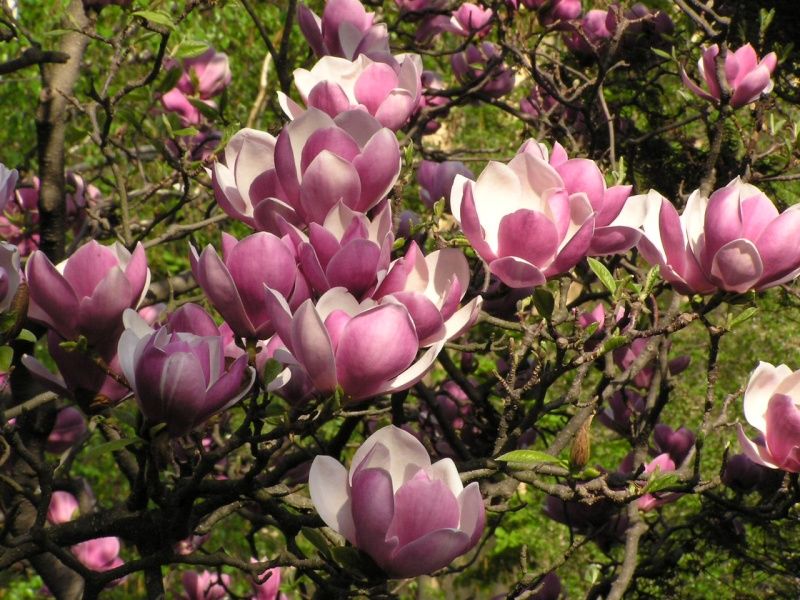
Saucer magnolia is a deciduous hybrid tree grown for its striking early spring flowers, which appear before the leaves. First bred in France, it is now a popular garden tree in Europe and the United States, known for its large blooms in shades of white, pink, and purple.
- Hybrid magnolia first bred in France in the 1820s
- Flowers appear before the leaves in early spring
- Blooms range from white to deep maroon and can reach 35 cm across
- Widely grown in gardens in Europe and the United States
What does Saucer magnolia look like?
Saucer magnolia grows as a large shrub or small tree with several stems. Its leaves are dark green, oval, and glossy, appearing after the flowers. The blooms are large—often 10 to 20 cm across—and come in shades from white to pink and maroon. Flowers open on bare branches in early spring, creating a dramatic display before the foliage appears. Some varieties have cup-shaped flowers, while others are more rounded.
Where does Saucer magnolia come from?
This hybrid was created in France in the early 19th century by Étienne Soulange-Bodin, who crossed two magnolia species at his estate near Paris. The first flowers appeared in 1826, and the plant quickly gained attention for its beauty. The name 'Magnolia × soulangeana' was given by a botanical society in Paris, recognizing Soulange-Bodin’s work. The hybrid soon spread from France to gardens across Europe and North America.
When and how Saucer magnolia blooms
Saucer magnolia blooms in early spring, often before many other trees. It is grown from cuttings or grafted plants, as it is a hybrid. The tree is valued for its ability to grow in a range of soils, including those with higher pH, and is less sensitive to wind than some other magnolias. Gardeners select from many named varieties, each with its own flower form and color.



How Saucer magnolia is used
This magnolia is widely planted in gardens and parks for its early and showy flowers. It is especially common in southern England and in both eastern and western parts of the United States. Some varieties have received awards for their garden performance. The tree is not used for food or medicine, but is valued for ornamental purposes and as a symbol of spring.
Kinds of Saucer magnolia
There are over a hundred named cultivars of saucer magnolia. For example, 'Grace McDade' from Alabama is known for its exceptionally large flowers, up to 35 cm across, tinged with pinkish-purple. The 'Jurmag1' variety is noted for its deep color and compact blooms. Flower shape and timing can differ between cultivars.
What Saucer magnolia means
Saucer magnolia is a familiar sight in spring gardens in many countries. It is appreciated for its early flowering and striking appearance. Some cultivars have received horticultural awards, such as 'Brozzonii' in the UK. The tree is not strongly tied to symbolism or religious use, but it is a favorite for ornamental planting.
Where Saucer magnolia is used and seen
 Hong Kong Zoological and Botanical GardensA historic garden and zoo in Central, Hong Kong with themed plant collections
 Kórnik ArboretumPoland’s oldest and largest collection of trees and shrubs, near Kórnik Castle
 Holden ArboretumA vast botanical garden and arboretum in Kirtland, Ohio
 New Orleans Botanical GardenA public garden in City Park with themed plant collections and art deco features
 Powell GardensA 970-acre botanical garden near Kansas City, Missouri
 Mendocino Coast Botanical GardensA coastal garden in Mendocino County, California with ocean views and diverse plantings
 South China National Botanical GardenA major botanical garden in Guangzhou with diverse plant collections and research focus
 Sim's Park, CoonoorA century-old botanical garden in the Nilgiri hills of Tamil Nadu
Questions people ask about Saucer magnolia
Where did saucer magnolia originate?
Saucer magnolia was first bred in France in the early 1800s by crossing two magnolia species at an estate near Paris.
What does the saucer magnolia look like?
It is a small tree or large shrub with dark green oval leaves and large flowers in white, pink, or maroon that bloom before the leaves in early spring.
How is saucer magnolia used?
It is mainly grown as an ornamental tree in gardens and parks for its showy spring flowers.
Are there different varieties of saucer magnolia?
Yes, there are over a hundred named varieties, differing in flower size, color, and shape.
Does saucer magnolia have any special meaning or symbolism?
The sources do not mention any particular symbolism, but it is widely valued for its beauty and as a sign of spring.
Good reading and sources
- USDA Plants DatabaseUS Department of Agriculture, Article
- Plants of the World OnlineRoyal Botanic Gardens, Kew, Plant database
- Where it has been recordedGBIF, Plant database
- Sightings and photos by naturalistsiNaturalist, Plant database
- Magnolia × soulangeana on WikipediaEncyclopedia
- More photos on Wikimedia CommonsPhotos
- Wikidata recordOpen data
The facts on this page come from the Wikipedia article "Magnolia × soulangeana", written by its contributors and used under the CC BY-SA 4.0 licence, and from its Wikidata record (CC0). Phool rewrote the text in its own words, with AI assistance, and compares every page with the article to make sure no passage is copied. It may be reused under the same CC BY-SA 4.0 licence with a link back.
It may contain mistakes. It is not medical or foraging advice: many flowers are poisonous, and traditional uses are reported, not recommended. If something is wrong, tell us. Last refreshed 2026-10-03.
Others in the family Magnoliaceae
The whole family Magnolia sieboldii
A summer-blooming magnolia with white, cup-shaped flowers from East Asia
🇨🇳 China and 3 more · Flowering tree
Magnolia sieboldii
A summer-blooming magnolia with white, cup-shaped flowers from East Asia
🇨🇳 China and 3 more · Flowering tree
 Magnolia liliiflora
A small Chinese magnolia with large pink-purple spring flowers
🇨🇳 China and 1 more · Flowering shrub
Magnolia liliiflora
A small Chinese magnolia with large pink-purple spring flowers
🇨🇳 China and 1 more · Flowering shrub
 Houpu MagnoliaMagnolia officinalis
A Chinese mountain magnolia valued for its fragrant white flowers and aromatic bark
🇨🇳 China · Flowering tree
Houpu MagnoliaMagnolia officinalis
A Chinese mountain magnolia valued for its fragrant white flowers and aromatic bark
🇨🇳 China · Flowering tree
 Banana magnoliaMagnolia figo
A fragrant evergreen tree with velvety buds and creamy or purple flowers
🇨🇳 China · Garden flower
Banana magnoliaMagnolia figo
A fragrant evergreen tree with velvety buds and creamy or purple flowers
🇨🇳 China · Garden flower
More from France
All the flowers of France TulipTulipa
Spring-blooming bulbs with showy, cup-shaped flowers in many colours
🇳🇱 Netherlands and 7 more · Wildflower
TulipTulipa
Spring-blooming bulbs with showy, cup-shaped flowers in many colours
🇳🇱 Netherlands and 7 more · Wildflower
 Common flaxLinum usitatissimum
The slender blue-flowered plant grown for linen and linseed
🇨🇳 China and 7 more · Wildflower
Common flaxLinum usitatissimum
The slender blue-flowered plant grown for linen and linseed
🇨🇳 China and 7 more · Wildflower
 Chrysanthemum菊花
Autumn-blooming flower with thousands of varieties, cherished in East Asia and beyond
🇨🇳 China and 6 more · Wildflower
Chrysanthemum菊花
Autumn-blooming flower with thousands of varieties, cherished in East Asia and beyond
🇨🇳 China and 6 more · Wildflower
 LindenTilia
Tall, broad-leaved trees with fragrant yellow flowers and heart-shaped leaves
🇨🇳 China and 7 more · Flowering tree
LindenTilia
Tall, broad-leaved trees with fragrant yellow flowers and heart-shaped leaves
🇨🇳 China and 7 more · Flowering tree