
Chinaberry
Melia azedarach, family Meliaceae
In its own language: آزاددرخت
A fragrant lilac-flowered tree known for bead-like berries and hardy timber
Chinaberry is a deciduous flowering tree native to Indomalaya and Australasia. It produces clusters of fragrant pale purple blossoms, followed by yellow marble-sized berries that hang through winter. People plant it for shade and ornament, craft beads from its hard stones, and harvest its rot-resistant timber.
- Clusters of small, fragrant blossoms feature five pale purple or lilac petals.
- Hard five-grooved seeds inside the berries were traditionally used to string rosaries.
- The fruits stay on bare branches all winter, turning from golden yellow to wrinkled white.
- Birds that feast heavily on the berries can become intoxicated before spreading seeds.
What does Chinaberry look like?
The chinaberry tree typically grows between seven and twelve metres tall, forming a broad, rounded canopy, though rare specimens reach forty-five metres. Its green foliage consists of long, multi-divided leaves with finely toothed edges that are darker on top and paler underneath. In the canopy, clusters of small blossoms open with five slender petals in shades of pale purple or lilac, releasing a sweet fragrance. After flowering, the tree forms clusters of round, marble-sized fruits that turn golden yellow as they ripen. These drupes stay on the bare branches throughout the cold winter months, gradually shrivelling and lightening to an off-white hue. Chinaberry trees have a relatively brief lifespan, generally surviving for about twenty years.
Where does Chinaberry come from?
Wild chinaberry originates across Australasia and the Indomalayan realm, including regions of China. Botanist Carl Linnaeus classified the genus as Melia, adapting the ancient Greek term for flowering ash because of their comparable foliage. Its species identifier, azedarach, traces back through French to a Persian phrase meaning noble or free tree. Travellers carried the tree around the globe during the nineteenth century. It arrived in the southern United States around 1830 and reached the Hawaiian islands a decade later. Today, the tree grows wild across many warm temperate and tropical landscapes worldwide.
When and how Chinaberry blooms
Chinaberry is an adaptable tree that handles wide swings in climate. Established trees tolerate temperatures from five degrees below freezing up to thirty-nine degrees Celsius. The tree reproduces abundantly through seed. Gardeners and city planners frequently plant it in parks, along footpaths, and in suburban street strips, such as around Melbourne. While introduced populations do not benefit local bees or butterflies, several hummingbird species visit the blooms for nectar. Birds feed heavily on the ripe drupes and spread the hard pits across broad distances.


How Chinaberry is used
People find diverse uses for almost every part of the chinaberry. The durable, five-grooved pits inside the berries were historically carved and strung into prayer beads and rosaries. Florists harvest cut boughs laden with winter berries for outdoor seasonal decorations. Its medium-density wood seasons smoothly without splitting, yielding durable timber that resembles teak. Dried leaves and berries serve as traditional deterrents against grain pests in stored fruit. In Kenya, farmers feed the foliage to cattle to boost milk yields. Past folk medicine also used mild leaf teas for uterine relaxation.
Kinds of Chinaberry
Although often called Persian lilac, Indian lilac, Cape lilac, or white cedar, Melia azedarach belongs to the mahogany family rather than the true lilac group. It is closely related to neem trees in the genus Azadirachta, but remains botanically distinct. Several regional names reflect its worldwide travels, including pride of India and Texas umbrella tree. While individual specimens vary in height and crown spread depending on soil and rainfall, all forms share the same compound leaves and star-shaped lilac blooms.
What Chinaberry means
Chinaberry berries contain toxic resins and neurotoxins that make them unsafe for humans, cats, and many domestic animals. Eating just a few berries can cause severe illness. In contrast, many wild birds can gorge on the fruit without fatal harm, though they sometimes become noticeably disoriented or intoxicated before scattering the seeds. Because the tree spreads aggressively through bird droppings, authorities in parts of Australia, New Zealand, and the southern United States classify chinaberry as a troublesome invasive weed.
Where Chinaberry is used and seen

Questions people ask about Chinaberry
Where does the chinaberry tree come from?
Melia azedarach is native to Australasia and the Indomalayan region, including parts of China. In the nineteenth century, people introduced it to North America, Hawaii, and Africa as an ornamental garden plant, and it has since naturalised across warm regions worldwide.
What are chinaberry trees used for?
People grow the tree for ornamental shade and harvest its high-quality, teak-like timber. Florists sell berry-laden branches for winter arrangements, while artisans carve the grooved seeds for rosaries. The leaves serve as livestock feed in Kenya and traditionally repel insects from stored crops.
Are chinaberry fruits poisonous?
Yes, the berries and bark contain potent neurotoxins and resins that are dangerous to humans and cats. Ingesting just six to nine fruits can cause severe vomiting, stomach pain, and potentially fatal illness. However, wild birds can eat them safely, though they sometimes appear intoxicated.
What do chinaberry flowers look like?
The flowers grow in fragrant clusters across the canopy. Each blossom is relatively small and features five pale lilac or light purple petals. While they do not attract bees or butterflies, certain hummingbird species feed on their nectar.
Good reading and sources
- Encyclopaedia BritannicaArticle
- Melia azedarachAustralian National Botanic Gardens, Article
- Melia azedarachUS Department of Agriculture, Article
- Plants of the World OnlineRoyal Botanic Gardens, Kew, Plant database
- Where it has been recordedGBIF, Plant database
- Sightings and photos by naturalistsiNaturalist, Plant database
- Melia azedarach on WikipediaEncyclopedia
- More photos on Wikimedia CommonsPhotos
- Wikidata recordOpen data
The facts on this page come from the Wikipedia article "Melia azedarach", written by its contributors and used under the CC BY-SA 4.0 licence, and from its Wikidata record (CC0). EveryPhool rewrote the text in its own words, with AI assistance, and compares every page with the article to make sure no passage is copied. It may be reused under the same CC BY-SA 4.0 licence with a link back.
It may contain mistakes. It is not medical or foraging advice: many flowers are poisonous, and traditional uses are reported, not recommended. If something is wrong, tell us. Last refreshed 2026-10-04.
Others in the family Meliaceae
The whole family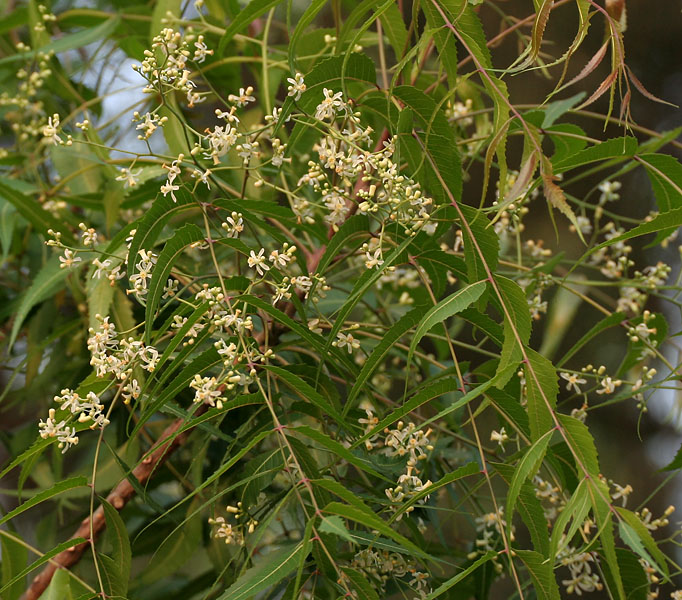

More from Australia
All the flowers of Australia AlmondPrunus amygdalus
A Mediterranean tree grown for its fragrant spring flowers and edible seeds
🇮🇷 Iran and 6 more · Flowering tree
AlmondPrunus amygdalus
A Mediterranean tree grown for its fragrant spring flowers and edible seeds
🇮🇷 Iran and 6 more · Flowering tree
 FennelFoeniculum vulgare
A tall, aromatic herb with feathery leaves and yellow umbels, used for food and spice
🇨🇳 China and 7 more · Herb or useful flower
FennelFoeniculum vulgare
A tall, aromatic herb with feathery leaves and yellow umbels, used for food and spice
🇨🇳 China and 7 more · Herb or useful flower
 RosemarySalvia rosmarinus
A fragrant evergreen shrub with needle-like leaves and purple, blue, or white flowers
🇪🇸 Spain and 5 more · Flowering shrub
RosemarySalvia rosmarinus
A fragrant evergreen shrub with needle-like leaves and purple, blue, or white flowers
🇪🇸 Spain and 5 more · Flowering shrub
 Eucalyptus
The tall, aromatic trees and shrubs known as gum trees or eucalypts
🇦🇺 Australia and 7 more · Flowering tree
Eucalyptus
The tall, aromatic trees and shrubs known as gum trees or eucalypts
🇦🇺 Australia and 7 more · Flowering tree