
Elder
Sambucus, family Viburnaceae
A group of shrubs and small trees with clusters of white flowers and dark berries
Elder refers to a group of fast-growing shrubs or small trees found in temperate and subtropical regions worldwide. These plants bear clusters of tiny white or cream flowers in late spring or early summer, followed by dark berries, and are valued for their ornamental use, edible cooked fruit, and traditional crafts.
- Elder shrubs and trees grow in temperate and subtropical regions worldwide
- Clusters of small white or cream flowers appear in late spring or early summer
- Cooked berries are edible and used in drinks and dyes
- Some parts of the plant are toxic if eaten raw
- Elder trees feature in many folk traditions and legends
What does Elder look like?
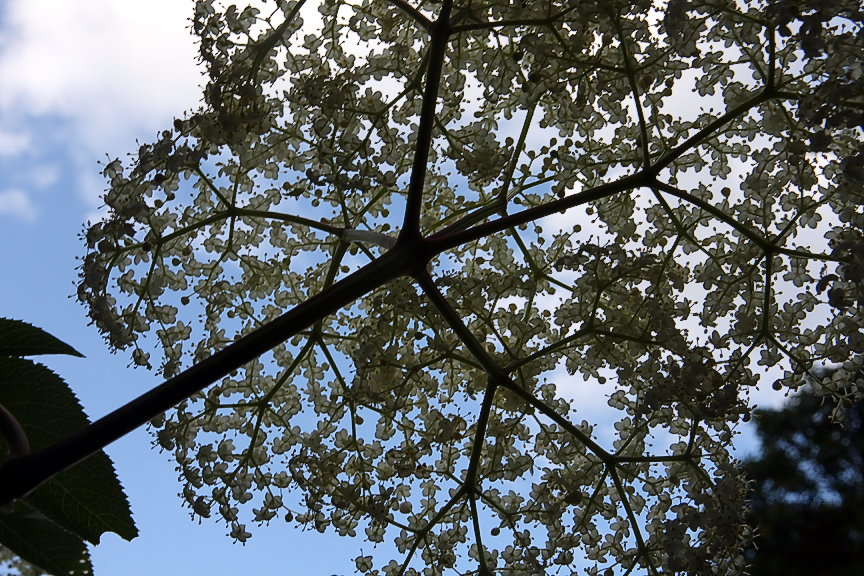
Elder plants are usually shrubs or small trees, reaching up to 10 meters, though some can grow taller. Their leaves are arranged in pairs and divided into several toothed leaflets. In late spring or early summer, they produce large, flat clusters of small white or cream flowers. These are followed by bunches of small berries, which can be black, blue-black, red, yellow, or rarely white, depending on the species. The flowers often have a strong scent, while the leaves and unripe fruit can have a sharp, unpleasant smell.
Where does Elder come from?
Elders are native to many temperate and subtropical areas across the globe, with most species found in the Northern Hemisphere. They thrive in a wide range of soils and are often seen near farms, homesteads, and places with rich organic matter. The name Sambucus comes from an ancient Greek word for a musical instrument, as the hollow twigs were used to make flutes. The group has a complex classification history due to its wide range and varied forms, and it was once placed in a different plant family before genetic studies led to its current classification.
When and how Elder blooms
Elder plants bloom in late spring or early summer, producing their distinctive flower clusters. They grow quickly and are easy to shape, making them popular for hedges and garden borders. Elders tolerate many soil types and thrive where there is enough sunlight. They are often started from cuttings or seeds, and some species are grown specifically for their decorative leaves, flowers, or fruit.



How Elder is used
People use elder plants in various ways. The cooked berries are eaten or made into wine, and the flowers are used for drinks like elderflower cordial and liqueurs. The plant's pigments serve as natural dyes for food and textiles. Hollow stems have been crafted into musical instruments and tools. Some parts of the plant are toxic if eaten raw, but certain species' berries and flowers are safe when prepared properly. Traditional medicine has used elder, though scientific evidence for health benefits is limited.
Kinds of Elder
There are between 20 and 30 species of elder, with Sambucus nigra, S. canadensis, and S. racemosa commonly grown in gardens. These differ in berry color and plant size. Some species have berries that are red or yellow, while others are black or blue-black. Ornamental varieties are chosen for their foliage and flower displays.
What Elder means
Elder trees have a rich place in folklore. In some regions, they are believed to protect against evil, while other traditions warn that witches gather under them. Cutting an elder tree was thought to release a spirit called the Elder Mother, so people would recite a rhyme for safety. Elder wood is considered unlucky to burn in Romani culture. The elder wand from the Harry Potter series draws on these legends.
Where Elder is used and seen


Questions people ask about Elder
Where do elder plants come from?
Elder species are native to temperate and subtropical areas around the world, especially in the Northern Hemisphere, but also in parts of Australasia and South America.
What do elder flowers and berries look like?
Elder plants produce large, flat clusters of small white or cream flowers, followed by bunches of small berries that can be black, blue-black, red, yellow, or rarely white.
Are elderberries safe to eat?
Cooked berries from most elder species are edible, but raw berries, leaves, and other parts can be toxic. Some species, like Sambucus nigra and S. canadensis, have berries and flowers that are safe when prepared properly.
How are elders used by people?
Elders are grown for their ornamental flowers and fruit, used in drinks, dyes, and crafts. Their hollow stems have been used to make instruments and tools, and they appear in traditional medicine and folklore.
What do elder trees symbolize?
Elder trees are linked to protection and magic in folklore, sometimes said to ward off evil or associated with spirits and witches, with customs and rhymes tied to cutting the tree.
Good reading and sources
- Encyclopaedia BritannicaArticle
- USDA Plants DatabaseUS Department of Agriculture, Article
- Plants of the World OnlineRoyal Botanic Gardens, Kew, Plant database
- Where it has been recordedGBIF, Plant database
- Sightings and photos by naturalistsiNaturalist, Plant database
The facts on this page come from the Wikipedia article "Sambucus", written by its contributors and used under the CC BY-SA 4.0 licence, and from its Wikidata record (CC0). EveryPhool rewrote the text in its own words, with AI assistance, and compares every page with the article to make sure no passage is copied. It may be reused under the same CC BY-SA 4.0 licence with a link back.
It may contain mistakes. It is not medical or foraging advice: many flowers are poisonous, and traditional uses are reported, not recommended. If something is wrong, tell us. Last refreshed 2026-10-03.
Others in the family Viburnaceae
The whole family ElderSambucus nigra
A tall shrub or small tree with clusters of white flowers and dark berries
🇩🇪 Germany and 6 more · Wildflower
ElderSambucus nigra
A tall shrub or small tree with clusters of white flowers and dark berries
🇩🇪 Germany and 6 more · Wildflower
 Viburnum
Shrubs and small trees with showy flower clusters and colourful berries
🇺🇦 Ukraine and 3 more · Wildflower
Viburnum
Shrubs and small trees with showy flower clusters and colourful berries
🇺🇦 Ukraine and 3 more · Wildflower
 Guelder-roseViburnum opulus
A white-flowered shrub with red berries, rooted in Slavic and Ukrainian tradition
🇷🇺 Russia and 1 more · Flowering shrub
Moschatel familyViburnaceae
A small flowering plant family spanning moschatels, elders, and viburnums
Viburnaceae · Wildflower
Guelder-roseViburnum opulus
A white-flowered shrub with red berries, rooted in Slavic and Ukrainian tradition
🇷🇺 Russia and 1 more · Flowering shrub
Moschatel familyViburnaceae
A small flowering plant family spanning moschatels, elders, and viburnums
Viburnaceae · Wildflower