
Soapberry family
Sapindaceae, family Sapindaceae
A global family of flowering trees, climbers, and fruit crops like lychee and maple
The soapberry family, or Sapindaceae, is a broad group of flowering trees, shrubs, and climbers found across tropical and temperate zones. It includes popular ornamentals, timber trees, and fruit crops like lychee and rambutan, along with species rich in natural soapy compounds.
- Spans 138 genera and 1,858 accepted species growing in temperate and tropical habitats worldwide.
- Includes edible fruit trees like lychee and rambutan as well as maples and horse chestnuts.
- Produces natural saponins from fruits like Sapindus drupes for use in detergents and cosmetics.
What does Soapberry family look like?
Members of the soapberry family grow in diverse forms, from towering trees and woody climbers to small herbaceous plants. Their leaves are often compound, arranged alternately in spiral patterns on tropical species and oppositely on temperate groups like maples and buckeyes. The flowers tend to be tiny and functionally single-sexed, grouped into clustered branch arrangements known as panicles. Blossoms typically feature four or five sepals and petals, surrounding a ring of four to ten stamens set upon a nectar disc. After pollination by insects, birds, or wind, the plants produce varied fruits, including berries, nuts, winged samaras, capsules, and drupes. Many species also produce milky sap or seeds wrapped in fleshy arils.
Where does Soapberry family come from?
Sapindaceae species grow across tropical and temperate climates around the world, frequently thriving in laurel forest habitats. Botanists place the family within the order Sapindales, closely allied to the citrus family, Rutaceae. Evolutionary studies identify Xanthoceras as the most basal surviving branch of the group. Modern botanical classification unites plants once split into separate families, incorporating the maples and horse chestnuts into a broadly defined soapberry family. Today, the family holds 138 recognized genera and nearly 1,900 distinct species. The largest tropical genera include Serjania, Paullinia, and Allophylus, while the maple genus Acer dominates among the temperate lineages.
When and how Soapberry family blooms
Plants in this family reproduce through pollination carried out mostly by visiting insects or birds, though some kinds rely on the wind to spread their pollen. Their small blossoms develop in branched clusters called cymes that gather into larger panicles. Flowers frequently carry eight hairy stamens arranged in two rings around a central nectar disc. Following fertilization, the plants develop specialized seeds that lack endosperm and contain curved or coiled embryos. In cultivation, various members grow in garden beds, orchards, and urban landscapes across temperate and warm climates, adapting to diverse soils and regional weather conditions.


How Soapberry family is used
People cultivate members of the soapberry family for food, timber, landscaping, and cleaning products. Tropical species yield celebrated fruits such as lychee, longan, rambutan, pulasan, ackee, and pitomba, while temperate maples provide sweet syrup and valuable wood. Several genera, including Cardiospermum, Koelreuteria, and Ungnadia, are grown as ornamental plants in private gardens and public parks. Additionally, species such as Schleichera trijuga provide Indian macassar oil. Natural saponin compounds harvested from Sapindus fruit serve as effective cleaning agents, finding commercial use in laundry detergents and cosmetic formulas.
Kinds of Soapberry family
The family is divided into four subfamilies. Sapindoideae forms the largest tropical division, containing over a hundred genera like Serjania and Paullinia. Hippocastanoideae includes temperate maples and buckeyes with opposite foliage. Dodonaeoideae encompasses roughly 38 genera, including Dodonaea, which produces flowers entirely lacking petals. Finally, Xanthoceroideae contains a single genus, representing the earliest diverging branch of the family.
What Soapberry family means
While primarily valued for their practical and ecological roles, soapberry family plants hold long-standing significance in daily life and traditional trade. Saponin-bearing fruits have historically served communities as natural soaps and washing materials. Other members, like guaraná, hold economic importance as regional crops. Many species contain mildly toxic saponin compounds that protect them from herbivores while providing useful raw materials for household cleaning traditions.
Questions people ask about Soapberry family
Where does the soapberry family come from?
Members of the soapberry family grow wild in temperate and tropical regions across the globe. Many species thrive naturally within lush laurel forest habitats in different parts of the world.
What kinds of plants belong to the soapberry family?
The family encompasses more than 1,800 species of trees, woody lianas, and herbaceous plants. Familiar members include sugar maples, buckeyes, horse chestnuts, ackee, lychee, longan, and rambutan.
How are soapberry plants used?
People plant them for garden ornamentals, harvest timber from maples, collect sap for syrup, enjoy fruits like lychees, and extract natural saponins from soapberry drupes for detergents.
Are plants in the soapberry family toxic?
Many species produce milky latex or contain mildly toxic saponins. While potentially harmful if ingested raw by animals, these same saponins are harvested to create effective soaps, cosmetics, and commercial cleansers.
Good reading and sources
- Encyclopaedia BritannicaArticle
- Plants of the World OnlineRoyal Botanic Gardens, Kew, Plant database
- Where it has been recordedGBIF, Plant database
- Sightings and photos by naturalistsiNaturalist, Plant database
The facts on this page come from the Wikipedia article "Sapindaceae", written by its contributors and used under the CC BY-SA 4.0 licence, and from its Wikidata record (CC0). EveryPhool rewrote the text in its own words, with AI assistance, and compares every page with the article to make sure no passage is copied. It may be reused under the same CC BY-SA 4.0 licence with a link back.
It may contain mistakes. It is not medical or foraging advice: many flowers are poisonous, and traditional uses are reported, not recommended. If something is wrong, tell us. Last refreshed 2026-10-04.
Others in the family Sapindaceae
The whole family Horse-chestnutAesculus hippocastanum
A large flowering tree known for its white spring blooms and shiny brown conkers
🇦🇱 Albania and 7 more · Flowering tree
Horse-chestnutAesculus hippocastanum
A large flowering tree known for its white spring blooms and shiny brown conkers
🇦🇱 Albania and 7 more · Flowering tree
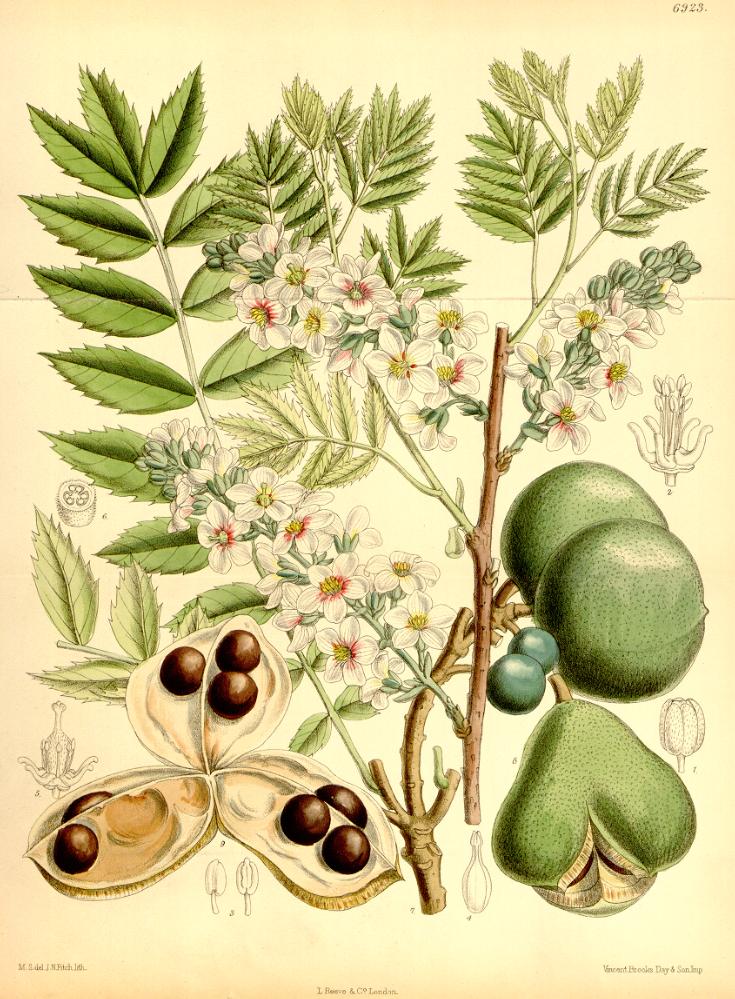 YellowhornXanthoceras sorbifolium
A hardy flowering tree from northern China with edible seeds and fragrant white blooms
🇨🇳 China and 2 more · Flowering tree
YellowhornXanthoceras sorbifolium
A hardy flowering tree from northern China with edible seeds and fragrant white blooms
🇨🇳 China and 2 more · Flowering tree
 MapleAcer
A genus of trees famed for autumn colour, winged seeds and syrup
🇯🇵 Japan and 7 more · Flowering tree
MapleAcer
A genus of trees famed for autumn colour, winged seeds and syrup
🇯🇵 Japan and 7 more · Flowering tree
 Sycamore mapleAcer pseudoplatanus
A tall European maple with greenish-yellow flower clusters and winged seeds
🇦🇱 Albania and 7 more · Flowering tree
Sycamore mapleAcer pseudoplatanus
A tall European maple with greenish-yellow flower clusters and winged seeds
🇦🇱 Albania and 7 more · Flowering tree