
Bladderwort
Utricularia, family Lentibulariaceae
A carnivorous plant with snapdragon-like flowers and underwater suction traps
Bladderwort is a genus of carnivorous plants found worldwide except in Antarctica. It grows in wet soil or freshwater, producing delicate flowers above water or ground while tiny bladder traps below capture microscopic prey.
- Traps work in 10–15 milliseconds using underwater suction
- Lacks true roots; vegetative parts aren't clearly divided
- Flowers resemble snapdragons or orchids
- Found on all continents except Antarctica
- Over 230 species with diverse life forms
What does Bladderwort look like?
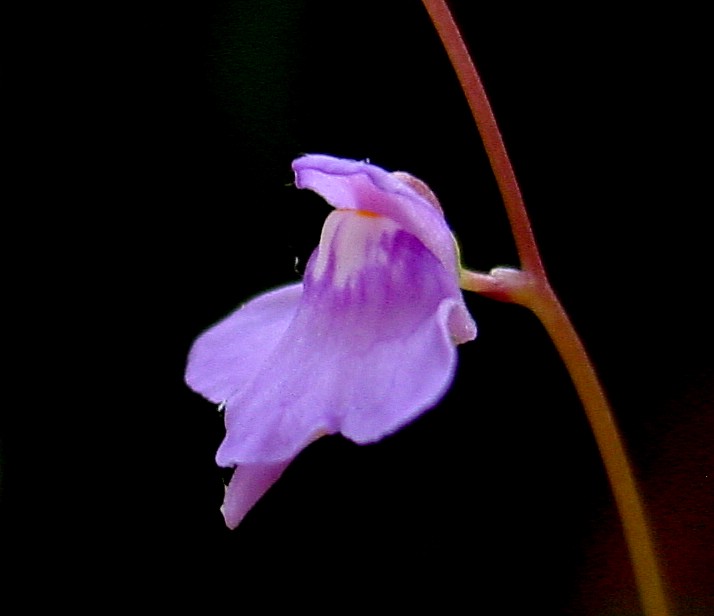
Bladderworts produce flowers that rise clear of water or soil on slender stalks. These blooms resemble small snapdragons or orchids and come in varied colours. The rest of the plant stays hidden below, made of thread-like stems bearing tiny bladders, specialized traps that suck in prey. The plant has no true roots, and its leaves and stems are not clearly distinct.
Where does Bladderwort come from?
Bladderworts grow on every continent except Antarctica, thriving wherever fresh water is seasonally present. They likely originated in South America, with fossil evidence suggesting divergence from related genera around 30 million years ago. From there, they spread to Australia, Africa, Eurasia, and the Americas through multiple independent dispersals.
When and how Bladderwort blooms
These plants grow in waterlogged soils, ponds, streams, or even on mossy trees. Terrestrial types live in soggy ground; aquatic ones float freely or anchor in mud; epiphytic species cling to bark in rainforests. Many temperate kinds form winter buds called turions that sink and survive freezing, while Australian species retreat into tubers during dry periods.



Kinds of Bladderwort
About 230 species exist. Most are terrestrial, but some are aquatic, epiphytic, lithophytic, or rheophytic. Aquatic forms like U. vulgaris drift in still waters, while South American epiphytes such as U. nelumbifolia grow in bromeliad tanks and bear showy, orchid-like flowers. Australian species include those that bloom en masse after rains.
Traditions that use it
Where to see Bladderwort

Questions people ask about Bladderwort
Where does bladderwort come from?
It grows naturally on every continent except Antarctica, especially in wet or aquatic habitats with low nutrients.
How does bladderwort catch its food?
It uses tiny bladder traps under negative pressure; when prey touches trigger hairs, the door opens and sucks in the organism with surrounding water in milliseconds.
What do bladderwort flowers look like?
They are often compared to small snapdragons or orchids, with two unequal lip-like petals and colours that vary by species.
Does bladderwort have roots?
No, it lacks a true root system; its stems and leaf-like structures blend together without clear separation.
Why is it called bladderwort?
The name comes from its bladder-shaped traps, derived from the Latin 'utriculus', meaning a small bag or flask.
Good reading and sources
- Encyclopaedia BritannicaArticle
- USDA Plants DatabaseUS Department of Agriculture, Article
- Plants of the World OnlineRoyal Botanic Gardens, Kew, Plant database
- Where it has been recordedGBIF, Plant database
- Sightings and photos by naturalistsiNaturalist, Plant database
The facts on this page come from the Wikipedia article "Utricularia", written by its contributors and used under the CC BY-SA 4.0 licence, and from its Wikidata record (CC0). Phool rewrote the text in its own words, with AI assistance, and compares every page with the article to make sure no passage is copied. It may be reused under the same CC BY-SA 4.0 licence with a link back.
It may contain mistakes. It is not medical or foraging advice: many flowers are poisonous, and traditional uses are reported, not recommended. If something is wrong, tell us. Last refreshed 2026-10-03.
More from Australia
All the flowers of Australia AlmondPrunus amygdalus
A Mediterranean tree grown for its fragrant spring flowers and edible seeds
🇮🇷 Iran and 6 more · Flowering tree
AlmondPrunus amygdalus
A Mediterranean tree grown for its fragrant spring flowers and edible seeds
🇮🇷 Iran and 6 more · Flowering tree
 FennelFoeniculum vulgare
A tall, aromatic herb with feathery leaves and yellow umbels, used for food and spice
🇨🇳 China and 7 more · Herb or useful flower
FennelFoeniculum vulgare
A tall, aromatic herb with feathery leaves and yellow umbels, used for food and spice
🇨🇳 China and 7 more · Herb or useful flower
 RosemarySalvia rosmarinus
A fragrant evergreen shrub with needle-like leaves and purple, blue, or white flowers
🇪🇸 Spain and 5 more · Flowering shrub
RosemarySalvia rosmarinus
A fragrant evergreen shrub with needle-like leaves and purple, blue, or white flowers
🇪🇸 Spain and 5 more · Flowering shrub
 Eucalyptus
The tall, aromatic trees and shrubs known as gum trees or eucalypts
🇦🇺 Australia and 7 more · Flowering tree
Eucalyptus
The tall, aromatic trees and shrubs known as gum trees or eucalypts
🇦🇺 Australia and 7 more · Flowering tree