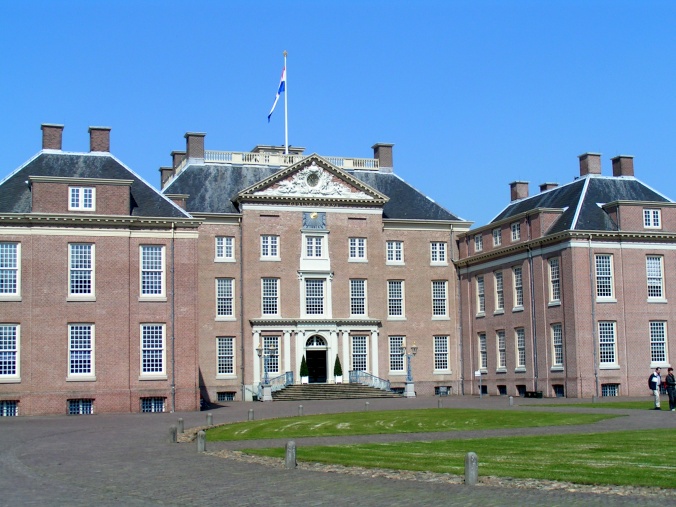
Het Loo Palace
In its own language: Paleis Het Loo
A Dutch Baroque palace and royal museum in Apeldoorn
Het Loo Palace is a former royal residence in Apeldoorn, Netherlands, built in the late 17th century for William III and Mary II. Designed in the Dutch Baroque style with formal gardens, it now serves as a national museum displaying the history of the House of Orange-Nassau.
- Built for William III and Mary II between 1684 and 1686
- Features a reconstructed Dutch Baroque garden nicknamed 'Versailles of Holland'
- Became a national museum in 1984 after royal ownership ended
- Houses royal carriages, historic interiors, and a library on the House of Orange
- Underwent a major underground expansion opening in April 2023
What is Het Loo Palace?
Het Loo Palace stands behind a modest courtyard in Apeldoorn. Its Dutch Baroque design avoids grandeur, presenting instead as a refined country house. Behind it lies a symmetrical formal garden with gravel paths, fountains, parterres, and statues. The palace now functions as a museum showcasing royal interiors, historic carriages, and collections related to Dutch honours.
The history of Het Loo Palace
Construction began in 1684 for William III, stadtholder of the Netherlands and later king of England, Scotland, and Ireland, and his wife Mary II. Architects Jacob Roman and Johan van Swieten designed the building, while Claude Desgots laid out the original garden. The name 'Het Loo' means 'the lea' or meadow in Dutch.
What there is to see
The palace was completed in 1686 and remained a summer home for the Dutch royal family until 1962. After Queen Wilhelmina’s death, it passed to the state. A major renovation from 1976 to 1982 prepared it for public opening in 1984. The historic Baroque garden was reconstructed between 1970 and 1984 based on original plans.


When to go
Since 1984, Het Loo has operated as a national museum. Visitors explore period rooms filled with original furnishings, art, and objects from the House of Orange-Nassau. The stables display royal coaches and sleighs. The grounds include both the restored 17th-century garden and later landscape elements, open year-round.
Parts and collections
The original Baroque garden was replaced in the 18th century by an English-style landscape garden. The current layout is a faithful reconstruction of the 1680s design, completed for the palace’s 300th anniversary. A modern underground extension opened in 2023 adds visitor facilities beneath the courtyard.
Why Het Loo Palace matters
Though inspired by Versailles, Het Loo reflects Dutch restraint, called a 'Lust-hof' or pleasure house rather than a palace. It symbolizes the House of Orange-Nassau’s legacy. The site is a protected rijksmonument and among the Netherlands’ Top 100 heritage sites. Falconry was once practiced here by royalty and guests.
Questions people ask about Het Loo Palace
Where is Het Loo Palace located?
It is in Apeldoorn, in the province of Gelderland, Netherlands.
Who built Het Loo Palace and why?
It was built for stadtholder William III and Queen Mary II as a country retreat, completed in 1686.
What can visitors see at Het Loo today?
Original royal rooms, historic carriages in the stables, the restored Baroque garden, and exhibits on Dutch honours.
Is the garden original?
The current garden is a reconstruction of the 1680s design, restored between 1970 and 1984 after being replaced centuries earlier.
When did it become a museum?
It opened to the public as a state museum in 1984, following renovations that began in 1976.
Good reading and sources
- Het Loo Palace on WikipediaEncyclopedia
- More photos on Wikimedia CommonsPhotos
- Wikidata recordOpen data
The facts on this page come from the Wikipedia article "Het Loo Palace", written by its contributors and used under the CC BY-SA 4.0 licence, and from its Wikidata record (CC0). EveryPhool rewrote the text in its own words, with AI assistance, and compares every page with the article to make sure no passage is copied. It may be reused under the same CC BY-SA 4.0 licence with a link back.
It may contain mistakes. Opening times, prices and bloom dates change: check with the place before you travel. If something is wrong, tell us. Last refreshed 2026-10-04.
More of the same kind
 Place
Tropical Botanical Garden and Research Institute
A major botanical garden and research centre in Thiruvananthapuram, Kerala
Thiruvananthapuram, 🇮🇳 India · Botanical garden
Place
National Botanical Research Institute
A premier plant science and botanical research center in Lucknow
Lucknow, 🇮🇳 India · Botanical garden
Place
Tropical Botanical Garden and Research Institute
A major botanical garden and research centre in Thiruvananthapuram, Kerala
Thiruvananthapuram, 🇮🇳 India · Botanical garden
Place
National Botanical Research Institute
A premier plant science and botanical research center in Lucknow
Lucknow, 🇮🇳 India · Botanical garden
 Place
Baldha Gardenবলধা গার্ডেন
A historic botanical garden in Old Dhaka with hundreds of plant species
Dhaka, 🇧🇩 Bangladesh · Botanical garden
Place
Baldha Gardenবলধা গার্ডেন
A historic botanical garden in Old Dhaka with hundreds of plant species
Dhaka, 🇧🇩 Bangladesh · Botanical garden
 Place
Sim's Park, Coonoor
A century-old botanical garden in the Nilgiri hills of Tamil Nadu
Coonoor, 🇮🇳 India · Botanical garden, May
Place
Sim's Park, Coonoor
A century-old botanical garden in the Nilgiri hills of Tamil Nadu
Coonoor, 🇮🇳 India · Botanical garden, May
More from the Netherlands
All the flowers of the Netherlands Place
Anna Paulowna
A Dutch town in North Holland named after a Russian queen
Anna Paulowna, 🇳🇱 Netherlands · Flower garden
Place
Anna Paulowna
A Dutch town in North Holland named after a Russian queen
Anna Paulowna, 🇳🇱 Netherlands · Flower garden
 Place
Keukenhof
A vast Dutch flower garden famous for its spring tulip displays
Lisse, 🇳🇱 Netherlands · Flower garden, Mar to May
Place
Keukenhof
A vast Dutch flower garden famous for its spring tulip displays
Lisse, 🇳🇱 Netherlands · Flower garden, Mar to May
 Place
Vondelpark
Amsterdam’s 47-hectare city park with gardens, ponds, theatre and statues
Amsterdam, 🇳🇱 Netherlands · Flower garden
Place
Vondelpark
Amsterdam’s 47-hectare city park with gardens, ponds, theatre and statues
Amsterdam, 🇳🇱 Netherlands · Flower garden
 Place
Floriade
The Netherlands’ once-a-decade international garden and horticultural exposition
Almere, 🇳🇱 Netherlands · Festival or show
Place
Floriade
The Netherlands’ once-a-decade international garden and horticultural exposition
Almere, 🇳🇱 Netherlands · Festival or show