🇨🇲 The flowers of Cameroon
8 pages from Cameroon: its flowers, the things made with them and the places to see them, across 2 cities and regions.
Cameroon is home to over 8,000 plant species, including many flowers and trees unique to its borders. Its plant life thrives in rainforests, savannas, and highland grasslands, shaped by a mix of tropical climates and varied landscapes. The country stands out for its high number of endemic species and large areas of protected forest.
- Cameroon has 8,260 recorded plant species.
- 156 plant species are unique to Cameroon.
- Rainforests in the south feature trees up to 60 meters tall.
- Montane grasslands and bamboo grow above 1,800 meters.
- Protected areas cover about 12% of the country.
The plant life of Cameroon
Cameroon's plant life is shaped by its tropical climate and diverse terrain, ranging from humid coastal rainforests to highland grasslands and northern savannas. The country supports more than 8,000 known plant species, making it one of Africa's richest areas for biodiversity. Dense forests cover much of the south, while the north features drier woodlands and open grasslands. Many of these forests are home to tall trees, some reaching up to 60 meters, and are draped with mosses and epiphytes. The country's varied elevations and climates create habitats for a wide range of flowering plants.
From region to region in Cameroon
Plant communities in Cameroon change with the landscape. The southern lowlands are covered in evergreen rainforest, while the central region has semi-deciduous forests. In the north, savannas with scattered trees dominate. Highlands above 900 meters support submontane and montane forests, and at the highest points, grasslands and bamboo thickets appear. Along the coast, mangrove forests line the estuaries and river mouths.
Flowers to know in Cameroon
Cameroon has 156 plant species found nowhere else. Its rainforests are known for towering mahogany, ebony, and sapelli trees. The highlands support unique afromontane plants, which are species adapted to African mountains. Some of these are only found in the Cameroonian Highlands, a region recognized for its rare and endangered flora. The country’s forests also host a variety of epiphytes—plants that grow on other plants for support.
Threats and protection in Cameroon
Cameroon's forests are shrinking, with forest cover dropping over recent decades. Population growth and farming put pressure on highland and lowland habitats, especially in areas with rare plants. Protected areas now cover about 12% of the country, and there are plans to increase this. Some regions, like the Cameroonian Highlands, are considered at risk and have little strict protection.
The facts in this overview come from the Wikipedia article "Wildlife of Cameroon", written by its contributors and used under the CC BY-SA 4.0 licence. Phool rewrote the text in its own words, with AI assistance, and compares every page with the article to make sure no passage is copied. It may be reused under the same CC BY-SA 4.0 licence with a link back.
Cities and regions of Cameroon
 Cape primroseStreptocarpus
A houseplant with tubular blooms from African mountains and forests
🇿🇦 South Africa and 7 more · Wildflower
Cape primroseStreptocarpus
A houseplant with tubular blooms from African mountains and forests
🇿🇦 South Africa and 7 more · Wildflower
 Hypericum revolutum
A bright yellow-flowered shrub of African and Arabian mountain slopes
🇨🇲 Cameroon and 2 more · Wildflower
Hypericum revolutum
A bright yellow-flowered shrub of African and Arabian mountain slopes
🇨🇲 Cameroon and 2 more · Wildflower
 Bleeding glory-bowerClerodendrum thomsoniae
A climbing plant with white and red flowers grown for decoration
🇨🇲 Cameroon and 4 more · Garden flower
Bleeding glory-bowerClerodendrum thomsoniae
A climbing plant with white and red flowers grown for decoration
🇨🇲 Cameroon and 4 more · Garden flower
 African tulip treeSpathodea
A tropical African tree with large, fiery orange-red flowers
🇦🇴 Angola and 4 more · Flowering tree
African tulip treeSpathodea
A tropical African tree with large, fiery orange-red flowers
🇦🇴 Angola and 4 more · Flowering tree
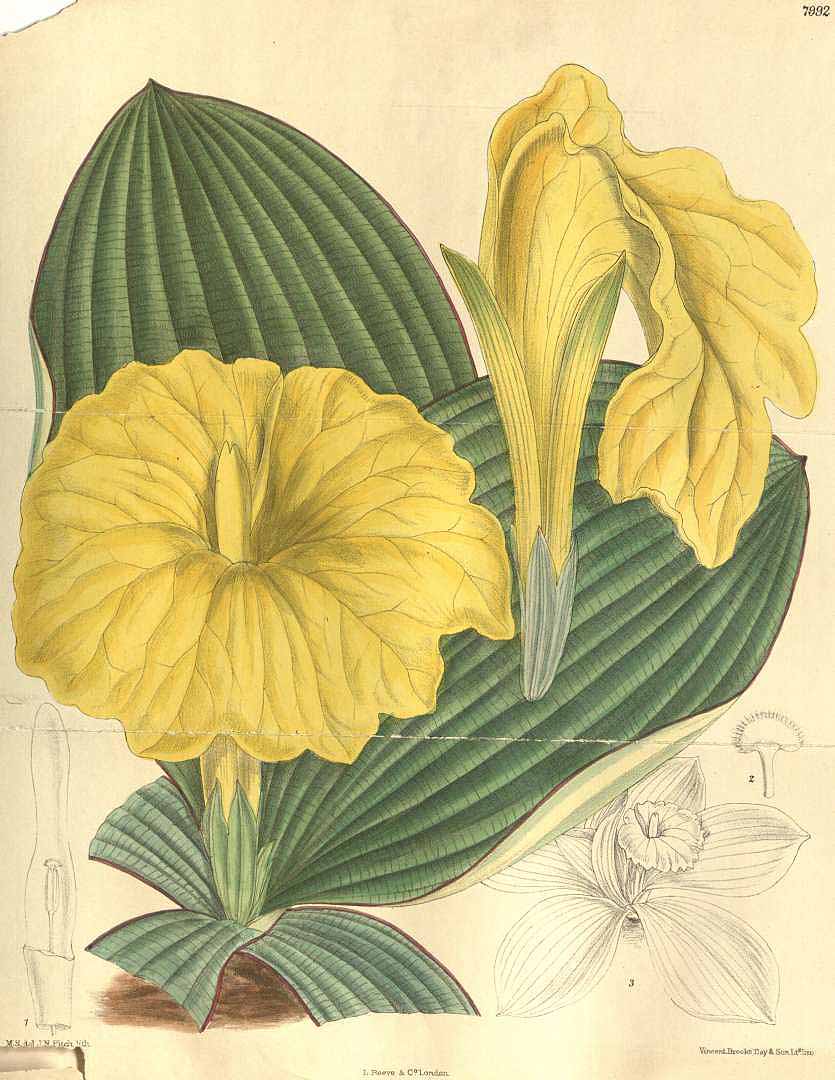 Costus spectabilis
A bright yellow ground-hugging flower from tropical Africa
🇳🇬 Nigeria and 7 more · Wildflower
Costus spectabilis
A bright yellow ground-hugging flower from tropical Africa
🇳🇬 Nigeria and 7 more · Wildflower
 Felicia
A daisy-like African genus with purple, blue or white ray flowers
🇿🇦 South Africa and 7 more · Flowering shrub
Felicia
A daisy-like African genus with purple, blue or white ray flowers
🇿🇦 South Africa and 7 more · Flowering shrub
 Gardenia
A fragrant white-flowered shrub from tropical regions worldwide
🇨🇳 China and 6 more · Flowering shrub
Gardenia
A fragrant white-flowered shrub from tropical regions worldwide
🇨🇳 China and 6 more · Flowering shrub
Photo credits on this page
The small pictures above come from Wikimedia Commons under free licences. Some are cropped to fit.
- Bleeding glory-bower: Kurt Stüber [1], CC BY-SA 3.0, source
- Gardenia: Queerbubbles, CC BY-SA 3.0, source
- Felicia: Stickpen, Public domain, source
- Cape primrose: Nzfauna, CC BY-SA 3.0, source
- African tulip tree: B.navez, CC BY-SA 3.0, source
- Hypericum revolutum: Alastair Rae, CC BY-SA 2.0, source
- Costus spectabilis: Matilda Smith (1854–1926), Public domain, source
- Cameroon: Ndijose, CC BY-SA 4.0, source