
Mughal painting
A detailed miniature art style from Mughal India
Mughal painting is a form of miniature art that developed in the Indian subcontinent under Mughal rule from the 16th to 19th centuries. It blends Persian, Indian, Islamic, Chinese and European influences, focusing on realistic portraits, court scenes, wildlife, and illustrated books.
- Blends Persian, Indian, Chinese and European artistic traditions
- Focused on realistic portraits and detailed animal and plant studies
- Used in illustrated memoirs like the Baburnama and Padshahnama
- Spread from Mughal courts to Hindu and Sikh princely states
- Largely secular despite originating in a Muslim empire
What is Mughal painting?
Mughal painting is a refined style of miniature art, usually created on paper for inclusion in books or collected in albums called muraqqa. The works are small but richly detailed, showing people, animals, plants, court life, battles, and literary scenes. They often feature a high viewpoint and decorative borders inherited from Persian traditions.
Where does Mughal painting come from?
This style began during the Mughal Empire in India, drawing heavily from Persian miniature painting, which itself had absorbed Chinese and later European elements. Though the first emperor Babur did not commission paintings, his grandson Akbar established a royal workshop that shaped the style into a distinct tradition blending multiple cultural influences.
How Mughal painting is made
Artists worked in imperial ateliers, often collaborating: senior painters sketched outlines while juniors filled in colors. Subjects ranged from single animal studies to complex narrative scenes. Albums and illustrated manuscripts were bound between decorated covers, with some projects involving hundreds of miniatures produced over years.
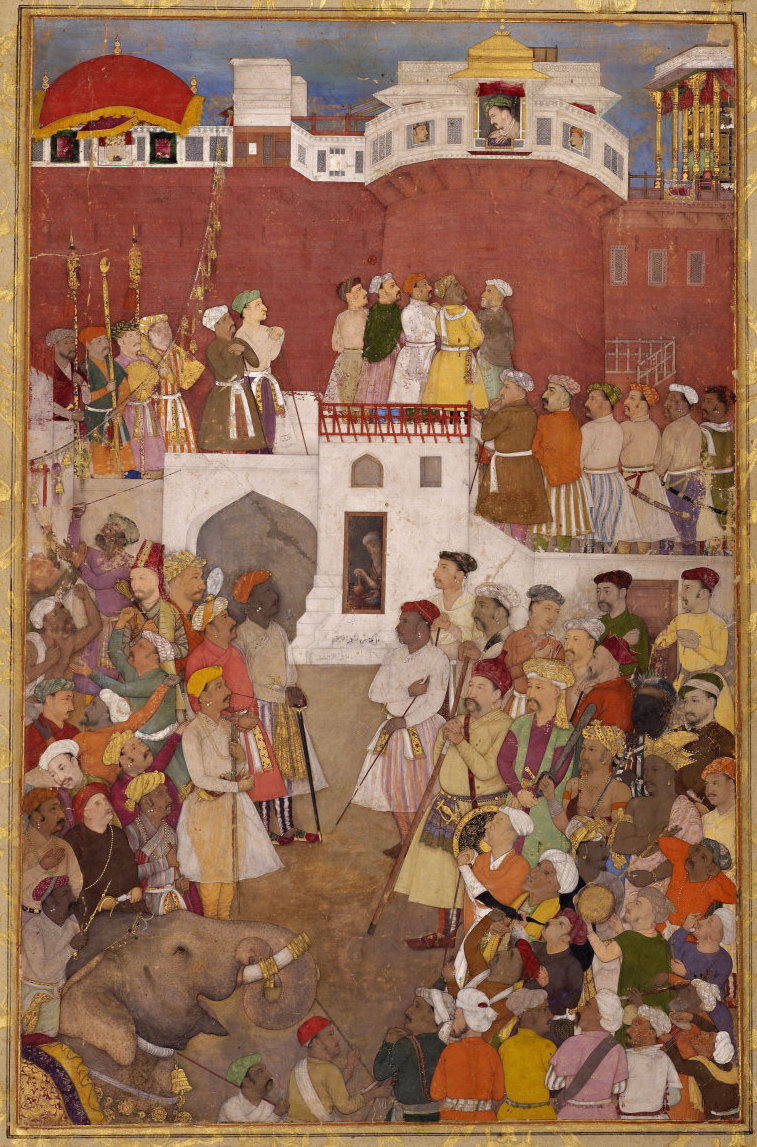


When and where Mughal painting is used
These paintings served both artistic and practical roles. Emperors like Akbar used portrait albums to recall courtiers during appointments. Illustrated memoirs, religious texts, and epics were made for royal libraries. The style later spread to Hindu and Sikh courts across northern India, influencing regional schools.
Forms of Mughal painting
After the peak under Akbar, Jahangir, and Shah Jahan, the style evolved in provincial courts into bolder but less refined forms, often called post-Mughal or sub-Mughal. These regional versions adapted Mughal techniques to local tastes, sometimes depicting Hindu themes with Mughal realism.
What Mughal painting means
Though rooted in a Muslim dynasty, Mughal painting was largely secular, portraying diverse subjects including Hindu epics translated into Persian. It marked a shift toward naturalism in Indian art, especially in portraiture and botanical studies. The daily Jharokha Darshan ceremony was also depicted, reflecting the emperor’s symbolic role.
Questions people ask about Mughal painting
Where did Mughal painting originate?
It developed in the Indian subcontinent during the Mughal Empire, beginning in the 16th century, drawing from Persian miniature traditions and incorporating Indian, Islamic, Chinese and European influences.
What subjects did Mughal painters depict?
They painted realistic portraits, court ceremonies, hunting scenes, battles, wildlife, plants, and illustrations for Persian and Indian literary works, including royal memoirs and Hindu epics.
Was Mughal painting religious?
Mostly not, it was largely secular, though it occasionally included religious figures. It focused on court life, nature, and literature rather than devotional themes.
How were these paintings made?
Artists worked in royal workshops, often collaborating: masters drew outlines and apprentices added color. Works were done on paper and collected in albums or bound into illustrated books.
Did it influence other art styles?
Yes, it spread to Hindu and Sikh courts across northern India, leading to regional styles known as post-Mughal or provincial Mughal painting, which adapted its realism to local subjects.
Good reading and sources
- Encyclopaedia BritannicaArticle
- BBC - ReligionsBBC, Article
- In a resplendent portrait of a Mughal emperor, subtle clues about a dark fallScroll.in, Article
- Mughal painting on WikipediaEncyclopedia
- More photos on Wikimedia CommonsPhotos
- Wikidata recordOpen data
The facts on this page come from the Wikipedia article "Mughal painting", written by its contributors and used under the CC BY-SA 4.0 licence, and from its Wikidata record (CC0). Phool rewrote the text in its own words, with AI assistance, and compares every page with the article to make sure no passage is copied. It may be reused under the same CC BY-SA 4.0 licence with a link back.
It may contain mistakes. If something is wrong, tell us. Last refreshed 2026-10-03.
More of the same kind
 Decoration
Nageirebana抛入花
A free-form ikebana style using tall vases and no flower holders
Arrangement
Decoration
Nageirebana抛入花
A free-form ikebana style using tall vases and no flower holders
Arrangement
 Decoration
Bonsai盆栽
The Japanese art of shaping miniature trees in shallow pots
🇯🇵 Japan and 7 more · Art or design
Decoration
Bonsai盆栽
The Japanese art of shaping miniature trees in shallow pots
🇯🇵 Japan and 7 more · Art or design
 Decoration
Tokonoma床の間
A Japanese alcove for displaying scrolls and flower arrangements
🇯🇵 Japan · Arrangement
Decoration
Tokonoma床の間
A Japanese alcove for displaying scrolls and flower arrangements
🇯🇵 Japan · Arrangement
 Decoration
Sōgetsu草月流
A modern school of Japanese ikebana open to all materials and styles
🇯🇵 Japan · Arrangement
Decoration
Sōgetsu草月流
A modern school of Japanese ikebana open to all materials and styles
🇯🇵 Japan · Arrangement
More from India
All the flowers of India Decoration
Varamalaवरमाला
A flower garland exchanged by bride and groom in Hindu weddings
🇮🇳 India · Garland or wreath
Decoration
Varamalaवरमाला
A flower garland exchanged by bride and groom in Hindu weddings
🇮🇳 India · Garland or wreath
 Decoration
Rangoliरंगोली
Indian floor art made with coloured powders, rice, or petals for festivals and daily welcome
🇮🇳 India and 1 more · Carpet or floor pattern
Decoration
Rangoliरंगोली
Indian floor art made with coloured powders, rice, or petals for festivals and daily welcome
🇮🇳 India and 1 more · Carpet or floor pattern
 Decoration
Onam
Kerala’s ten-day harvest festival with flower carpets, feasts and boat races
🇮🇳 India and 1 more · Custom, Aug to Sep
Decoration
Onam
Kerala’s ten-day harvest festival with flower carpets, feasts and boat races
🇮🇳 India and 1 more · Custom, Aug to Sep
 Decoration
Pohela Boishakhপহেলা বৈশাখ
Bengali New Year marked by processions, fairs, and flower-adorned gatherings
🇧🇩 Bangladesh and 1 more · Custom, April
Decoration
Pohela Boishakhপহেলা বৈশাখ
Bengali New Year marked by processions, fairs, and flower-adorned gatherings
🇧🇩 Bangladesh and 1 more · Custom, April