
Paisley
In its own language: بته
A curved teardrop motif from Iran and India, now used worldwide on textiles
Paisley is a decorative pattern shaped like a curved teardrop, first seen in Iran and later in India. It became famous in Europe through Kashmir shawls and is now found on clothing, accessories, and home textiles in many countries.
- Paisley began as the boteh motif in Iran and spread to India and beyond.
- The Scottish town of Paisley gave the pattern its English name.
- Kashmir shawls with paisley designs were prized luxury items in Europe.
- Paisley patterns are still common on clothing and home textiles worldwide.
What is Paisley?
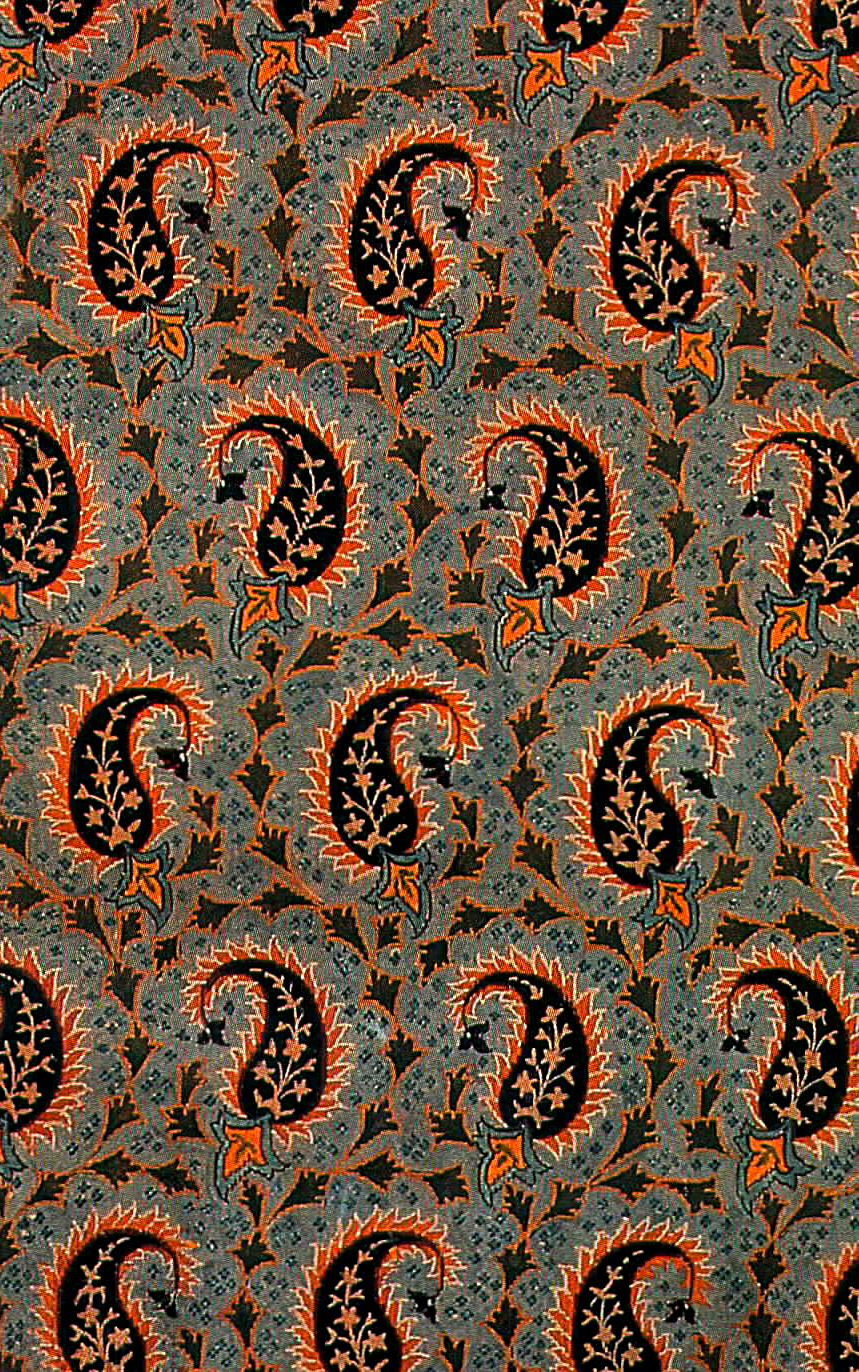
Paisley is a pattern made up of a droplet or teardrop shape with a curved tip, often filled with detailed floral or leaf-like designs. It appears on fabrics such as shawls, scarves, ties, dresses, and even home furnishings like curtains and wallpaper. The motif can be simple or highly intricate, and is usually repeated in rows or clusters across the textile. Its look varies by region and era, but the basic curved shape remains the same.
Where does Paisley come from?
The paisley motif began in Iran, where it was called boteh and woven into silk and wool for royal clothing. It spread to Kashmir in India by the 1400s, where it decorated fine shawls worn by nobility and rulers. The design reached Europe in the 1700s through imports of these Kashmir shawls. The Scottish town of Paisley became known for producing its own versions, giving the pattern its English name. Over time, the motif was adapted in many cultures and languages, each giving it a local name and meaning.
How Paisley is made
Traditionally, paisley was woven into silk or wool using handlooms, with gold and silver threads sometimes added for luxury. In Kashmir, skilled artisans wove the motif into shawls. In 19th-century Scotland, the design was first woven, then printed onto cotton and wool using new textile machines. Today, paisley is printed or woven onto a wide range of materials, from clothing to home décor, using both traditional and modern techniques.


When and where Paisley is used
Paisley has been used for centuries on clothing, especially shawls, scarves, and ties. In South and Central Asia, it often appears in formal and festive garments. In Europe and America, it became a fashion statement in the 1800s and saw a revival in the 1960s. The motif is also found on bandanas, jewelry, and even furniture. It is sometimes chosen for gifts or as a symbol of cultural heritage.
Forms of Paisley
The paisley motif is known by different names in various languages, often linked to the mango or a flower bud. Its look changes from region to region: Indian and Iranian versions tend to be more floral and detailed, while European styles may be simpler or more geometric. Modern paisley comes in many colors and sizes, and is used in both traditional and contemporary designs.
What Paisley means
Paisley has symbolized status and taste, especially in Iran and India where it was worn by nobility. In the West, it became associated with fashion, music, and counterculture, especially in the 1960s. The motif has also been used in sports emblems and architecture. Its shape is linked to natural forms like the mango, palm, or cypress, and it carries different meanings in each culture.
The flowers of Paisley

Questions people ask about Paisley
Where did the paisley pattern originate?
Paisley started in Iran, where it was called boteh, and later became popular in India, especially in Kashmir. It spread to Europe in the 18th century through the trade of Kashmir shawls.
What does the paisley motif look like?
The paisley motif is shaped like a curved teardrop or droplet, often filled with floral or leaf designs. It is usually repeated across textiles in rows or clusters.
What is paisley used for today?
Paisley is found on many items, including clothing like scarves, ties, and dresses, as well as home furnishings such as curtains, pillows, and wallpaper.
What does paisley symbolize?
Paisley has represented status and luxury in Iran and India, and became a symbol of fashion and counterculture in the West, especially in the 1960s.
Why is it called paisley?
The pattern is named after Paisley, a town in Scotland known for producing shawls and textiles with this motif in the 1800s.
Good reading and sources
- Encyclopaedia BritannicaArticle
- The mango houseMint, Article
- Paisley: The story of a classic bohemian printBBC, Article
- The Global History of the BandanaSmithsonian Magazine, Article
- A brief history of paisleyThe Guardian, Article
- Paisley (design) on WikipediaEncyclopedia
- More photos on Wikimedia CommonsPhotos
- Wikidata recordOpen data
The facts on this page come from the Wikipedia article "Paisley (design)", written by its contributors and used under the CC BY-SA 4.0 licence, and from its Wikidata record (CC0). Phool rewrote the text in its own words, with AI assistance, and compares every page with the article to make sure no passage is copied. It may be reused under the same CC BY-SA 4.0 licence with a link back.
It may contain mistakes. If something is wrong, tell us. Last refreshed 2026-10-03.
More of the same kind
 Decoration
Nageirebana抛入花
A free-form ikebana style using tall vases and no flower holders
Arrangement
Decoration
Nageirebana抛入花
A free-form ikebana style using tall vases and no flower holders
Arrangement
 Decoration
Bonsai盆栽
The Japanese art of shaping miniature trees in shallow pots
🇯🇵 Japan and 7 more · Art or design
Decoration
Bonsai盆栽
The Japanese art of shaping miniature trees in shallow pots
🇯🇵 Japan and 7 more · Art or design
 Decoration
Tokonoma床の間
A Japanese alcove for displaying scrolls and flower arrangements
🇯🇵 Japan · Arrangement
Decoration
Tokonoma床の間
A Japanese alcove for displaying scrolls and flower arrangements
🇯🇵 Japan · Arrangement
 Decoration
Sōgetsu草月流
A modern school of Japanese ikebana open to all materials and styles
🇯🇵 Japan · Arrangement
Decoration
Sōgetsu草月流
A modern school of Japanese ikebana open to all materials and styles
🇯🇵 Japan · Arrangement
More from Iran
All the flowers of Iran Decoration
Suzani textileسوزن
Embroidered dowry textiles from Central Asia, rich in floral and tribal designs
🇹🇯 Tajikistan and 3 more · Flower craft
Decoration
Suzani textileسوزن
Embroidered dowry textiles from Central Asia, rich in floral and tribal designs
🇹🇯 Tajikistan and 3 more · Flower craft
 Decoration
rose oil
Essential oil distilled from rose petals, prized in perfume and tradition
🇧🇬 Bulgaria and 4 more · Flower craft
Decoration
rose oil
Essential oil distilled from rose petals, prized in perfume and tradition
🇧🇬 Bulgaria and 4 more · Flower craft
 Decoration
Butaبوته
A curved floral motif found in Persian, Indian, and Central Asian art and textiles
🇮🇷 Iran and 5 more · Art or design
Decoration
Butaبوته
A curved floral motif found in Persian, Indian, and Central Asian art and textiles
🇮🇷 Iran and 5 more · Art or design
 Decoration
Bird-and-flower painting花鳥畫
A genre of East Asian painting showing birds, flowers, and nature’s creatures
🇨🇳 China and 2 more · Art or design
Decoration
Bird-and-flower painting花鳥畫
A genre of East Asian painting showing birds, flowers, and nature’s creatures
🇨🇳 China and 2 more · Art or design