
Achiote
Bixa orellana, family Bixaceae
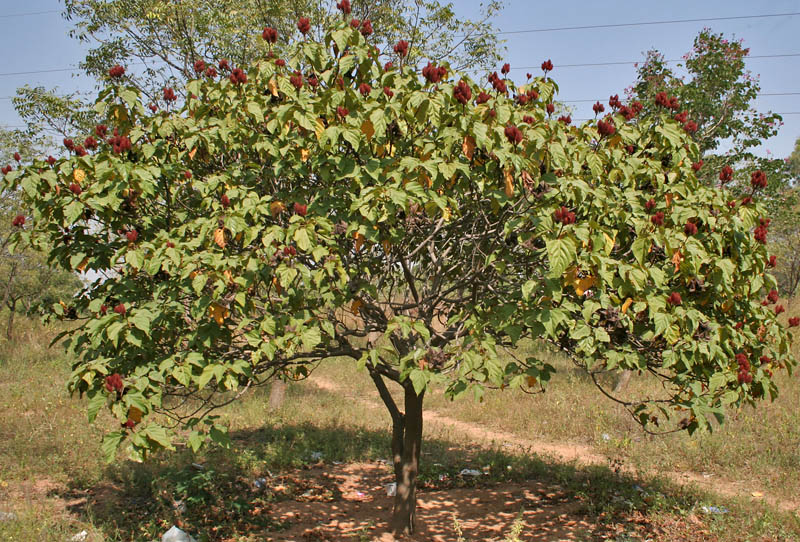
Shrub with spiky red pods, source of the natural dye annatto
Achiote (Bixa orellana) is a shrub or small tree native to tropical America, grown for its spiky red seed pods that yield annatto, a natural orange-red dye. Its seeds are used to color and flavor foods, in cosmetics, and for traditional body paint by indigenous peoples.
- Achiote seeds yield annatto, a widely used natural food dye.
- Indigenous peoples used its red pigment for body paint and lipstick.
- The plant grows as a shrub or small tree with spiky red seed pods.
- Annatto colors foods like cheese, butter, and traditional dishes.
- Achiote is native to tropical America but grown worldwide.
What does Achiote look like?
Achiote is a tall shrub or small evergreen tree, reaching 6 to 10 meters high. It has clusters of bright white or pink flowers at the tips of its branches, each about 5 cm across and similar to wild roses. Its most striking feature is the spiky, red-brown seed pods, which grow in clusters and are covered in soft spines. When mature, these pods split open to reveal 30–45 cone-shaped seeds, each coated in a thin, waxy, blood-red layer called an aril. This aril is the source of the plant’s famous orange-red dye.
Where does Achiote come from?
Achiote is native to tropical regions of Mexico, Central America, and northern South America, with wild and cultivated populations from Mexico to Brazil and Bolivia. Its exact origin is uncertain, but it has long been found in these regions. The name 'Bixa' comes from the Taíno language, and 'orellana' honors Amazon explorer Francisco de Orellana. The plant spread widely after the 16th century, reaching Asia, Africa, and the Caribbean through trade, and is now grown in many tropical areas for its dye.
When and how Achiote blooms
Achiote thrives in frost-free, tropical or subtropical climates with year-round moisture and good drainage. It grows best in full sun or partial shade and can be started from seeds or cuttings. Commercially, the main producers are in Latin America, especially Peru, Brazil, and Mexico, but it is also grown in Africa and Asia. The dye, called annatto, is extracted from the waxy coating of the seeds using water, oil, or solvents.



How Achiote is used
The seeds of achiote are ground or heated in oil to make annatto, which is used to color and flavor foods such as cheese, butter, meats, and traditional dishes in Latin America and the Caribbean. Indigenous peoples have long used the red pigment for body and face paint, as well as for lipstick. The plant is also valued in traditional medicine and for its fibers and gum. Annatto is important in industry as a natural food and cosmetic dye.
Kinds of Achiote
Achiote is known by many names in different regions, such as urucu in Brazil and annatto in English. In Brazil, a powder called colorau is made from its seeds. In Mexico and Belize, it is used in recado rojo, a spice paste. The plant’s flowers can be white or pink, and the dye varies from yellow to deep red depending on processing.
What Achiote means
Achiote holds cultural importance as a source of color for food, art, and ritual. Indigenous groups in the Americas used its pigment for ceremonial body paint and as a symbol of protection. The Aztecs used it as ink for manuscripts. Today, it remains a key ingredient in regional cuisines and is valued for being a natural, non-toxic dye, though some people may have allergic reactions.
Questions people ask about Achiote
Where does achiote come from?
Achiote is native to tropical regions of Mexico, Central America, and northern South America, but is now grown in many tropical countries around the world.
What is achiote used for?
Achiote seeds are used to produce annatto, a natural dye for coloring and flavoring foods, and are also used in cosmetics, traditional body paint, and traditional medicine.
What does the achiote plant look like?
Achiote is a shrub or small tree with clusters of white or pink flowers and spiky red-brown seed pods that split open to reveal red-coated seeds.
Why is it called the lipstick tree?
It is called the lipstick tree because indigenous peoples used the red pigment from its seeds as body paint and lipstick.
Is annatto safe to eat?
Annatto is widely used as a food coloring and is generally considered non-toxic, but it may cause allergic reactions in sensitive individuals.
Good reading and sources
- Encyclopaedia BritannicaArticle
- IUCN Red List of Threatened SpeciesIUCN Red List, Article
- USDA Plants DatabaseUS Department of Agriculture, Article
- Plants of the World OnlineRoyal Botanic Gardens, Kew, Plant database
- Where it has been recordedGBIF, Plant database
- Sightings and photos by naturalistsiNaturalist, Plant database
- Bixa orellana on WikipediaEncyclopedia
- More photos on Wikimedia CommonsPhotos
- Wikidata recordOpen data
The facts on this page come from the Wikipedia article "Bixa orellana", written by its contributors and used under the CC BY-SA 4.0 licence, and from its Wikidata record (CC0). Phool rewrote the text in its own words, with AI assistance, and compares every page with the article to make sure no passage is copied. It may be reused under the same CC BY-SA 4.0 licence with a link back.
It may contain mistakes. It is not medical or foraging advice: many flowers are poisonous, and traditional uses are reported, not recommended. If something is wrong, tell us. Last refreshed 2026-10-03.

More from Brazil
All the flowers of Brazil CactusCactaceae
Succulent plants with spines, native to the Americas
🇲🇽 Mexico and 7 more · Wildflower
CactusCactaceae
Succulent plants with spines, native to the Americas
🇲🇽 Mexico and 7 more · Wildflower
 Eucalyptus
The tall, aromatic trees and shrubs known as gum trees or eucalypts
🇦🇺 Australia and 7 more · Flowering tree
Eucalyptus
The tall, aromatic trees and shrubs known as gum trees or eucalypts
🇦🇺 Australia and 7 more · Flowering tree
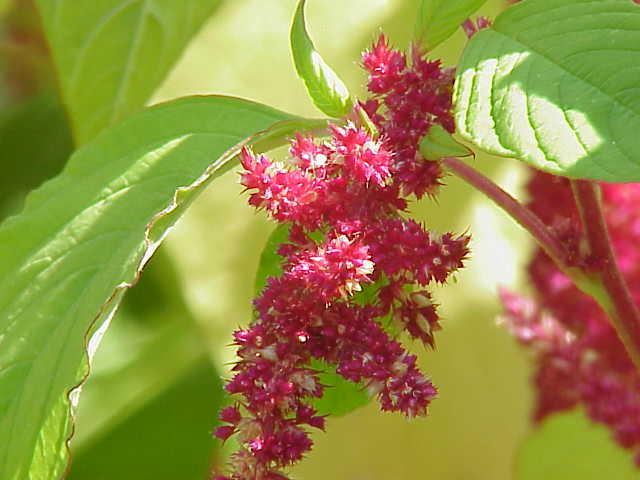 AmaranthAmaranthus
A tall, colourful plant grown for its flowers, leaves and edible seeds
🇲🇽 Mexico and 7 more · Wildflower
AmaranthAmaranthus
A tall, colourful plant grown for its flowers, leaves and edible seeds
🇲🇽 Mexico and 7 more · Wildflower
 Sensitive PlantMimosa pudica
A touch-sensitive plant whose leaves fold up when disturbed
🇧🇷 Brazil and 8 more · Wildflower
Sensitive PlantMimosa pudica
A touch-sensitive plant whose leaves fold up when disturbed
🇧🇷 Brazil and 8 more · Wildflower