Pride of Barbados
Caesalpinia pulcherrima, family Fabaceae
A showy shrub with red, orange, and yellow flowers grown in warm gardens worldwide
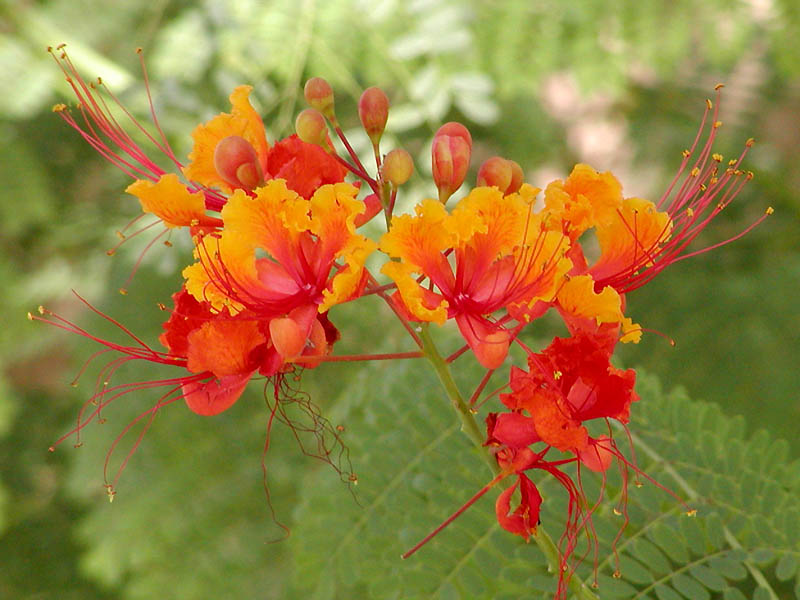
Pride of Barbados is a flowering shrub from the pea family, grown for its bright clusters of red, orange, and yellow blooms. It is native to parts of the Americas, but is now found in gardens and public spaces across many warm regions and is the national flower of Barbados.
- National flower of Barbados
- Flowers in red, orange, and yellow clusters
- All seeds are poisonous unless treated
- Grown widely in warm gardens
- Attracts hummingbirds
What does Pride of Barbados look like?
Pride of Barbados is a shrub that can reach about 3 meters tall, though in frost-free places it may grow taller and stay green all year. Its leaves are finely divided and feathery, with many small leaflets. The plant produces upright clusters of five-petaled flowers in vivid shades of red, orange, and yellow. The blooms grow in long racemes, and the plant forms flat seed pods after flowering.
Where does Pride of Barbados come from?
The exact wild origin of this shrub is uncertain, but it comes from tropical and subtropical parts of the Americas. It has been widely planted in gardens and public spaces throughout warm regions, making its original range hard to pinpoint. Over time, it has become a familiar sight in places as far apart as Brazil, Myanmar, Gabon, and Barbados, where it is now a symbol of the island.
When and how Pride of Barbados blooms
This plant thrives in warm climates with little or no frost. In areas with mild winters, it can stay evergreen and grow quite tall, while in colder spots it may die back and regrow in spring. It is often grown from seed and can be pruned to shape or used as a hedge. The flowers appear in large, colorful clusters that attract hummingbirds.


How Pride of Barbados is used
Pride of Barbados is valued for its ornamental flowers and is commonly planted in gardens and parks. In Barbados, it is a national emblem and appears on the country's symbols. The plant has also been used in traditional medicine, though all its seeds are poisonous unless specially prepared. In the past, it was used by various peoples for medicinal purposes.
Kinds of Pride of Barbados
Caesalpinia pulcherrima is the most commonly grown species in its genus, and is sometimes called by other names depending on the region. Its flowers can range from yellow to deep red, and gardeners may select forms with particular color mixes. The plant is also known for its ability to be shaped by pruning.
What Pride of Barbados means
This shrub holds special meaning in Barbados, where it is the national flower and features on official flags. Its bright flowers have made it a favorite in gardens across the tropics and subtropics. The plant has a history of use in traditional medicine, and its striking appearance has earned it awards from horticultural societies.
Questions people ask about Pride of Barbados
Where does Pride of Barbados come from?
Its wild origins are in the tropical and subtropical regions of the Americas, but it is now grown widely in warm climates around the world, and its exact native range is uncertain due to long cultivation.
What does the plant look like?
It is a shrub with finely divided, feathery leaves and upright clusters of bright red, orange, or yellow flowers. The plant can reach up to 3 meters tall, or even taller in frost-free areas.
Is Pride of Barbados poisonous?
Yes, all seeds of this plant are poisonous unless specially prepared. Some parts of the plant have been used in traditional medicine, but care is needed due to its toxicity.
What is Pride of Barbados used for?
It is mainly grown as an ornamental shrub in gardens and public spaces. In Barbados, it is the national flower and features on official symbols. It has also been used in traditional medicine.
What does Pride of Barbados symbolize?
In Barbados, it is a national emblem and appears on the country's flag. Its bright flowers are a symbol of the island.
Good reading and sources
- Caesalpinia pulcherrimaRoyal Horticultural Society, Article
- Plants of the World OnlineRoyal Botanic Gardens, Kew, Plant database
- Where it has been recordedGBIF, Plant database
- Sightings and photos by naturalistsiNaturalist, Plant database
- Caesalpinia pulcherrima on WikipediaEncyclopedia
- More photos on Wikimedia CommonsPhotos
- Wikidata recordOpen data
The facts on this page come from the Wikipedia article "Caesalpinia pulcherrima", written by its contributors and used under the CC BY-SA 4.0 licence, and from its Wikidata record (CC0). Phool rewrote the text in its own words, with AI assistance, and compares every page with the article to make sure no passage is copied. It may be reused under the same CC BY-SA 4.0 licence with a link back.
It may contain mistakes. It is not medical or foraging advice: many flowers are poisonous, and traditional uses are reported, not recommended. If something is wrong, tell us. Last refreshed 2026-10-03.
Others in the family Fabaceae
The whole family Acacia
Shrubs and trees with golden or cream puffball flowers, native mostly to Australia
🇦🇺 Australia and 6 more · Wildflower
Acacia
Shrubs and trees with golden or cream puffball flowers, native mostly to Australia
🇦🇺 Australia and 6 more · Wildflower
 Black locustRobinia pseudoacacia
A tall, fragrant-flowered tree native to eastern North America
🇺🇸 United States and 7 more · Flowering tree
Black locustRobinia pseudoacacia
A tall, fragrant-flowered tree native to eastern North America
🇺🇸 United States and 7 more · Flowering tree
 LupinLupinus
Tall, spiky-flowered legumes grown for gardens, food, and soil health
🇺🇸 United States and 7 more · Wildflower
LupinLupinus
Tall, spiky-flowered legumes grown for gardens, food, and soil health
🇺🇸 United States and 7 more · Wildflower
 White cloverTrifolium repens
A low-growing, mat-forming clover with white flower heads
🇨🇳 China and 7 more · Wildflower
White cloverTrifolium repens
A low-growing, mat-forming clover with white flower heads
🇨🇳 China and 7 more · Wildflower
More from Brazil
All the flowers of Brazil CactusCactaceae
Succulent plants with spines, native to the Americas
🇲🇽 Mexico and 7 more · Wildflower
CactusCactaceae
Succulent plants with spines, native to the Americas
🇲🇽 Mexico and 7 more · Wildflower
 Eucalyptus
The tall, aromatic trees and shrubs known as gum trees or eucalypts
🇦🇺 Australia and 7 more · Flowering tree
Eucalyptus
The tall, aromatic trees and shrubs known as gum trees or eucalypts
🇦🇺 Australia and 7 more · Flowering tree
 AmaranthAmaranthus
A tall, colourful plant grown for its flowers, leaves and edible seeds
🇲🇽 Mexico and 7 more · Wildflower
AmaranthAmaranthus
A tall, colourful plant grown for its flowers, leaves and edible seeds
🇲🇽 Mexico and 7 more · Wildflower
 Sensitive PlantMimosa pudica
A touch-sensitive plant whose leaves fold up when disturbed
🇧🇷 Brazil and 8 more · Wildflower
Sensitive PlantMimosa pudica
A touch-sensitive plant whose leaves fold up when disturbed
🇧🇷 Brazil and 8 more · Wildflower