
Ceropegia
A group of trailing or climbing plants with unusual, cage-like flowers
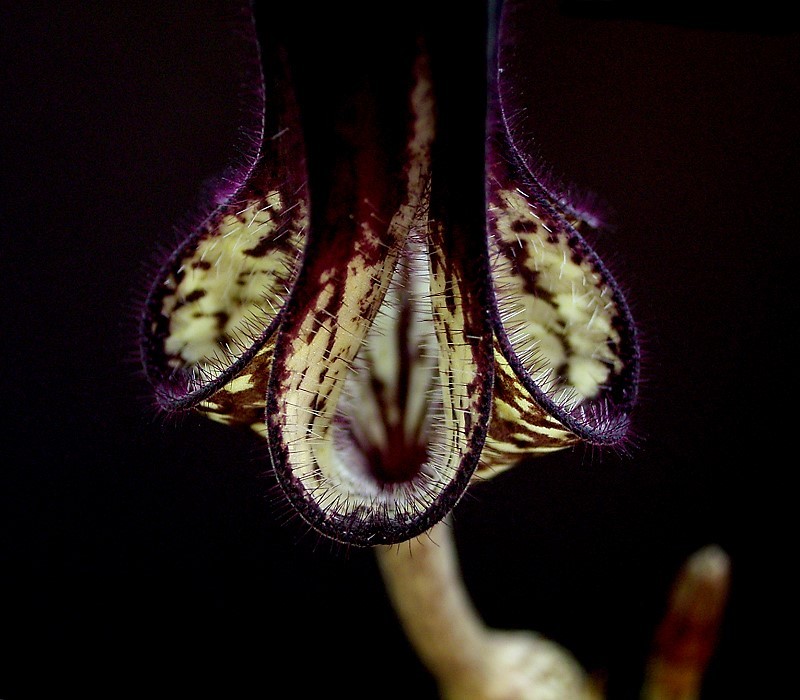
Ceropegia is a genus of vining or trailing plants in the dogbane family, found from Africa to Australia. Its flowers are shaped like lanterns or umbrellas, often forming a cage that traps pollinating flies. Some species are grown as ornamentals, and others are used for food in Africa and India.
- Ceropegia flowers often form cage-like structures to trap pollinating flies
- Some species are grown as trailing houseplants, like the 'string of hearts'
- Tubers of certain species are eaten in India and Africa
- Over 450 species are known, with new ones still being described
What does Ceropegia look like?
Ceropegia plants usually have long, slender stems that either trail along the ground or climb. Some species, like Ceropegia woodii, develop swollen nodes and underground tubers. Leaves are simple, arranged in pairs, and can be thick and fleshy in succulent types. The flowers are striking, with a long tube and five tips that often join to create a canopy, cage, or antenna-like structures. These unusual blooms are designed to attract and temporarily trap flies for pollination.
Where does Ceropegia come from?
The genus Ceropegia is native to a broad area stretching from sub-Saharan Africa and Madagascar through southern Asia to Australia and the Pacific. Carl Linnaeus first described the group in 1737, naming it after a plant illustrated in the Hortus Malabaricus. The name comes from Greek, meaning candelabrum or lamp-stand, inspired by the flower's shape. Later botanists suggested the name might also refer to the waxy look of some species' flower clusters.
When and how Ceropegia blooms
Ceropegia species flower at different times depending on the region and species. Most are adapted to warm climates and can grow in well-drained soils. Many are propagated for ornamental use, especially those with attractive trailing stems or patterned leaves. Some species form tubers underground, which help them survive dry periods.


How Ceropegia is used
People grow Ceropegia for their unusual flowers and trailing stems, making them popular as houseplants and in gardens. In parts of Africa, the roots and leaves of certain species are eaten raw, while in India, the tubers are sometimes cooked in curries. The flowers are not commonly used in ceremonies or as cut flowers.
Kinds of Ceropegia
There are over 450 recognized species of Ceropegia, with new ones still being described. Some, like Ceropegia woodii ('string of hearts'), are well-known as decorative houseplants. Others differ in growth habit, flower shape, and leaf thickness. The genus is closely related to Brachystelma and Riocreuxia, and botanists continue to study their relationships.
What Ceropegia means
Ceropegia is mainly valued for its ornamental qualities and unusual pollination strategy. The flowers' ability to attract and trap flies is a subject of interest for botanists. In some regions, the edible tubers are part of traditional diets. The genus does not have a strong symbolic or religious role in most cultures.
Questions people ask about Ceropegia
Where does Ceropegia come from?
Ceropegia is native to a wide region including Africa, Madagascar, southern Asia, and Australia. Its species can be found growing wild in these areas.
What does a Ceropegia flower look like?
The flowers are tubular and often have five tips that join to form a canopy or cage. This unusual shape helps them attract and trap flies for pollination.
How is Ceropegia used by people?
Many species are grown as ornamental plants for their trailing stems and unique flowers. In some African and Indian communities, the roots, leaves, or tubers are eaten.
Are there many types of Ceropegia?
Yes, there are more than 450 recognized species, and botanists continue to discover and describe new ones.
Does Ceropegia have any special meaning or symbolism?
Ceropegia is mainly valued for its decorative qualities and interesting pollination, rather than for symbolism or religious use.
Good reading and sources
- USDA Plants DatabaseUS Department of Agriculture, Article
- Plants of the World OnlineRoyal Botanic Gardens, Kew, Plant database
- Where it has been recordedGBIF, Plant database
- Sightings and photos by naturalistsiNaturalist, Plant database
The facts on this page come from the Wikipedia article "Ceropegia", written by its contributors and used under the CC BY-SA 4.0 licence, and from its Wikidata record (CC0). Phool rewrote the text in its own words, with AI assistance, and compares every page with the article to make sure no passage is copied. It may be reused under the same CC BY-SA 4.0 licence with a link back.
It may contain mistakes. It is not medical or foraging advice: many flowers are poisonous, and traditional uses are reported, not recommended. If something is wrong, tell us. Last refreshed 2026-10-03.
Others in the family Apocynaceae
The whole family OleanderNerium oleander
A showy, evergreen shrub with clusters of pink, white or red flowers
🇲🇦 Morocco and 8 more · Flowering shrub
OleanderNerium oleander
A showy, evergreen shrub with clusters of pink, white or red flowers
🇲🇦 Morocco and 8 more · Flowering shrub
 Plumeria
Fragrant tropical tree with waxy, five-petaled flowers in many colours
🇲🇽 Mexico and 6 more · Flowering tree
Plumeria
Fragrant tropical tree with waxy, five-petaled flowers in many colours
🇲🇽 Mexico and 6 more · Flowering tree
 Mandevilla
A tropical vine with large trumpet-shaped blooms in vivid colours
🇧🇷 Brazil and 2 more · Climber
Mandevilla
A tropical vine with large trumpet-shaped blooms in vivid colours
🇧🇷 Brazil and 2 more · Climber
 Pinwheel flowerTabernaemontana divaricata
A fragrant white-flowered shrub native to South and Southeast Asia
🇲🇲 Myanmar and 2 more · Flowering shrub
Pinwheel flowerTabernaemontana divaricata
A fragrant white-flowered shrub native to South and Southeast Asia
🇲🇲 Myanmar and 2 more · Flowering shrub