
Fireweed
Chamaenerion angustifolium, family Onagraceae
A tall pink wildflower that quickly covers burned or disturbed ground
Fireweed is a perennial herb with tall reddish stems and bright pink to magenta flowers. Native to the temperate northern hemisphere, it thrives on disturbed or burned land, forming dense stands. People eat its shoots, make tea from its leaves, and value its honey. It is the floral emblem of Yukon and known as 'bombweed' in Britain.
- Quickly covers burned or disturbed ground with bright pink flowers
- Young shoots, leaves, and flowers are edible and used for tea
- Floral emblem of Yukon, Canada
- Known as 'bombweed' in Britain for growing on WWII bomb sites
- Valued by pollinators and for high-quality honey
What does Fireweed look like?
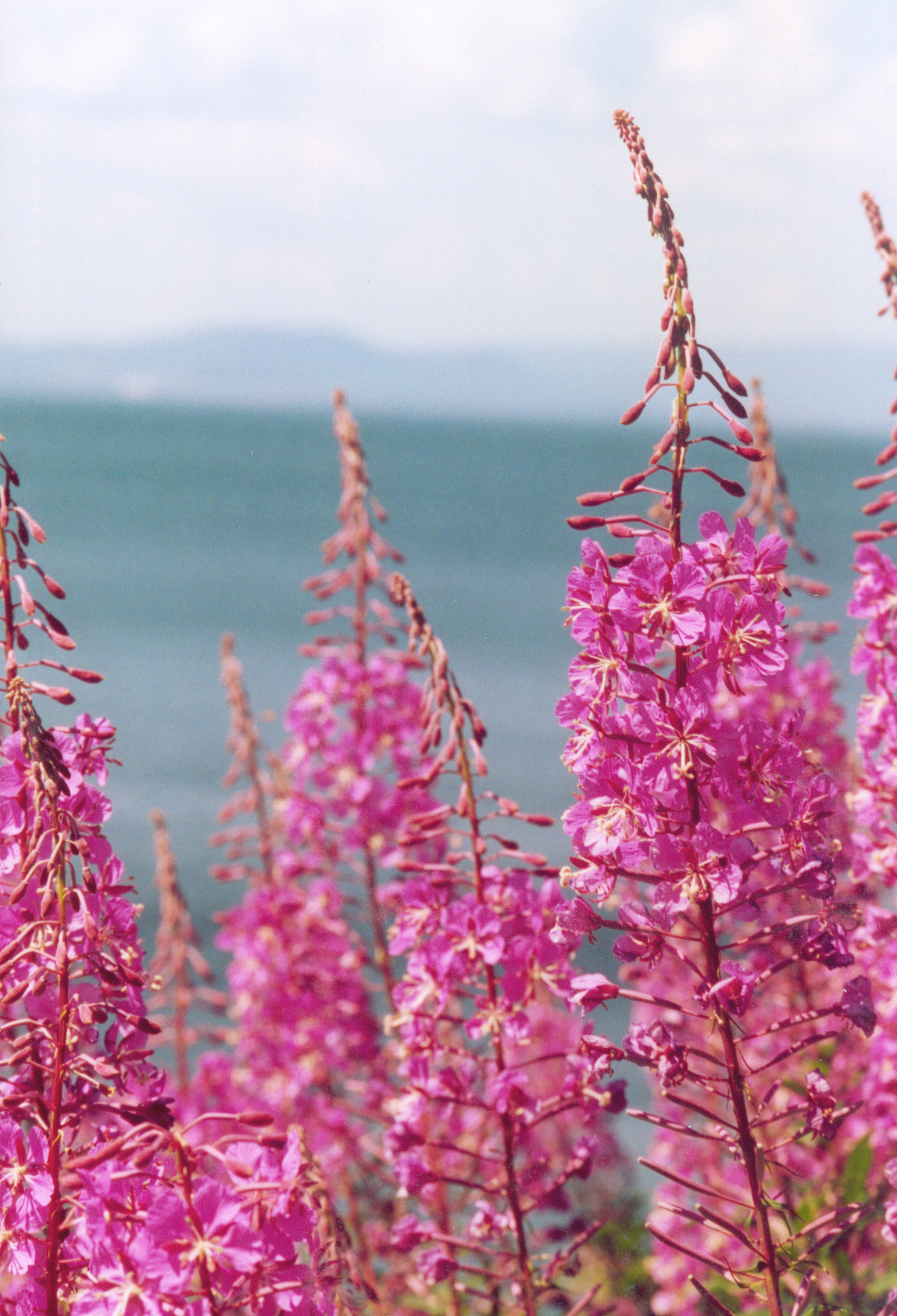
Fireweed is a tall perennial herb, growing from half a metre to over two metres high. Its stems are reddish and smooth, with narrow, lance-shaped leaves arranged in a spiral. The plant produces a long, tapering cluster of flowers at the top, each flower about 2–3 cm wide with four bright pink to magenta petals and four slender sepals. After flowering, it forms long, reddish-brown seed pods that split open to release many tiny seeds with silky hairs, carried far by the wind. White-flowered forms also exist.
Where does Fireweed come from?
Fireweed is native across the temperate northern hemisphere, especially in boreal forests and open areas. It is most common in regions with cool climates and is found from 30° to 68° latitude. The plant is a pioneer, quickly colonizing disturbed ground such as after fires, volcanic eruptions, or human activity. Its name 'fireweed' comes from its habit of being one of the first plants to grow after a fire. In Britain, it became widespread with the expansion of the railways and was called 'bombweed' for its appearance on bomb sites during World War II.
When and how Fireweed blooms
Fireweed blooms in summer, thriving in open, sunny places with moist, slightly acidic to calcareous soils. It spreads both by wind-borne seeds and by underground roots, forming large patches. The plant is easily established on disturbed sites, and seeds germinate well on bare mineral soil. In gardens, it is sometimes grown for its ornamental value, and a white-flowered variety is recognized.


How Fireweed is used
Young shoots and leaves of fireweed are eaten raw or cooked, and the flowers can be made into jelly. The leaves are dried for herbal tea, especially in Russia where it is known as Ivan-Chai. The plant is also used in traditional medicine by various Indigenous peoples, and its honey is highly prized. Fireweed is valued for quickly covering bare land, preventing erosion, and providing habitat and food for wildlife and pollinators. It is the floral emblem of Yukon and has cultural significance in Britain and Finland.
Kinds of Fireweed
There are two recognized subspecies: Chamaenerion angustifolium subsp. angustifolium and subsp. circumvagum. A white-flowered garden form, 'Album', is also known. The plant is called by different names in various regions, such as 'fireweed' in North America and 'rosebay willowherb' in Britain. Its tea, Ivan-Chai, is a notable regional product in Russia.
What Fireweed means
Fireweed is a symbol of recovery and renewal, often appearing after fires or destruction. It is featured in British literature as 'bombweed', marking the regrowth on bombed sites. Yukon in Canada has chosen it as its floral emblem. In Russia, fireweed tea is a traditional drink. The plant appears in poetry, novels, and songs, and was voted the county flower of London. Its rapid colonization of waste ground has made it a familiar sight and cultural reference in many northern countries.
Questions people ask about Fireweed
Where does fireweed come from?
Fireweed is native to the temperate regions of the northern hemisphere, including parts of North America, Europe, and Asia. It is especially common in cool climates and boreal forests.
What does fireweed look like?
Fireweed grows up to two metres tall with reddish stems and narrow, lance-shaped leaves. It has clusters of bright pink to magenta flowers at the top, and produces long seed pods filled with silky-haired seeds.
What is fireweed used for?
People eat the young shoots and leaves, make jelly from the flowers, and dry the leaves for tea. Fireweed is also valued for honey production, used in traditional medicine, and planted to restore disturbed land.
Why is it called fireweed?
The name 'fireweed' comes from its habit of quickly colonizing areas that have been burned by fire, often being one of the first plants to appear after a disturbance.
What does fireweed symbolise?
Fireweed is seen as a symbol of renewal and recovery, especially in places recovering from fire or destruction. It is the floral emblem of Yukon and has cultural significance in Britain and Russia.
Good reading and sources
- Encyclopaedia BritannicaArticle
- Plants of the World OnlineRoyal Botanic Gardens, Kew, Plant database
- Where it has been recordedGBIF, Plant database
- Sightings and photos by naturalistsiNaturalist, Plant database
- Chamaenerion angustifolium on WikipediaEncyclopedia
- More photos on Wikimedia CommonsPhotos
- Wikidata recordOpen data
The facts on this page come from the Wikipedia article "Chamaenerion angustifolium", written by its contributors and used under the CC BY-SA 4.0 licence, and from its Wikidata record (CC0). Phool rewrote the text in its own words, with AI assistance, and compares every page with the article to make sure no passage is copied. It may be reused under the same CC BY-SA 4.0 licence with a link back.
It may contain mistakes. It is not medical or foraging advice: many flowers are poisonous, and traditional uses are reported, not recommended. If something is wrong, tell us. Last refreshed 2026-10-03.
Others in the family Onagraceae
The whole family Clarkia
Wildflowers and garden annuals with four-petalled blooms, mostly from western North America
Clarkia · Wildflower
Clarkia
Wildflowers and garden annuals with four-petalled blooms, mostly from western North America
Clarkia · Wildflower
 Hardy fuchsiaFuchsia magellanica
A South American shrub with drooping red and purple flowers
🇦🇷 Argentina and 5 more · Flowering shrub
Hardy fuchsiaFuchsia magellanica
A South American shrub with drooping red and purple flowers
🇦🇷 Argentina and 5 more · Flowering shrub
 Dwarf fireweedChamerion latifolium
A bright pink wildflower of Arctic and alpine regions, eaten and cherished in Greenland
🇬🇱 Greenland · Wildflower
Dwarf fireweedChamerion latifolium
A bright pink wildflower of Arctic and alpine regions, eaten and cherished in Greenland
🇬🇱 Greenland · Wildflower
More from China
All the flowers of China PeachPrunus persica
A flowering fruit tree from China, grown for its pink blossoms and sweet fruit
🇨🇳 China and 7 more · Flowering tree
PeachPrunus persica
A flowering fruit tree from China, grown for its pink blossoms and sweet fruit
🇨🇳 China and 7 more · Flowering tree
 Common sunflowerHelianthus annuus
A tall annual plant grown for its large yellow flower heads and edible seeds
🇨🇦 Canada and 4 more · Wildflower
Common sunflowerHelianthus annuus
A tall annual plant grown for its large yellow flower heads and edible seeds
🇨🇦 Canada and 4 more · Wildflower
 PomegranatePunica granatum
A shrub with bright red flowers and a fruit full of edible seeds
🇮🇷 Iran and 9 more · Flowering shrub
PomegranatePunica granatum
A shrub with bright red flowers and a fruit full of edible seeds
🇮🇷 Iran and 9 more · Flowering shrub
 BirchBetula
Slender trees with papery bark found across the northern world
🇨🇳 China and 7 more · Wildflower
BirchBetula
Slender trees with papery bark found across the northern world
🇨🇳 China and 7 more · Wildflower