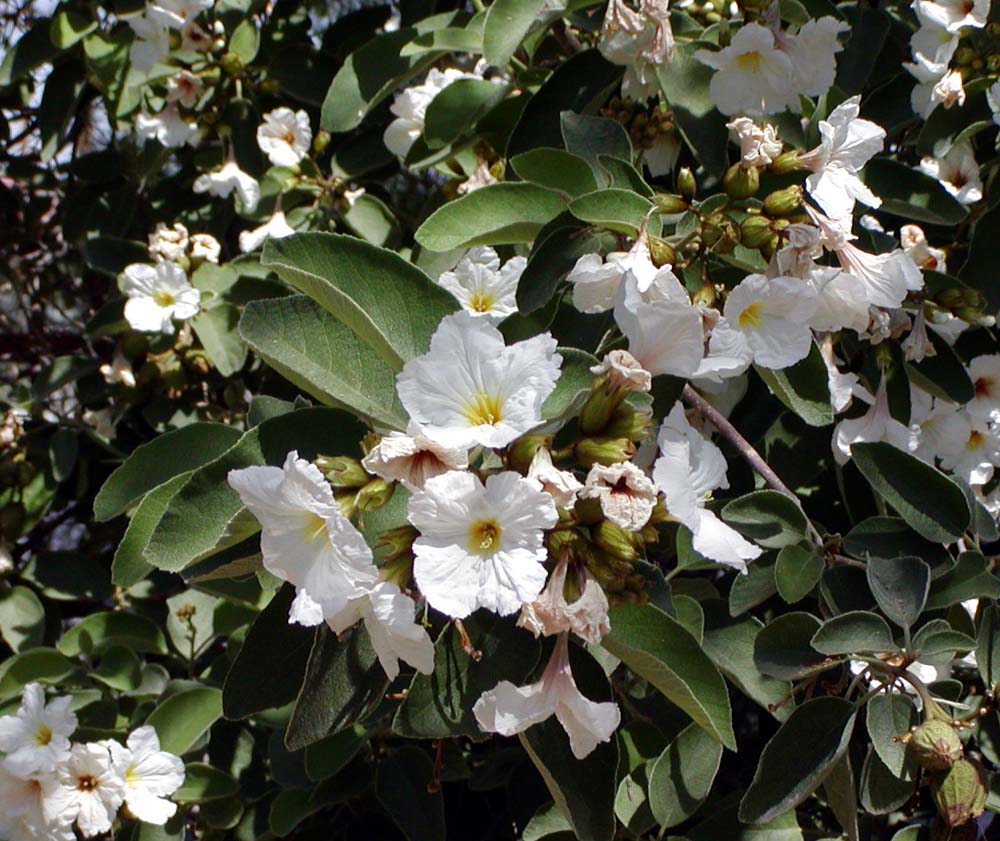
Cordia
A tropical genus of shrubs and trees with edible fruit and fragrant flowers
Cordia is a large group of flowering shrubs and trees found across tropical and subtropical zones. Many species bear scented blooms and fleshy fruits used in food, glue, or woodworking.
- Fruits are eaten in India, Nepal and Taiwan, often pickled
- Sticky pulp from the fruit makes traditional glue
- Wood from some species builds guitars and drums
- Named after 16th-century botanist Valerius Cordus
- Host plant for several moth and beetle species
What does Cordia look like?
Plants in the Cordia genus grow as shrubs or small to medium trees. Their leaves often feel rough due to fine hairs. The flowers are usually clustered and give off a noticeable scent. Fruits are fleshy, sometimes sticky inside, and vary in shape and size across species.
Where does Cordia come from?
The name Cordia comes from Valerius Cordus, a 16th-century German botanist. These plants occur naturally throughout tropical and subtropical areas around the world. Their classification has been difficult because individuals within a single species can look very different, and some early descriptions were based on poor specimens.
When and how Cordia blooms
Cordia species thrive in warm climates and are typically grown from seed. They flower and fruit in their native habitats without special care. Some are cultivated in gardens for their blooms, while others are left wild or managed for their fruit or timber.


How Cordia is used
In India and Nepal, certain Cordia fruits are eaten raw, cooked, or preserved in brine. In Taiwan, they are commonly pickled. The sticky pulp has long served as a natural adhesive. The wood of several species is valued for furniture, doors, and musical instruments like guitar backs and drum shells.
Kinds of Cordia
Over two hundred species belong to this genus. Notable ones include fragrant manjack (C. dichotoma), known for its edible fruit, and ziricote (C. dodecandra), prized for its decorative timber. Regional names differ widely even for the same plant.
What Cordia means
Cordia holds practical importance rather than symbolic meaning. Its fruits appear in regional cuisines, its sap functions as glue, and its resonant wood supports instrument making. It also feeds caterpillars of several moth species and the wild olive tortoise beetle.
Questions people ask about Cordia
Where does Cordia come from?
Cordia species grow naturally across tropical and subtropical regions worldwide, with uses recorded in India, Nepal, Taiwan and Ecuador.
Are Cordia fruits edible?
Yes, many tropical Cordia species produce edible fruits. In India and Nepal they are eaten raw, cooked or pickled; in Taiwan they are commonly pickled.
What is Cordia wood used for?
The timber of several species is used for furniture, doors, and musical instruments such as acoustic guitar backs and drum shells due to its resonance.
Do Cordia plants have scented flowers?
Yes, many Cordia species produce fragrant, showy flowers, which is why some are grown ornamentally in gardens in warm climates.
Is Cordia used in traditional practices?
Its sticky fruit pulp has been traditionally used to make glue, and its leaves are sometimes dried and mixed with cannabis for smoking.
Good reading and sources
- Encyclopaedia BritannicaArticle
- USDA Plants DatabaseUS Department of Agriculture, Article
- Plants of the World OnlineRoyal Botanic Gardens, Kew, Plant database
- Where it has been recordedGBIF, Plant database
- Sightings and photos by naturalistsiNaturalist, Plant database
The facts on this page come from the Wikipedia article "Cordia", written by its contributors and used under the CC BY-SA 4.0 licence, and from its Wikidata record (CC0). Phool rewrote the text in its own words, with AI assistance, and compares every page with the article to make sure no passage is copied. It may be reused under the same CC BY-SA 4.0 licence with a link back.
It may contain mistakes. It is not medical or foraging advice: many flowers are poisonous, and traditional uses are reported, not recommended. If something is wrong, tell us. Last refreshed 2026-10-03.
Others in the family Cordiaceae
The whole family

More from India
All the flowers of India PeachPrunus persica
A flowering fruit tree from China, grown for its pink blossoms and sweet fruit
🇨🇳 China and 7 more · Flowering tree
PeachPrunus persica
A flowering fruit tree from China, grown for its pink blossoms and sweet fruit
🇨🇳 China and 7 more · Flowering tree
 PomegranatePunica granatum
A shrub with bright red flowers and a fruit full of edible seeds
🇮🇷 Iran and 9 more · Flowering shrub
PomegranatePunica granatum
A shrub with bright red flowers and a fruit full of edible seeds
🇮🇷 Iran and 9 more · Flowering shrub
 Eucalyptus
The tall, aromatic trees and shrubs known as gum trees or eucalypts
🇦🇺 Australia and 7 more · Flowering tree
Eucalyptus
The tall, aromatic trees and shrubs known as gum trees or eucalypts
🇦🇺 Australia and 7 more · Flowering tree
 OleanderNerium oleander
A showy, evergreen shrub with clusters of pink, white or red flowers
🇲🇦 Morocco and 8 more · Flowering shrub
OleanderNerium oleander
A showy, evergreen shrub with clusters of pink, white or red flowers
🇲🇦 Morocco and 8 more · Flowering shrub