
Geiger tree
Cordia sebestena, family Cordiaceae
A tropical tree with bright orange-red flowers and rough, dark green leaves
The Geiger tree is a shrubby evergreen native to Cuba and the American tropics, grown for its clusters of vivid orange-red flowers. It is widely planted in tropical gardens and coastal areas, valued for its showy blooms, salt tolerance, and use as a street or shade tree.
- Native to Cuba and the American tropics
- Produces clusters of bright orange-red flowers year-round
- Tolerates salt spray and is often planted near the sea
- Leaves are rough and sandpapery to the touch
- A Vulnerable variety grows in the Cayman Islands
What does Geiger tree look like?
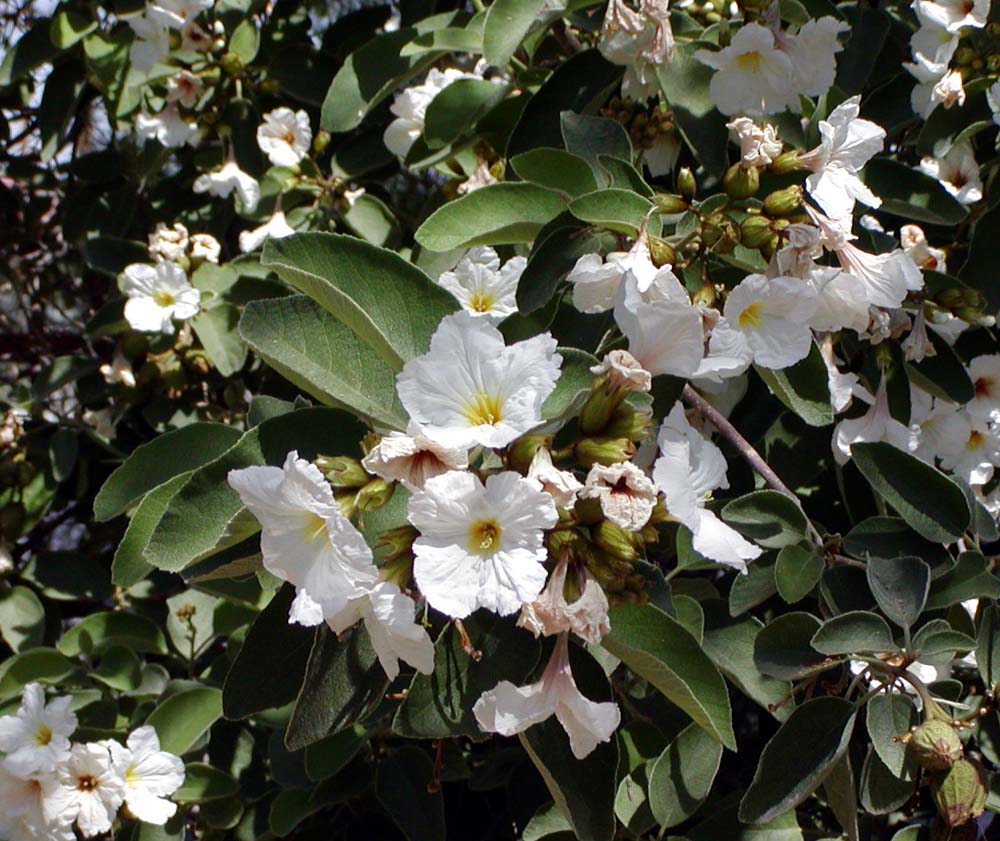
The Geiger tree is a small to medium-sized tree, reaching up to 8–9 meters tall with a rounded or vase-like crown. Its leaves are dark green, leathery, and oval, with a rough, sandpaper-like surface. At the ends of its branches, it produces clusters of bright orange-red, tubular flowers, each about 5 cm wide with 5–7 flaring lobes. The tree is evergreen and its branches often droop. After flowering, it forms pear-shaped fruits that are fragrant and edible, though not especially tasty.
Where does Geiger tree come from?
Cordia sebestena is native to Cuba and the wider American tropics, ranging from southern Florida and the Bahamas through Central America and the Greater Antilles. It has been known by different names in various regions, such as 'scarlet cordia' in Jamaica and 'siricote' or 'kopté' in the Yucatán. In Florida, it is called the Geiger tree, named after John Geiger of Key West. A variety found only in the Cayman Islands is considered Vulnerable.
When and how Geiger tree blooms
The Geiger tree blooms mainly in spring and summer but can flower throughout the year. It grows best in well-drained soil and full sun, tolerating drought and salt spray but not frost. It is slow-growing and sheds leaves and fruit, requiring some maintenance. Young trees benefit from pruning to shape their structure. The tree is used in gardens, as a street or shade tree, and can be grown in containers when young.


How Geiger tree is used
People plant the Geiger tree for its bright flowers and as an ornamental feature in tropical and coastal gardens. It is also used as a street and shade tree, and in parking lots and traffic medians. The pear-shaped fruit is edible but not widely eaten due to its lack of flavor. Its salt tolerance makes it popular in seaside plantings.
Kinds of Geiger tree
A notable variety of Cordia sebestena is found in the Cayman Islands, where it is considered Vulnerable. The species is known by different names in various regions, reflecting local languages and traditions. Its form can vary from multitrunked to single-trunked, depending on how it is pruned and grown.
What Geiger tree means
The Geiger tree is valued for its ornamental qualities in tropical landscapes. Its name in Florida honors John Geiger, a historical figure from Key West. While not tied to specific religious or cultural festivals, its bright flowers and adaptability have made it a familiar sight in gardens and streetscapes across the tropics. Conservation concerns exist for some local varieties.
Questions people ask about Geiger tree
Where does the Geiger tree come from?
The Geiger tree is native to Cuba and the American tropics, including southern Florida, the Bahamas, Central America, and the Greater Antilles.
What does the Geiger tree look like?
It is a small to medium tree with dark green, rough leaves and clusters of bright orange-red, tubular flowers at the ends of its branches.
How is the Geiger tree used?
It is widely planted as an ornamental tree in gardens, streets, and coastal areas for its showy flowers and salt tolerance. Its fruit is edible but not flavorful.
Is the Geiger tree important in any culture or tradition?
The tree is named after John Geiger in Florida and is valued for its ornamental use, but sources do not mention specific cultural or religious traditions.
Are there any conservation concerns for the Geiger tree?
A variety of Cordia sebestena that is found only in the Cayman Islands is considered Vulnerable.
Good reading and sources
- Encyclopaedia BritannicaArticle
- IUCN Red List of Threatened SpeciesIUCN Red List, Article
- USDA Plants DatabaseUS Department of Agriculture, Article
- Plants of the World OnlineRoyal Botanic Gardens, Kew, Plant database
- Where it has been recordedGBIF, Plant database
- Sightings and photos by naturalistsiNaturalist, Plant database
- Cordia sebestena on WikipediaEncyclopedia
- More photos on Wikimedia CommonsPhotos
- Wikidata recordOpen data
The facts on this page come from the Wikipedia article "Cordia sebestena", written by its contributors and used under the CC BY-SA 4.0 licence, and from its Wikidata record (CC0). Phool rewrote the text in its own words, with AI assistance, and compares every page with the article to make sure no passage is copied. It may be reused under the same CC BY-SA 4.0 licence with a link back.
It may contain mistakes. It is not medical or foraging advice: many flowers are poisonous, and traditional uses are reported, not recommended. If something is wrong, tell us. Last refreshed 2026-10-03.

More from Cuba
All the flowers of Cuba Prickly pearOpuntia
Cactus with flat pads and edible fruit, native to the Americas
🇲🇽 Mexico and 7 more · Wildflower
Prickly pearOpuntia
Cactus with flat pads and edible fruit, native to the Americas
🇲🇽 Mexico and 7 more · Wildflower
 Datura metelधतूरा
A shrubby plant with trumpet-shaped flowers, grown for ornament and tradition
🇮🇳 India and 4 more · Garden flower
Datura metelधतूरा
A shrubby plant with trumpet-shaped flowers, grown for ornament and tradition
🇮🇳 India and 4 more · Garden flower
 Kalmia
Evergreen shrubs with star-shaped pink, white or purple flowers from North America and Cuba
🇨🇺 Cuba · Wildflower
Kalmia
Evergreen shrubs with star-shaped pink, white or purple flowers from North America and Cuba
🇨🇺 Cuba · Wildflower
 White garland-lilyHedychium coronarium
Tall, fragrant white flowers from the ginger family, grown and loved across continents
🇮🇳 India and 7 more · Wildflower
White garland-lilyHedychium coronarium
Tall, fragrant white flowers from the ginger family, grown and loved across continents
🇮🇳 India and 7 more · Wildflower