
Kalmia
Evergreen shrubs with star-shaped pink, white or purple flowers from North America and Cuba
Kalmia is a group of evergreen shrubs with star-like flowers in white, pink or purple, native mainly to eastern North America and Cuba. Grown for their decorative blooms, these plants are toxic to livestock and humans, and are known by names like mountain laurel and lambkill.
- Kalmia is native to eastern North America and Cuba.
- Its flowers are star-shaped and come in white, pink, or purple.
- All parts of the plant are toxic to livestock and humans.
- Kalmia latifolia is known as mountain laurel.
- The genus was named after botanist Pehr Kalm.
What does Kalmia look like?
Kalmia shrubs range from 20 cm to 5 m tall and keep their leaves year-round. The leaves are long and narrow, from 2 to 12 cm, and have a simple, lance-shaped form. Their flowers grow in large clusters of 10 to 50, each flower 1 to 3 cm wide, with five joined petals forming a flat, star-like shape. The blooms come in shades of white, pink, or purple and resemble rhododendrons, though they are flatter. After flowering, the plant forms a five-lobed capsule filled with many small seeds.
Where does Kalmia come from?
Kalmia grows wild in the acidic soils of eastern North America and Cuba. Some species prefer wet bogs, while others thrive in dry, sandy ground. The genus was named by Linnaeus for Pehr Kalm, who collected it in North America in the 18th century. Seeds were brought to England in the 1720s, where the plant was prized as a rare shrub. Fossil records show Kalmia once grew in Europe during the Miocene period.
When and how Kalmia blooms
Kalmia blooms depend on species and local climate, but all need acidic soil. Some species grow in bogs, others in dry, sandy areas. They are usually grown from seed or cuttings and are valued in gardens for their showy flowers. The plants are evergreen and need to be kept away from livestock due to their toxic foliage.


![Kalmia buxifolia (Bergius) Gift & Kron [as syn. Leiophyllum buxifolium (Bergius) Elliott] - sandmyrtle - USA, NC, Burke Co., Pisgah National Forest, Linville Gorge Wilderness, Pinch In Trail. April 18, 2011.](https://thumb.wikimedia.org/wikipedia/commons/thumb/2/2a/Kalmia_buxifolia_NRCS-2.jpg/960px-Kalmia_buxifolia_NRCS-2.jpg)
How Kalmia is used
Gardeners grow Kalmia for its decorative flowers and evergreen leaves. It is not used for food or medicine because all parts are toxic to humans and animals, especially sheep and goats. The wood has been linked in folklore to spoon-making by Native Americans, but this is not confirmed. Some species are state or regional emblems.
Kinds of Kalmia
There are about ten species of Kalmia, including Kalmia latifolia (mountain laurel), Kalmia angustifolia (sheep-laurel or lambkill), Kalmia polifolia (bog-laurel), and Kalmia ericoides (Cuban kalmia). Each species grows in different habitats, from bogs to dry sand. Kalmia latifolia and Kalmia angustifolia are especially well known.
What Kalmia means
Kalmia is valued for its beauty in gardens and as a symbol in some regions. Its common names, such as lambkill and sheep-laurel, reflect its toxicity to livestock. The plant is not used in religious or festival practices, but it has a place in botanical history and is sometimes chosen as an emblem for states or regions.
Where Kalmia is used and seen
 WreathA ring-shaped decoration made from flowers, leaves, or other materials
 Highland ParkA 150-acre arboretum and park in Rochester, New York
 Christmas treeA decorated evergreen tree displayed for Christmas in homes and public places
 Winterthur Museum, Garden and LibraryA historic Delaware estate with 60 acres of naturalistic gardens and woodland
Questions people ask about Kalmia
Where does Kalmia come from?
Kalmia is native mainly to the eastern half of North America and Cuba. Different species grow in habitats ranging from wet bogs to dry, sandy soils.
What does Kalmia look like?
Kalmia shrubs are evergreen, with narrow, lance-shaped leaves and clusters of star-shaped flowers in white, pink, or purple. The flowers are flat and grow in groups of 10 to 50.
Is Kalmia poisonous?
Yes, all parts of Kalmia contain toxins called grayanotoxins. The plant is especially dangerous to sheep and goats, but it is also toxic to humans if eaten.
What is Kalmia used for?
Kalmia is mainly grown as a decorative shrub in gardens for its attractive flowers and evergreen leaves. It is not used for food or medicine due to its toxicity.
Are there different types of Kalmia?
Yes, there are about ten species, including mountain laurel (Kalmia latifolia), sheep-laurel (Kalmia angustifolia), and bog-laurel (Kalmia polifolia), each adapted to different habitats.
Good reading and sources
- Encyclopaedia BritannicaArticle
- USDA Plants DatabaseUS Department of Agriculture, Article
- Plants of the World OnlineRoyal Botanic Gardens, Kew, Plant database
- Where it has been recordedGBIF, Plant database
- Sightings and photos by naturalistsiNaturalist, Plant database
The facts on this page come from the Wikipedia article "Kalmia", written by its contributors and used under the CC BY-SA 4.0 licence, and from its Wikidata record (CC0). EveryPhool rewrote the text in its own words, with AI assistance, and compares every page with the article to make sure no passage is copied. It may be reused under the same CC BY-SA 4.0 licence with a link back.
It may contain mistakes. It is not medical or foraging advice: many flowers are poisonous, and traditional uses are reported, not recommended. If something is wrong, tell us. Last refreshed 2026-10-03.
Others in the family Ericaceae
The whole family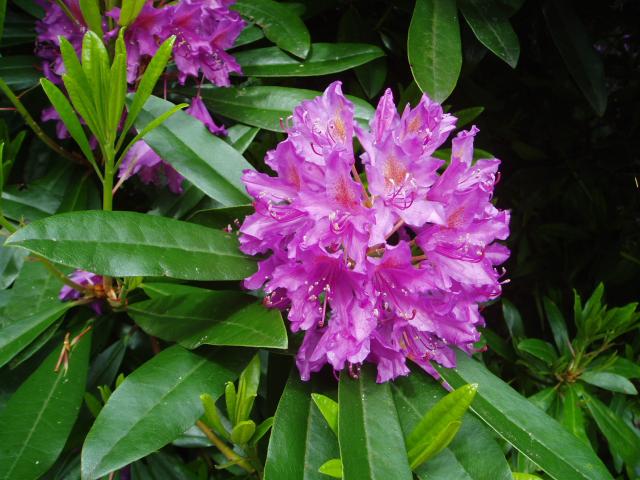 Rhododendron
A vast group of shrubs and trees with showy blooms in many colours
🇳🇵 Nepal and 4 more · Wildflower
Rhododendron
A vast group of shrubs and trees with showy blooms in many colours
🇳🇵 Nepal and 4 more · Wildflower
 Erica
Evergreen shrubs with tiny needle leaves and nodding flowers, known as heaths or heathers
🇿🇦 South Africa and 1 more · Wildflower
Erica
Evergreen shrubs with tiny needle leaves and nodding flowers, known as heaths or heathers
🇿🇦 South Africa and 1 more · Wildflower
 Catawba rosebayRhododendron catawbiense
A spring-flowering rhododendron native to the southern Appalachian Mountains
🇺🇸 United States · Wildflower
Catawba rosebayRhododendron catawbiense
A spring-flowering rhododendron native to the southern Appalachian Mountains
🇺🇸 United States · Wildflower
 Common rhododendronRhododendron ponticum
A dense evergreen shrub with violet-purple flowers from Europe and the Caucasus
🇵🇹 Portugal and 6 more · Flowering shrub
Common rhododendronRhododendron ponticum
A dense evergreen shrub with violet-purple flowers from Europe and the Caucasus
🇵🇹 Portugal and 6 more · Flowering shrub
More from Cuba
All the flowers of Cuba Prickly pearOpuntia
Cactus with flat pads and edible fruit, native to the Americas
🇲🇽 Mexico and 7 more · Wildflower
Prickly pearOpuntia
Cactus with flat pads and edible fruit, native to the Americas
🇲🇽 Mexico and 7 more · Wildflower
 Datura metelधतूरा
A shrubby plant with trumpet-shaped flowers, grown for ornament and tradition
🇮🇳 India and 4 more · Garden flower
Datura metelधतूरा
A shrubby plant with trumpet-shaped flowers, grown for ornament and tradition
🇮🇳 India and 4 more · Garden flower
 Pieris
Evergreen shrubs with bell-shaped white or pink flowers in spring
🇨🇳 China and 5 more · Flowering shrub
Pieris
Evergreen shrubs with bell-shaped white or pink flowers in spring
🇨🇳 China and 5 more · Flowering shrub
 White garland-lilyHedychium coronarium
Tall, fragrant white flowers from the ginger family, grown and loved across continents
🇮🇳 India and 7 more · Wildflower
White garland-lilyHedychium coronarium
Tall, fragrant white flowers from the ginger family, grown and loved across continents
🇮🇳 India and 7 more · Wildflower