
Common rhododendron
Rhododendron ponticum, family Ericaceae
A dense evergreen shrub with violet-purple flowers from Europe and the Caucasus
Common rhododendron is an evergreen shrub or small tree with violet-purple flowers, native to the Iberian Peninsula and the Caucasus region. It is widely grown as an ornamental plant, but is invasive in parts of western Europe and Ireland, where it can crowd out native plants.
- Native to the Iberian Peninsula and the Caucasus region
- Produces violet-purple flowers with greenish-yellow spots
- Invasive in parts of western Europe and Ireland
- Its nectar can make toxic 'mad honey'
- Emblem of Bulgaria's Strandja mountains
What does Common rhododendron look like?
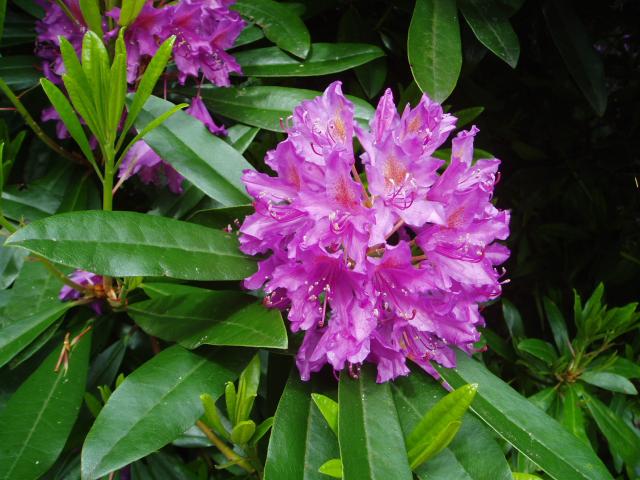
Common rhododendron is a dense, evergreen shrub or small tree that can reach up to 5 meters tall, sometimes more. Its leaves are long, leathery, and remain green throughout the year. The flowers are showy, about 3.5 to 5 cm wide, and typically violet-purple with small greenish-yellow spots or streaks. The plant produces dry capsules filled with many tiny seeds. It often forms large thickets, especially where it spreads unchecked.
Where does Common rhododendron come from?
This species is native to two separate regions: the southwestern Iberian Peninsula, including parts of Portugal and Spain, and the area around the southern Black Sea, covering eastern Bulgaria, northern Turkey, Georgia, and the Northern Caucasus. Fossil evidence shows it once grew across much of southern and western Europe before the last ice age. The plant was described by Linnaeus, who named it after the ancient kingdom of Pontus near the Black Sea. It was introduced to Britain in the 18th century as an ornamental shrub.
When and how Common rhododendron blooms
Rhododendron ponticum blooms in spring, producing clusters of purple flowers. It thrives in acidic soils and shady woodlands, and is often grown as an ornamental shrub in gardens. The plant spreads both by seed and by suckers from its roots, which can allow it to form dense stands. It is sometimes used as a rootstock for grafting other rhododendron varieties.


How Common rhododendron is used
People grow common rhododendron mainly for its decorative flowers and evergreen foliage in gardens and parks. In Bulgaria, it is a symbol of the Strandja mountains. In some places, it was planted to provide cover for game birds. However, it is now considered invasive in parts of western Europe and Ireland, where it can overtake native habitats. The plant and its nectar are toxic to humans and some animals.
Kinds of Common rhododendron
There are two subspecies and a variegated variety, including R. p. var. heterophyllum found in Turkey. Rhododendron ponticum subsp. baeticum is widely cultivated in western and central Europe, often used as a rootstock for grafting. Hybrids with other rhododendrons also exist.
What Common rhododendron means
Rhododendron ponticum is the emblem of Bulgaria's Strandja mountains. In Britain and Ireland, it is known for its invasive nature and the challenges it poses to native woodlands. The plant's toxic nectar can produce 'mad honey,' which has been referenced in popular culture. Its spread and management are subjects of ongoing conservation efforts.
Where Common rhododendron is used and seen
 Parc Floral de la SourceA large public garden in Orléans built around the source of the Loiret river
 Kórnik ArboretumPoland’s oldest and largest collection of trees and shrubs, near Kórnik Castle
 Abkhazi GardenA one-acre garden in Victoria, British Columbia, created by Prince and Princess Abkhazi
 Holden ArboretumA vast botanical garden and arboretum in Kirtland, Ohio
 Roan MountainA high Appalachian massif known for rhododendrons and grassy summits
 Powell GardensA 970-acre botanical garden near Kansas City, Missouri
 Dandenong Ranges Botanic GardenA cool-climate garden in the hills near Melbourne, famous for rhododendrons and cherry blossom
 Parc floral de ParisA botanical garden and flower park in the Bois de Vincennes, Paris
Questions people ask about Common rhododendron
Where does common rhododendron come from?
It is native to the southwestern Iberian Peninsula, including Portugal and Spain, and the Caucasus region near the Black Sea, covering parts of Turkey, Georgia, and Bulgaria.
What does Rhododendron ponticum look like?
It is a dense, evergreen shrub or small tree with long, leathery leaves and clusters of violet-purple flowers, often marked with greenish-yellow spots.
Is common rhododendron toxic?
Yes, its nectar and leaves contain toxic compounds called grayanotoxins. Honey made from its flowers can be poisonous, and the plant is avoided by grazing animals.
Why is Rhododendron ponticum considered invasive?
It spreads rapidly by seeds and root suckers, forming dense thickets that crowd out native plants, especially in western Europe and Ireland.
What does common rhododendron symbolise?
It is the emblem of Bulgaria's Strandja mountains and is valued for its ornamental beauty, but in some regions it is mainly known for being invasive.
Good reading and sources
- Rhododendron ponticumRoyal Horticultural Society, Article
- Plants of the World OnlineRoyal Botanic Gardens, Kew, Plant database
- Where it has been recordedGBIF, Plant database
- Sightings and photos by naturalistsiNaturalist, Plant database
- Rhododendron ponticum on WikipediaEncyclopedia
- More photos on Wikimedia CommonsPhotos
- Wikidata recordOpen data
The facts on this page come from the Wikipedia article "Rhododendron ponticum", written by its contributors and used under the CC BY-SA 4.0 licence, and from its Wikidata record (CC0). Phool rewrote the text in its own words, with AI assistance, and compares every page with the article to make sure no passage is copied. It may be reused under the same CC BY-SA 4.0 licence with a link back.
It may contain mistakes. It is not medical or foraging advice: many flowers are poisonous, and traditional uses are reported, not recommended. If something is wrong, tell us. Last refreshed 2026-10-03.
Others in the family Ericaceae
The whole family
Rhododendron
A vast group of shrubs and trees with showy blooms in many colours
🇳🇵 Nepal and 4 more · Wildflower
 Erica
Evergreen shrubs with tiny needle leaves and nodding flowers, known as heaths or heathers
🇿🇦 South Africa and 1 more · Wildflower
Erica
Evergreen shrubs with tiny needle leaves and nodding flowers, known as heaths or heathers
🇿🇦 South Africa and 1 more · Wildflower
 Rhododendron molle羊踯躅
A yellow-flowered deciduous azalea from China and Japan
🇨🇳 China and 1 more · Wildflower
Rhododendron molle羊踯躅
A yellow-flowered deciduous azalea from China and Japan
🇨🇳 China and 1 more · Wildflower
 Rhododendron aureum
A low evergreen shrub with pale yellow spring flowers from northeastern Asia
🇨🇳 China and 2 more · Wildflower
Rhododendron aureum
A low evergreen shrub with pale yellow spring flowers from northeastern Asia
🇨🇳 China and 2 more · Wildflower
More from Portugal
All the flowers of Portugal RosemarySalvia rosmarinus
A fragrant evergreen shrub with needle-like leaves and purple, blue, or white flowers
🇪🇸 Spain and 5 more · Flowering shrub
RosemarySalvia rosmarinus
A fragrant evergreen shrub with needle-like leaves and purple, blue, or white flowers
🇪🇸 Spain and 5 more · Flowering shrub
 Eucalyptus
The tall, aromatic trees and shrubs known as gum trees or eucalypts
🇦🇺 Australia and 7 more · Flowering tree
Eucalyptus
The tall, aromatic trees and shrubs known as gum trees or eucalypts
🇦🇺 Australia and 7 more · Flowering tree
 Narcissus
Spring-flowering bulbs with trumpet-shaped blooms in white, yellow, and orange
🇬🇧 United Kingdom and 7 more · Wildflower
Narcissus
Spring-flowering bulbs with trumpet-shaped blooms in white, yellow, and orange
🇬🇧 United Kingdom and 7 more · Wildflower
 OleanderNerium oleander
A showy, evergreen shrub with clusters of pink, white or red flowers
🇲🇦 Morocco and 8 more · Flowering shrub
OleanderNerium oleander
A showy, evergreen shrub with clusters of pink, white or red flowers
🇲🇦 Morocco and 8 more · Flowering shrub