
Kousa dogwood
Cornus kousa, family Cornaceae
A small East Asian tree with showy white bracts and sweet red berries
Kousa dogwood is a small deciduous tree from East Asia, known for its white bracts in spring and red, sweet berries in late summer. It is grown as an ornamental tree and is resistant to dogwood anthracnose, making it popular in gardens and parks.
- Native to East Asia: Korea, China, and Japan
- Showy white bracts appear in spring, followed by red berries
- Berries are sweet and edible, though the rind is usually discarded
- Resistant to dogwood anthracnose disease
- Widely grown as an ornamental tree in gardens and parks
What does Kousa dogwood look like?
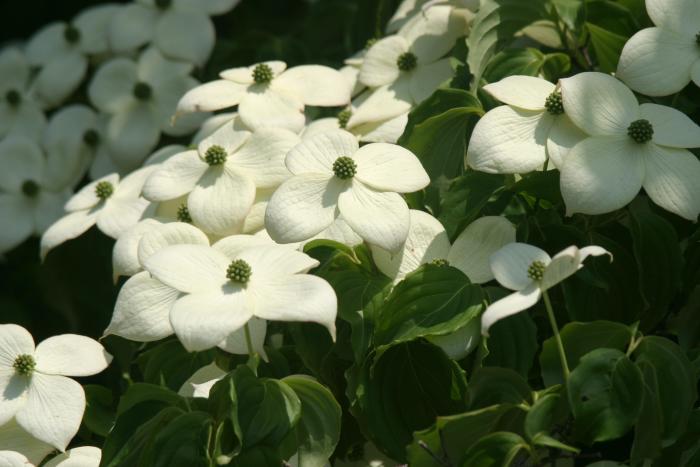
Kousa dogwood is a small tree, reaching up to 10 metres tall and 6 metres wide. Its leaves are simple, opposite, and turn a showy red in autumn. In spring, the tree is covered with four large whitish bracts, sometimes fading to red, which surround clusters of small yellowish-green flowers. The tree produces round, pink to red compound berries about 2 cm wide, which have a sweet flavour. The overall look is elegant, with upright branches and a neat shape.
Where does Kousa dogwood come from?
Kousa dogwood is native to East Asia, specifically Korea, China, and Japan. It has been widely cultivated outside its native range and has become naturalized in places such as New York State. The species has been valued for its ornamental qualities and resistance to disease, leading to its spread in gardens and parks. Its scientific name is Cornus kousa, and it is also known by synonyms such as Benthamia kousa and Cynoxylon kousa.
When and how Kousa dogwood blooms
The tree blooms in spring, producing showy bracts that last for several weeks. It grows best in temperate climates and is often planted in gardens for its attractive flowers and autumn foliage. Kousa dogwood can be grown from seed or young plants, and several cultivars have been developed for improved flower display and disease resistance. The tree is also used in hybrid breeding with other dogwoods.
![The Cow Lot - an open lawn edged with magnificent trees that was once a pasture. Seen here on the eastern path are the Japanese flowering dogwoods [Cornus kousa] that bloom in June and are some of the most spectacular to](https://thumb.wikimedia.org/wikipedia/commons/thumb/c/cb/Longwood_2011_09_02_0241_%286160777858%29.jpg/960px-Longwood_2011_09_02_0241_%286160777858%29.jpg)


How Kousa dogwood is used
Kousa dogwood is mainly grown as an ornamental tree for its striking spring bracts and colourful fall leaves. The sweet berry pulp is edible and sometimes eaten raw or used to make wine, though the rind is usually discarded. Young leaves can be cooked and eaten, but they are less commonly used. Its resistance to disease makes it a popular choice in areas where other dogwoods struggle.
Kinds of Kousa dogwood
There are two main subspecies: Cornus kousa subsp. kousa, native to Japan and Korea, and Cornus kousa subsp. chinensis, native to China. The Chinese variety is said to have larger bracts and leaves and to flower more freely, though its status is debated. Many cultivars and hybrids exist, some bred for disease resistance and ornamental value.
What Kousa dogwood means
Kousa dogwood is widely planted in gardens and parks for its beauty and reliability. It is not tied to any particular symbolism or religious use in the sources, but its disease resistance has made it important in regions affected by dogwood anthracnose. Some cultivars have received horticultural awards for their performance and appearance.
Questions people ask about Kousa dogwood
Where does the kousa dogwood come from?
Kousa dogwood is native to East Asia, specifically Korea, China, and Japan. It is also grown in gardens and parks in other parts of the world, including the United States.
What does the kousa dogwood look like?
It is a small tree with simple, opposite leaves that turn red in autumn. In spring, it displays large white bracts around clusters of small yellowish-green flowers, and later produces round, pink to red berries.
Are the berries of kousa dogwood edible?
Yes, the sweet pulp of the berries is edible and sometimes eaten raw or used to make wine. The rind is tough and bitter, so it is usually discarded.
Why is kousa dogwood popular in gardens?
It is popular for its showy spring bracts, attractive fall foliage, and resistance to dogwood anthracnose disease, which affects other dogwood species.
Does kousa dogwood have any special cultural or symbolic meaning?
The sources do not mention any particular symbolism or religious use for kousa dogwood. It is mainly valued for its ornamental qualities and disease resistance.
Good reading and sources
- Cornus kousa 'John Slocock'Royal Horticultural Society, Article
- IUCN Red List of Threatened SpeciesIUCN Red List, Article
- Plants of the World OnlineRoyal Botanic Gardens, Kew, Plant database
- Where it has been recordedGBIF, Plant database
- Sightings and photos by naturalistsiNaturalist, Plant database
The facts on this page come from the Wikipedia article "Cornus kousa", written by its contributors and used under the CC BY-SA 4.0 licence, and from its Wikidata record (CC0). Phool rewrote the text in its own words, with AI assistance, and compares every page with the article to make sure no passage is copied. It may be reused under the same CC BY-SA 4.0 licence with a link back.
It may contain mistakes. It is not medical or foraging advice: many flowers are poisonous, and traditional uses are reported, not recommended. If something is wrong, tell us. Last refreshed 2026-10-03.
Others in the family Cornaceae
The whole family
More from Japan
All the flowers of Japan PeachPrunus persica
A flowering fruit tree from China, grown for its pink blossoms and sweet fruit
🇨🇳 China and 7 more · Flowering tree
PeachPrunus persica
A flowering fruit tree from China, grown for its pink blossoms and sweet fruit
🇨🇳 China and 7 more · Flowering tree
 BirchBetula
Slender trees with papery bark found across the northern world
🇨🇳 China and 7 more · Wildflower
BirchBetula
Slender trees with papery bark found across the northern world
🇨🇳 China and 7 more · Wildflower
 Chrysanthemum菊花
Autumn-blooming flower with thousands of varieties, cherished in East Asia and beyond
🇨🇳 China and 6 more · Wildflower
Chrysanthemum菊花
Autumn-blooming flower with thousands of varieties, cherished in East Asia and beyond
🇨🇳 China and 6 more · Wildflower
 Sacred lotusNelumbo nucifera
The pink aquatic flower sacred in Asia and grown for food, worship and beauty
🇮🇳 India and 7 more · Water flower
Sacred lotusNelumbo nucifera
The pink aquatic flower sacred in Asia and grown for food, worship and beauty
🇮🇳 India and 7 more · Water flower