Eulophia
A large group of mostly ground-dwelling orchids from Africa and Asia
Eulophia is a genus of about 200 orchid species, mainly found in Africa and Asia. These orchids grow mostly on the ground and show a wide variety in flower size and colour, with some species adapted to dry or shady habitats. People grow them for their unusual flowers and hardy nature.
- About 200 species belong to the Eulophia genus
- Most Eulophia orchids grow on the ground, not on trees
- They are mainly found in Africa and Asia
- Some species can survive in very dry, desert-like places
What does Eulophia look like?
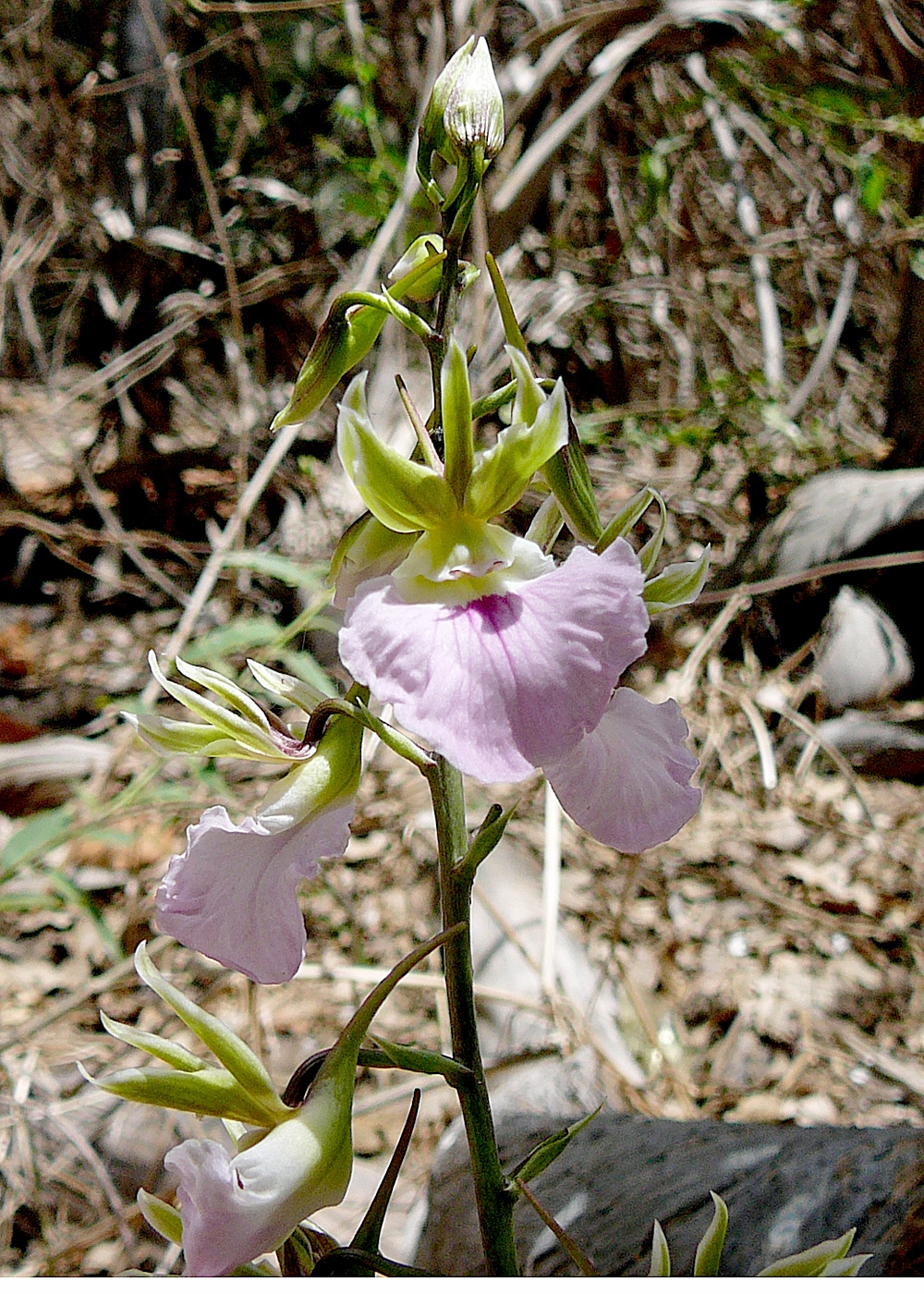
Eulophia orchids are mostly ground-growing plants, though a few live on trees in Madagascar. They may have thick underground stems or bulb-like bases. Some species have no leaves, while others have long, narrow, sometimes pleated leaves. Their flowers grow on slender spikes, sometimes before the leaves appear, and can be small or quite large. Flower colours vary widely, and the blooms often have a lip with three lobes and a pouch or spur at the base.
Where does Eulophia come from?
The genus Eulophia was first described in 1821. Its name comes from Greek words meaning 'good crest,' likely referring to a feature on the flower’s lip. Most species are native to Africa and Asia, with a few found in Madagascar, India, Queensland, and the Americas. Eulophia orchids are adapted to a range of habitats, from shady forests to open, dry grasslands. Some, like Eulophia petersii, are able to survive in desert-like conditions.
When and how Eulophia blooms
Eulophia orchids usually bloom on upright stems that may appear before or with the leaves. They grow from underground rhizomes or surface pseudobulbs, which help them survive dry periods. In cultivation, they do well in warm, frost-free climates with well-drained soil, and can be divided for propagation. Some species are grown outdoors in places like Southern California and Florida.


How Eulophia is used
People grow Eulophia orchids mainly for their unusual and varied flowers, both in gardens and as potted plants. Their ability to handle dry conditions makes them popular with collectors who want hardy orchids. There is no mention of traditional medicinal or ceremonial uses in the sources.
Kinds of Eulophia
There are around 200 species in the Eulophia genus, ranging from small-flowered types to those with large, showy blooms. Hybrids have been made both within the genus and with other orchid groups, and several named hybrids are registered. Only two species are known to grow on trees, and these are found in Madagascar.
What Eulophia means
Eulophia orchids are valued by orchid enthusiasts for their diversity and resilience. The genus does not have a special symbolic meaning or role in festivals, but its adaptability and unusual flowers make it notable among orchids. The name reflects a feature of the flower, rather than any cultural association.
Questions people ask about Eulophia
Where do Eulophia orchids come from?
Most Eulophia species are native to Africa and Asia, with some found in Madagascar, India, Queensland, and the Americas.
What do Eulophia flowers look like?
Their flowers can be small or large, with a wide range of colours. The blooms grow on thin spikes and often have a three-lobed lip with a pouch or spur.
How are Eulophia orchids grown?
They are usually grown in warm, frost-free areas with well-drained soil. Gardeners often divide the underground rhizomes or pseudobulbs to propagate new plants.
Are Eulophia orchids used for anything besides gardening?
The sources only mention their use as ornamental plants in gardens and collections, not for food, medicine, or ceremonies.
Are there different types of Eulophia orchids?
Yes, there are about 200 species, plus several hybrids, with a range of flower sizes, shapes, and colours.
Good reading and sources
- The International Orchid Register / RHS GardeningRoyal Horticultural Society, Article
- USDA Plants DatabaseUS Department of Agriculture, Article
- Plants of the World OnlineRoyal Botanic Gardens, Kew, Plant database
- Where it has been recordedGBIF, Plant database
- Sightings and photos by naturalistsiNaturalist, Plant database
The facts on this page come from the Wikipedia article "Eulophia", written by its contributors and used under the CC BY-SA 4.0 licence, and from its Wikidata record (CC0). Phool rewrote the text in its own words, with AI assistance, and compares every page with the article to make sure no passage is copied. It may be reused under the same CC BY-SA 4.0 licence with a link back.
It may contain mistakes. It is not medical or foraging advice: many flowers are poisonous, and traditional uses are reported, not recommended. If something is wrong, tell us. Last refreshed 2026-10-03.
Others in the family Orchidaceae
The whole family OrchidOrchidaceae
A vast family of colourful, often fragrant flowers found almost everywhere on earth
Orchidaceae · Wildflower
OrchidOrchidaceae
A vast family of colourful, often fragrant flowers found almost everywhere on earth
Orchidaceae · Wildflower
 Vanilla
Climbing orchids with pods used for the world’s most popular flavor
🇲🇽 Mexico and 7 more · Wildflower
Vanilla
Climbing orchids with pods used for the world’s most popular flavor
🇲🇽 Mexico and 7 more · Wildflower
 Orchis
A group of wild orchids with tuberous roots from Europe, North Africa and Asia
🇹🇷 Turkey and 7 more · Wildflower
Orchis
A group of wild orchids with tuberous roots from Europe, North Africa and Asia
🇹🇷 Turkey and 7 more · Wildflower
 VanillaVanilla planifolia
The climbing orchid behind most of the world’s vanilla flavour
🇲🇽 Mexico and 8 more · Wildflower
VanillaVanilla planifolia
The climbing orchid behind most of the world’s vanilla flavour
🇲🇽 Mexico and 8 more · Wildflower