
Fritillaria
Bell-shaped spring flowers from the lily family grown for gardens and tradition
Fritillaria is a group of bulb plants in the lily family, known for their nodding, bell-like flowers. Native to temperate parts of the Northern Hemisphere, these perennials are grown for their striking patterns and are used in gardens, art, and traditional medicine.
- Fritillaria flowers hang down and often show a checkered pattern
- Some species are used in traditional Chinese medicine
- Certain types have a strong or unusual scent
- Over-harvesting has endangered several species
- Fritillaria has one of the largest plant genomes known
What does Fritillaria look like?
Fritillaria plants grow from bulbs and send up stems with leaves arranged either opposite each other or in whorls. Their flowers usually hang down and have a bell or cup shape, with six petal-like segments that may show a checkered or tessellated pattern. The blooms come in a range of shades, including white, yellow, green, purple, and red. Some species have a noticeable scent, which can be sweet or, in certain types, unpleasant. After flowering, the plant dies back and regrows from its bulb the next year.
Where does Fritillaria come from?
Fritillaria species are native to mild climates across the Northern Hemisphere, stretching from North Africa and the Mediterranean through Asia and into western North America. The first European record of Fritillaria dates to the 16th century, when bulbs were brought from Turkey and Persia to botanical gardens. The name comes from the Latin for a dice box, inspired by the checkered look of some flowers. Over time, these plants became popular in gardens and were described by early botanists and writers.
When and how Fritillaria blooms
Fritillaria bulbs are planted in the ground, where they remain dormant until spring. When the weather warms, shoots emerge and produce their characteristic nodding flowers. The plants prefer temperate conditions and well-drained soil. Most species grow from bulbs with fleshy scales, and some can produce small bulbils. After flowering, the above-ground parts die back, and the bulb stores energy for the next season.


How Fritillaria is used
Gardeners value Fritillaria for their unusual flowers and patterns, making them a choice for ornamental planting. In some regions, certain species are harvested for traditional Chinese medicine, which has led to over-collection and the decline of wild populations. Fritillaria flowers have also been used as symbols in art and as emblems for organizations and regions.
Kinds of Fritillaria
The genus includes about 130 to 140 species, divided into several groups. Some, like Fritillaria meleagris, are known for their checkered petals, while others, such as F. imperialis, have larger, more dramatic blooms. There is also a range in scent, from sweet in some species to strong and unpleasant in others. The group shows great diversity in flower shape, color, and size.
What Fritillaria means
Fritillaria has appeared in art and literature since the 16th century, and some regions have adopted it as an emblem. The checkered pattern of certain species inspired their Latin name and common names in Europe. Over-picking for gardens and medicine has made some species rare or endangered. The genus is also notable for having some of the largest genomes among flowering plants.
Questions people ask about Fritillaria
Where does Fritillaria come from?
Fritillaria species are native to temperate regions across the Northern Hemisphere, including areas from North Africa and the Mediterranean through Asia to western North America.
What do Fritillaria flowers look like?
They usually have bell-shaped or cup-shaped flowers that nod downward, with six petal-like segments. Many show a checkered or tessellated pattern and come in colors such as white, yellow, green, purple, and red.
How are Fritillaria plants used?
They are grown as ornamental plants in gardens, used in traditional Chinese medicine, and serve as emblems or symbols in art and for organizations.
Are any Fritillaria species endangered?
Yes, several species have become endangered due to being picked for gardens and for use in traditional medicine.
What does Fritillaria symbolize?
Certain species have been used as regional emblems and are featured in art, often admired for their unique patterns and shapes.
Good reading and sources
- Encyclopaedia BritannicaArticle
- Rare Japanese plant has largest genome known to scienceScienceDaily, Article
- Shakespeare: writer claims discovery of only portrait made during his lifetimeThe Guardian, Article
- Plants of the World OnlineRoyal Botanic Gardens, Kew, Plant database
- Where it has been recordedGBIF, Plant database
- Sightings and photos by naturalistsiNaturalist, Plant database
The facts on this page come from the Wikipedia article "Fritillaria", written by its contributors and used under the CC BY-SA 4.0 licence, and from its Wikidata record (CC0). Phool rewrote the text in its own words, with AI assistance, and compares every page with the article to make sure no passage is copied. It may be reused under the same CC BY-SA 4.0 licence with a link back.
It may contain mistakes. It is not medical or foraging advice: many flowers are poisonous, and traditional uses are reported, not recommended. If something is wrong, tell us. Last refreshed 2026-10-03.
Others in the family Liliaceae
The whole family TulipTulipa
Spring-blooming bulbs with showy, cup-shaped flowers in many colours
🇳🇱 Netherlands and 7 more · Wildflower
TulipTulipa
Spring-blooming bulbs with showy, cup-shaped flowers in many colours
🇳🇱 Netherlands and 7 more · Wildflower
 LilyLilium
Tall bulb flowers with large, colourful blooms in many gardens and cultures
Lilium · Wildflower
LilyLilium
Tall bulb flowers with large, colourful blooms in many gardens and cultures
Lilium · Wildflower
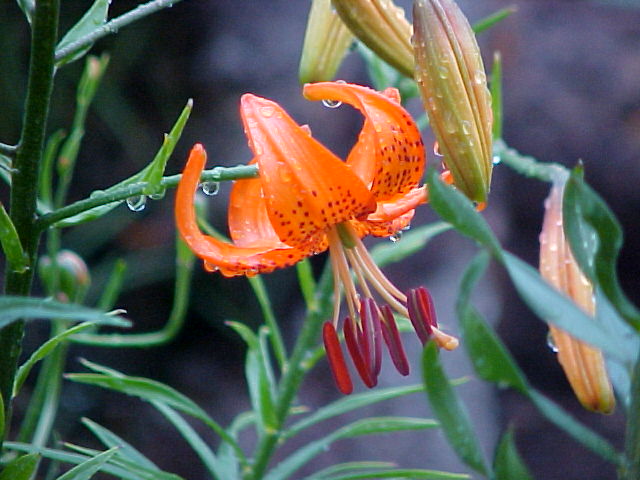 Lilium davidii
A tall Asian lily with edible bulbs and orange recurved flowers
🇨🇳 China and 1 more · Wildflower
Lilium davidii
A tall Asian lily with edible bulbs and orange recurved flowers
🇨🇳 China and 1 more · Wildflower
 Chinese LilyLilium brownii
A wild and cultivated lily from China with edible bulbs
🇨🇳 China and 3 more · Wildflower
Chinese LilyLilium brownii
A wild and cultivated lily from China with edible bulbs
🇨🇳 China and 3 more · Wildflower