
Herb-Robert
Geranium robertianum, family Geraniaceae
A pink-flowered wild geranium found in woods and gardens across the north
Herb-Robert is a small wild geranium with pink, white-striped flowers and finely divided leaves, often tinged red. Native to Europe and parts of Asia, it grows in woods, hedges, gardens, and even on rocky ground. People have long grown white-flowered forms in gardens, and its leaves have a strong scent when crushed.
- Pink flowers with white stripes bloom from spring to autumn
- Leaves and stems often turn red in sunlight
- Crushed leaves have a strong, sharp smell
- Seeds are flung away from the plant when ripe
- White-flowered garden forms have been grown for centuries
What does Herb-Robert look like?
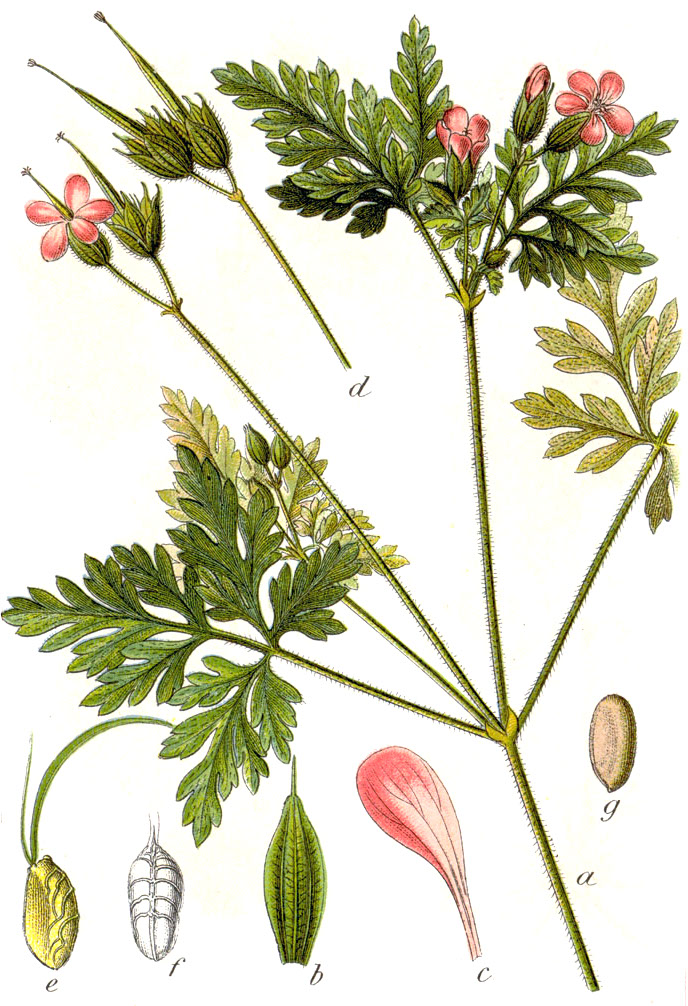
Herb-Robert is a low-growing plant, usually reaching about 30 cm tall, but sometimes larger. Its stems and leaves can be green or turn red, especially in sunny places. The leaves are deeply cut and have a palmate shape, with toothed edges. Flowers are small, about 12–16 mm across, pink with white stripes, and have five petals. When bruised, the plant gives off a strong, often unpleasant smell. Its fruit splits apart and can fling seeds away from the parent plant.
Where does Herb-Robert come from?
This geranium is native to much of Europe and parts of Asia, including Xinjiang and Tibet. It has spread widely across the northern hemisphere and is now found in North America and North Africa as well. The name 'Geranium' comes from Greek, meaning 'little crane', a nod to the fruit’s shape. The name 'herb-robert' may refer to Saint Rupert or a figure from folklore, and it has been known by many local names.
When and how Herb-Robert blooms
Herb-Robert flowers from early spring through late autumn, especially in northern Europe. It grows in shady or partly sunny places, often on limestone or chalk soils, but can also survive on rocky or disturbed ground. The plant reproduces by seed, which are ejected from the fruit when ripe. Some forms are annual, others biennial or short-lived perennials.



How Herb-Robert is used
Gardeners have long grown white-flowered forms of herb-robert, such as the variety 'Celtic White'. In folk traditions, the plant has been used for minor wounds, toothache, and other ailments, though its medicinal value is debated. Some people rub the leaves on their skin to keep away mosquitoes. Its strong scent and red-tinged leaves have inspired many local nicknames.
Kinds of Herb-Robert
There are several forms of herb-robert, including green annuals with pale flowers on limestone, and red, sprawling types with darker flowers on shingle beaches. The common inland form is most widespread. It can hybridise with related geraniums in some regions, producing mostly infertile offspring.
What Herb-Robert means
Herb-Robert has gathered many folk names and stories, sometimes linked to saints or to the robin bird. Its bright colour and strong scent have made it memorable in rural traditions. While not a national emblem, it is a familiar wildflower in many countries and has been part of garden plantings for centuries.
Where Herb-Robert is used and seen

Questions people ask about Herb-Robert
Where does Herb-Robert come from?
Herb-Robert is native to Europe and parts of Asia, including regions like Xinjiang and Tibet. It now grows widely across the northern hemisphere and has also been introduced to North America and North Africa.
What does Herb-Robert look like?
It is a small plant with finely divided, palmate leaves and pink flowers that have white stripes. The stems and leaves can turn red, especially in bright sunlight, and the plant has a strong smell when bruised.
How is Herb-Robert used?
People have grown white-flowered forms in gardens. In folk traditions, it has been used for minor wounds and other ailments, and its leaves are sometimes rubbed on the skin to repel mosquitoes.
What does Herb-Robert symbolise?
The plant has gathered many folk names and stories, sometimes linked to saints or the robin bird, but it is not a national or state emblem.
Is Herb-Robert invasive?
In some places outside its native range, Herb-Robert can spread quickly and is considered invasive.
Good reading and sources
- USDA Plants DatabaseUS Department of Agriculture, Article
- Geranium robertianum 'Celtic White'Royal Horticultural Society, Article
- Plants of the World OnlineRoyal Botanic Gardens, Kew, Plant database
- Where it has been recordedGBIF, Plant database
- Sightings and photos by naturalistsiNaturalist, Plant database
- Geranium robertianum on WikipediaEncyclopedia
- More photos on Wikimedia CommonsPhotos
- Wikidata recordOpen data
The facts on this page come from the Wikipedia article "Geranium robertianum", written by its contributors and used under the CC BY-SA 4.0 licence, and from its Wikidata record (CC0). Phool rewrote the text in its own words, with AI assistance, and compares every page with the article to make sure no passage is copied. It may be reused under the same CC BY-SA 4.0 licence with a link back.
It may contain mistakes. It is not medical or foraging advice: many flowers are poisonous, and traditional uses are reported, not recommended. If something is wrong, tell us. Last refreshed 2026-10-03.
Others in the family Geraniaceae
The whole family Geranium
A group of wild and garden flowers with five-petaled blooms and lobed leaves
Geranium · Wildflower
Geranium
A group of wild and garden flowers with five-petaled blooms and lobed leaves
Geranium · Wildflower
 Pelargonium
A diverse group of flowering plants often grown as garden and house plants
🇿🇦 South Africa and 7 more · Garden flower
Pelargonium
A diverse group of flowering plants often grown as garden and house plants
🇿🇦 South Africa and 7 more · Garden flower
 Meadow Crane's-billGeranium pratense
A hardy wildflower with pale blue, saucer-shaped blooms
🇨🇳 China · Wildflower
Meadow Crane's-billGeranium pratense
A hardy wildflower with pale blue, saucer-shaped blooms
🇨🇳 China · Wildflower
 Bloody crane's-billGeranium sanguineum
A hardy crimson-flowered perennial of grasslands and gardens
🇨🇭 Switzerland · Wildflower
Bloody crane's-billGeranium sanguineum
A hardy crimson-flowered perennial of grasslands and gardens
🇨🇭 Switzerland · Wildflower