
Lampranthus
A succulent with large, vivid flowers from southern Africa
Lampranthus is a group of succulent shrubs native to Namibia and South Africa, known for their large, bright flowers that bloom in summer. Their flowers come in many colours and often cover the whole plant, making them popular for gardens in dry regions.
- Native to Namibia and South Africa's Cape Provinces
- Large, bright flowers bloom in summer
- Flowers come in red, orange, yellow, pink, and purple
- Succulent leaves store water for dry conditions
- Seed capsules open when wet to release seeds
What does Lampranthus look like?
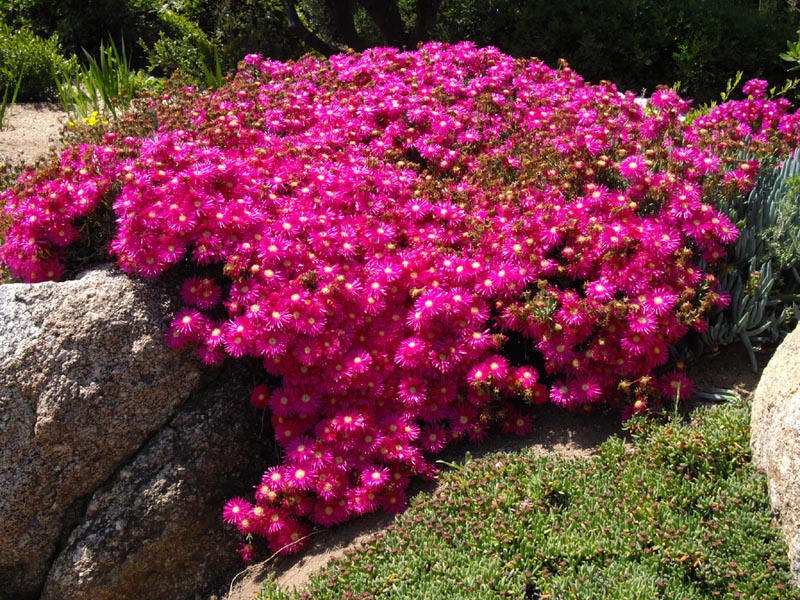
Lampranthus plants are succulents with long, smooth leaves that can be triangular or cylindrical and grow in opposite pairs along the branches. Their standout feature is the large, bright flowers that can be red, orange, peach, yellow, pink, magenta, or purple, sometimes even showing two colours at once. In bloom, the flowers often cover the entire shrub, creating a striking display. The seed capsules are unique, with triangular valves that open when wet and have two wings on each valve.
Where does Lampranthus come from?
Lampranthus is native to southern Africa, mainly Namibia and the Cape Provinces of South Africa. These plants are found especially in dry, arid areas, including the Fynbos habitats. The name 'Lampranthus' comes from Greek and means 'shining-flowers', reflecting the vivid look of their blooms. Over time, they have become popular in gardens outside their native range, especially in regions with similar dry climates.
When and how Lampranthus blooms
Lampranthus flowers appear in summer, from June to August in the northern hemisphere. The plants thrive in arid conditions and are suited to dry, sunny spots. They are grown for their showy blooms and are usually propagated from cuttings or seeds. The seed capsules open when wet, releasing seeds for new plants. Their succulent leaves help them store water and survive drought.



How Lampranthus is used
These succulents are mainly grown for their colourful flowers and are popular in home gardens, especially in dry or Mediterranean climates. The bright, massed blooms make them a favourite for ground cover and rock gardens. Their flowers attract many insects, including bees, wasps, and beetles, which help with pollination.
Kinds of Lampranthus
There are many species within the Lampranthus genus, each with its own flower colours and leaf shapes. Some, like L. aureus and L. spectabilis, have been studied for their chemical compounds. The genus is distinguished from similar plants by the structure of its seed capsules and the way its seeds are partially covered inside.
What Lampranthus means
Lampranthus is valued for its ability to bring colour to dry landscapes and is often used in gardens for this reason. The genus name highlights the brightness of its flowers. Some species have been confused with other succulents in herbal markets, but Lampranthus is mainly known for its ornamental use rather than cultural or symbolic meanings.
Questions people ask about Lampranthus
Where does Lampranthus come from?
Lampranthus is native to southern Africa, especially Namibia and the Cape Provinces of South Africa. It grows naturally in arid areas, including Fynbos habitats.
What do Lampranthus flowers look like?
The flowers are large, bright, and come in many colours, including red, orange, yellow, pink, magenta, and purple. Sometimes the flowers are even bi-coloured and often cover the whole plant.
When does Lampranthus bloom?
Lampranthus species flower in summer, between June and August in the northern hemisphere.
How is Lampranthus used?
Lampranthus is mainly grown as an ornamental plant in gardens, especially in dry regions. Its colourful flowers make it popular for ground cover and rock gardens.
What does Lampranthus symbolise?
The sources do not mention any specific symbolism for Lampranthus. It is mainly valued for its bright, showy flowers and its use in gardens.
Good reading and sources
- USDA Plants DatabaseUS Department of Agriculture, Article
- Plants of the World OnlineRoyal Botanic Gardens, Kew, Plant database
- Where it has been recordedGBIF, Plant database
- Sightings and photos by naturalistsiNaturalist, Plant database
The facts on this page come from the Wikipedia article "Lampranthus", written by its contributors and used under the CC BY-SA 4.0 licence, and from its Wikidata record (CC0). EveryPhool rewrote the text in its own words, with AI assistance, and compares every page with the article to make sure no passage is copied. It may be reused under the same CC BY-SA 4.0 licence with a link back.
It may contain mistakes. It is not medical or foraging advice: many flowers are poisonous, and traditional uses are reported, not recommended. If something is wrong, tell us. Last refreshed 2026-10-03.
Others in the family Aizoaceae
The whole family Mesembryanthemum
A southern African succulent with sparkling, long-lasting flowers
🇿🇦 South Africa and 1 more · Wildflower
Mesembryanthemum
A southern African succulent with sparkling, long-lasting flowers
🇿🇦 South Africa and 1 more · Wildflower
 Livingstone daisyCleretum bellidiforme
A succulent annual with iridescent daisy-like flowers from South Africa
🇿🇦 South Africa · Cactus or succulent
Livingstone daisyCleretum bellidiforme
A succulent annual with iridescent daisy-like flowers from South Africa
🇿🇦 South Africa · Cactus or succulent
 Sour figCarpobrotus edulis
A coastal succulent mat with wide yellow blooms and tart edible fruits
🇿🇦 South Africa and 4 more · Cactus or succulent
Sour figCarpobrotus edulis
A coastal succulent mat with wide yellow blooms and tart edible fruits
🇿🇦 South Africa and 4 more · Cactus or succulent
 Fig-marigoldAizoaceae
Succulent plants of Southern Africa known for pebble shapes and shimmering leaves
🇿🇦 South Africa and 4 more · Cactus or succulent
Fig-marigoldAizoaceae
Succulent plants of Southern Africa known for pebble shapes and shimmering leaves
🇿🇦 South Africa and 4 more · Cactus or succulent
More from Namibia
All the flowers of Namibia Pelargonium
A diverse group of flowering plants often grown as garden and house plants
🇿🇦 South Africa and 7 more · Garden flower
Pelargonium
A diverse group of flowering plants often grown as garden and house plants
🇿🇦 South Africa and 7 more · Garden flower
 Adenium boehmianum
A toxic succulent from arid parts of Namibia and Angola
🇳🇦 Namibia and 1 more · Wildflower
Adenium boehmianum
A toxic succulent from arid parts of Namibia and Angola
🇳🇦 Namibia and 1 more · Wildflower
 Desert roseAdenium
A succulent with thick stems and bright flowers, grown as a bonsai and houseplant
🇳🇦 Namibia and 7 more · Wildflower
Desert roseAdenium
A succulent with thick stems and bright flowers, grown as a bonsai and houseplant
🇳🇦 Namibia and 7 more · Wildflower
 Babianabobbejaantjie
A group of small, colourful flowering plants from southern Africa
🇿🇦 South Africa and 4 more · Wildflower
Babianabobbejaantjie
A group of small, colourful flowering plants from southern Africa
🇿🇦 South Africa and 4 more · Wildflower