
Mesembryanthemum
A southern African succulent with sparkling, long-lasting flowers
Mesembryanthemum is a group of flowering succulents from southern Africa, known for their shiny, crystal-like leaf surfaces and showy blooms. These plants open their flowers in sunlight and are grown as ornamentals, but some species have become invasive in new regions.
- Native to southern Africa and known as 'vygies' locally
- Leaves and stems sparkle due to bladder cells, resembling ice crystals
- Flowers open in sunlight and close at night
- Some species are considered invasive outside their native range
- Legal restrictions apply in places like Louisiana, USA
What does Mesembryanthemum look like?
Mesembryanthemum plants are low-growing succulents with fleshy leaves and stems. Their most striking feature is the covering of glistening, bubble-like bladder cells on leaves, stems, and fruit, which reflect light and give the appearance of ice crystals. The flowers are showy and long-lasting, opening in sunlight and closing at night. Raphides, which are needle-shaped crystals, are present in abundance within the plant tissues.
Where does Mesembryanthemum come from?
Mesembryanthemum is native to southern Africa, where it grows in dry, sunny habitats. The genus name was first given in 1684 by Jacob Breyne, meaning 'midday flower' in Greek, as the species he knew opened at noon. Later, the spelling and meaning were changed to reflect discoveries of night-flowering species. Over time, many species have been moved to other genera, but Mesembryanthemum remains a well-known group within the Aizoaceae family.
When and how Mesembryanthemum blooms
These succulents bloom when exposed to sunlight, with flowers that close at night or in poor weather. They are usually grown as ornamental plants in gardens or pots, thriving in sunny, well-drained conditions. Their ability to escape cultivation means they can naturalize and spread in suitable climates.


How Mesembryanthemum is used
Mesembryanthemum is mainly grown for its decorative value, thanks to its sparkling foliage and attractive flowers. In some regions, it has spread beyond gardens and become invasive. Certain species are thought to have hallucinogenic properties, leading to legal restrictions in places like Louisiana, where cultivation is only allowed for ornamental use.
Kinds of Mesembryanthemum
The genus includes over 100 accepted species, with some now placed in related genera such as Cleretum and Carpobrotus. The term 'vygie' in South Africa refers to many similar plants in the Aizoaceae family, not just Mesembryanthemum.
What Mesembryanthemum means
In South Africa, Mesembryanthemum and its relatives are called 'vygies' and are valued for their bright, long-lasting flowers. Some species have been associated with hallucinogenic effects. Legal controls exist in certain areas, such as Louisiana, due to these properties and their potential to become invasive.
Where Mesembryanthemum is used and seen

Traditions that use it
Where to see Mesembryanthemum

Questions people ask about Mesembryanthemum
Where does Mesembryanthemum come from?
Mesembryanthemum is indigenous to southern Africa, where it grows in sunny, dry areas and is known locally as 'vygie'.
Why are they called ice plants?
They are called ice plants because their leaves and stems are covered with glistening bladder cells that reflect light and look like ice crystals.
What are Mesembryanthemum plants used for?
They are mainly grown as ornamental plants for their sparkling foliage and showy flowers, but in some places they have become invasive.
Are there any legal issues with growing Mesembryanthemum?
Yes, in Louisiana (USA), growing, selling, or possessing Mesembryanthemum is restricted except for ornamental purposes due to concerns about hallucinogenic properties.
What does the name Mesembryanthemum mean?
The name was originally coined to mean 'midday flower' in Greek, as early known species opened at noon, but was later reinterpreted to refer to the flower's central pistil.
Good reading and sources
- USDA Plants DatabaseUS Department of Agriculture, Article
- Plants of the World OnlineRoyal Botanic Gardens, Kew, Plant database
- Where it has been recordedGBIF, Plant database
- Sightings and photos by naturalistsiNaturalist, Plant database
- Mesembryanthemum on WikipediaEncyclopedia
- More photos on Wikimedia CommonsPhotos
- Wikidata recordOpen data
The facts on this page come from the Wikipedia article "Mesembryanthemum", written by its contributors and used under the CC BY-SA 4.0 licence, and from its Wikidata record (CC0). Phool rewrote the text in its own words, with AI assistance, and compares every page with the article to make sure no passage is copied. It may be reused under the same CC BY-SA 4.0 licence with a link back.
It may contain mistakes. It is not medical or foraging advice: many flowers are poisonous, and traditional uses are reported, not recommended. If something is wrong, tell us. Last refreshed 2026-10-03.
Others in the family Aizoaceae
The whole family

More from South Africa
All the flowers of South Africa Eucalyptus
The tall, aromatic trees and shrubs known as gum trees or eucalypts
🇦🇺 Australia and 7 more · Flowering tree
Eucalyptus
The tall, aromatic trees and shrubs known as gum trees or eucalypts
🇦🇺 Australia and 7 more · Flowering tree
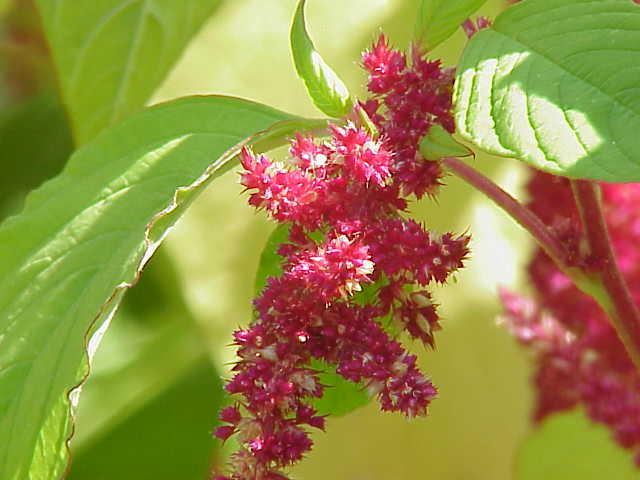 AmaranthAmaranthus
A tall, colourful plant grown for its flowers, leaves and edible seeds
🇲🇽 Mexico and 7 more · Wildflower
AmaranthAmaranthus
A tall, colourful plant grown for its flowers, leaves and edible seeds
🇲🇽 Mexico and 7 more · Wildflower
 Acacia
Shrubs and trees with golden or cream puffball flowers, native mostly to Australia
🇦🇺 Australia and 6 more · Wildflower
Acacia
Shrubs and trees with golden or cream puffball flowers, native mostly to Australia
🇦🇺 Australia and 6 more · Wildflower
 Sensitive PlantMimosa pudica
A touch-sensitive plant whose leaves fold up when disturbed
🇧🇷 Brazil and 8 more · Wildflower
Sensitive PlantMimosa pudica
A touch-sensitive plant whose leaves fold up when disturbed
🇧🇷 Brazil and 8 more · Wildflower