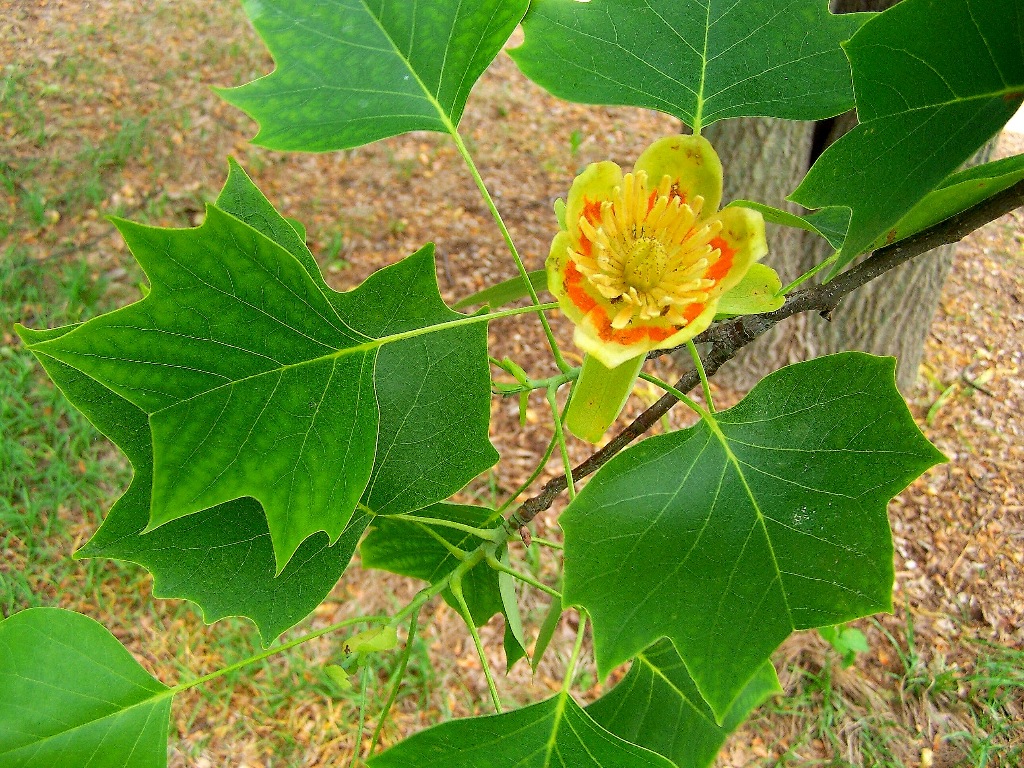
Tulip tree
Liriodendron, family Magnoliaceae
A tall deciduous tree with tulip-shaped flowers and four-lobed leaves
The tulip tree is a large deciduous tree in the magnolia family, known for its distinctive four-lobed leaves and showy flowers that resemble tulips. Two living species exist: one native to eastern North America, the other to China and Vietnam. Both grow quickly in rich, moist soils and are valued for timber and ornamental planting.
- Flowers resemble tulips and have a faint cucumber scent
- Leaves are four-lobed and turn yellow in autumn
- Tallest native angiosperm in North America, over 58 m high
- Two living species: one in North America, one in China and Vietnam
- Wood used for furniture frames and historically for dugout canoes
What does Tulip tree look like?
Tulip trees are tall, often reaching over 50 meters, with straight trunks and compact conical crowns. Their leaves have four lobes and a notched tip, turning yellow or yellow-brown in autumn. The flowers are 3–10 cm wide, with six inner petals that are yellow-green and marked with orange at the base. They emit a faint cucumber-like scent.
Where does Tulip tree come from?
The genus Liriodendron includes two living species: L. tulipifera from eastern North America and L. chinense from China and Vietnam. Fossil evidence shows the group once had a circumpolar distribution across the Northern Hemisphere during the Tertiary period but disappeared from Europe due to glacial climate shifts.
When and how Tulip tree blooms
These trees grow rapidly in temperate zones with deep, fertile, well-drained soil. They flower after about 15 years when grown from seed, though grafted specimens may bloom sooner. Both species hybridize readily, producing the cultivated hybrid L. × sinoamericanum.


How Tulip tree is used
The North American species is widely planted in gardens and parks and used for timber, sold as 'poplar' or 'tulipwood'. Its lightweight, stable wood is common in furniture frames and veneer backing. Historically, Native Americans carved its large trunks into dugout canoes, giving rise to the name 'canoewood'.
Kinds of Tulip tree
L. chinense has slightly larger leaves than L. tulipifera, though they overlap in size. Each species has a semi-deciduous form at the southern edge of its range, Florida for the American tree, Yunnan for the Chinese one. Hybrids between the two are cultivated as L. × sinoamericanum.
What Tulip tree means
The tulip tree is the state tree of Indiana, Kentucky, and Tennessee. It is prized in horticulture for its height, rapid growth, and striking form. In Appalachian forests, it often towers above oaks and maples, with some specimens exceeding 190 feet, the tallest native flowering trees in North America.
Where Tulip tree is used and seen


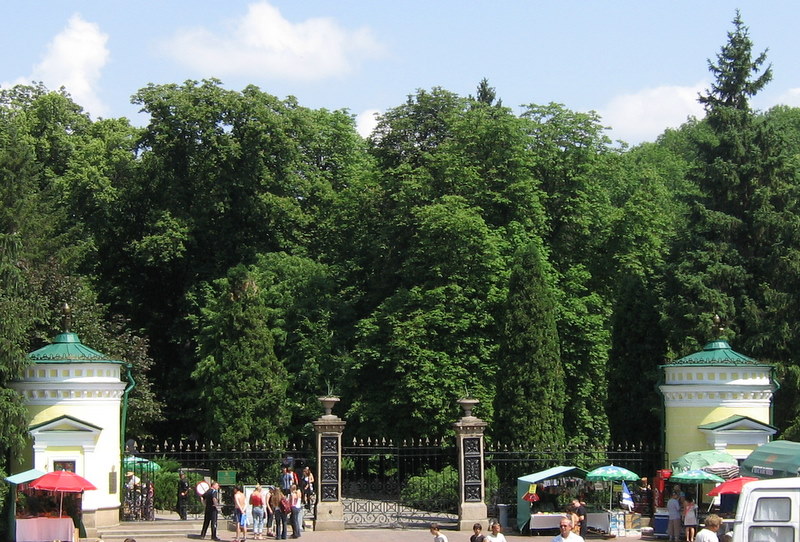
Questions people ask about Tulip tree
Where does the tulip tree come from?
It has two species: Liriodendron tulipifera is native to eastern North America, and Liriodendron chinense grows wild in China and Vietnam.
Why is it called a tulip tree?
Its flowers are shaped like tulips, with yellow-green petals and an orange mark at the base, giving the tree its common name.
Is the tulip tree related to poplars?
No. Despite names like 'tulip poplar' or 'yellow poplar', it belongs to the magnolia family and is not closely related to true poplars.
What is tulip tree wood used for?
Its fine-grained, stable wood is used in furniture framing, cabinetry, and veneer backing, and was historically carved into dugout canoes.
When does the tulip tree flower?
It typically begins flowering around 15 years of age, producing blooms in summer that are 3–10 cm wide with a light cucumber-like scent.
Good reading and sources
- Encyclopaedia BritannicaArticle
- USDA Plants DatabaseUS Department of Agriculture, Article
- What’s in a Plant Name: Liriodendron tulipifera L.New York Botanical Garden, Article
- Plants of the World OnlineRoyal Botanic Gardens, Kew, Plant database
- Where it has been recordedGBIF, Plant database
- Sightings and photos by naturalistsiNaturalist, Plant database
The facts on this page come from the Wikipedia article "Liriodendron", written by its contributors and used under the CC BY-SA 4.0 licence, and from its Wikidata record (CC0). Phool rewrote the text in its own words, with AI assistance, and compares every page with the article to make sure no passage is copied. It may be reused under the same CC BY-SA 4.0 licence with a link back.
It may contain mistakes. It is not medical or foraging advice: many flowers are poisonous, and traditional uses are reported, not recommended. If something is wrong, tell us. Last refreshed 2026-10-03.
Others in the family Magnoliaceae
The whole family ChampakMagnolia champaca
A tall tree with fragrant yellow to orange flowers, prized in South and Southeast Asia
🇲🇲 Myanmar and 7 more · Flowering tree
ChampakMagnolia champaca
A tall tree with fragrant yellow to orange flowers, prized in South and Southeast Asia
🇲🇲 Myanmar and 7 more · Flowering tree
 Campbell's MagnoliaMagnolia campbellii
A Himalayan tree with large pink or white flowers blooming before the leaves
🇨🇳 China and 3 more · Flowering tree
Campbell's MagnoliaMagnolia campbellii
A Himalayan tree with large pink or white flowers blooming before the leaves
🇨🇳 China and 3 more · Flowering tree
 Magnolia sieboldii
A summer-blooming magnolia with white, cup-shaped flowers from East Asia
🇨🇳 China and 3 more · Flowering tree
Magnolia sieboldii
A summer-blooming magnolia with white, cup-shaped flowers from East Asia
🇨🇳 China and 3 more · Flowering tree
 Tulip treeLiriodendron tulipifera
A towering North American tree with tulip-shaped yellow-green flowers
🇺🇸 United States and 1 more · Flowering tree
Tulip treeLiriodendron tulipifera
A towering North American tree with tulip-shaped yellow-green flowers
🇺🇸 United States and 1 more · Flowering tree
More from China
All the flowers of China PeachPrunus persica
A flowering fruit tree from China, grown for its pink blossoms and sweet fruit
🇨🇳 China and 7 more · Flowering tree
PeachPrunus persica
A flowering fruit tree from China, grown for its pink blossoms and sweet fruit
🇨🇳 China and 7 more · Flowering tree
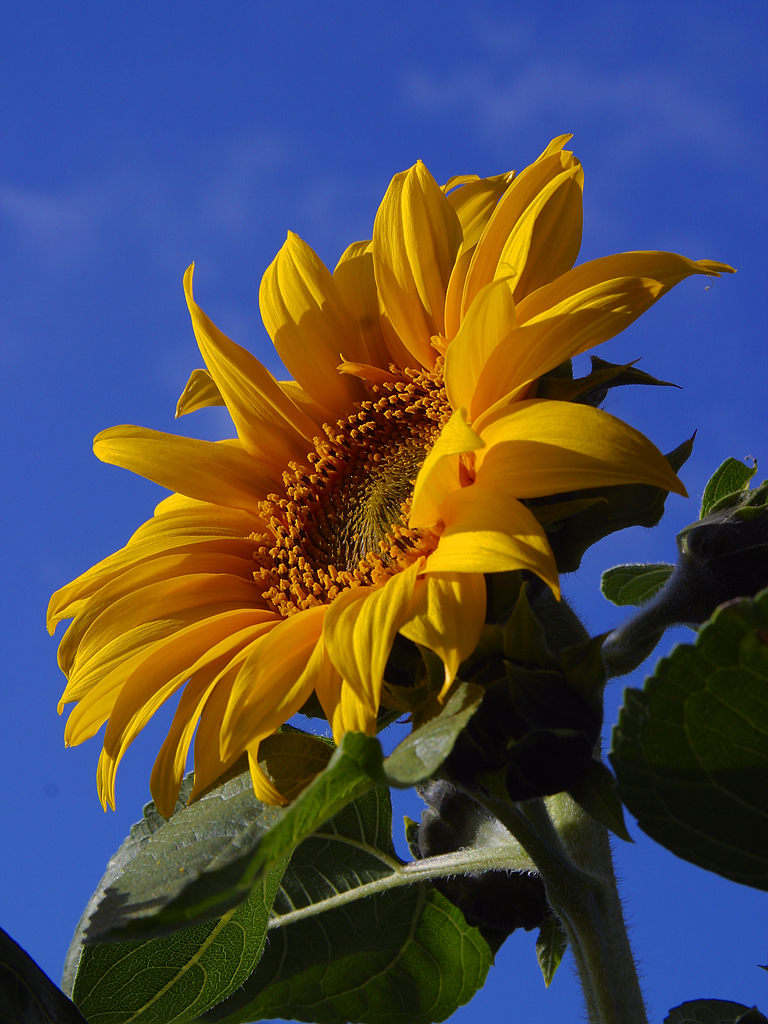 Common sunflowerHelianthus annuus
A tall annual plant grown for its large yellow flower heads and edible seeds
🇨🇦 Canada and 4 more · Wildflower
Common sunflowerHelianthus annuus
A tall annual plant grown for its large yellow flower heads and edible seeds
🇨🇦 Canada and 4 more · Wildflower
 PomegranatePunica granatum
A shrub with bright red flowers and a fruit full of edible seeds
🇮🇷 Iran and 9 more · Flowering shrub
PomegranatePunica granatum
A shrub with bright red flowers and a fruit full of edible seeds
🇮🇷 Iran and 9 more · Flowering shrub
 BirchBetula
Slender trees with papery bark found across the northern world
🇨🇳 China and 7 more · Wildflower
BirchBetula
Slender trees with papery bark found across the northern world
🇨🇳 China and 7 more · Wildflower