
Philotheca
A group of Australian shrubs with delicate five-petalled flowers
Philotheca is a genus of around fifty shrub species native only to Australia. They bear small, often fragrant flowers with five petals and ten inward-curving stamens, and grow in every Australian state except the Northern Territory.
- Endemic to Australia, absent only from the Northern Territory
- Flowers typically have five petals and ten inward-bending stamens
- Seeds are ejected explosively from dry capsules
- Formerly included in the genus Eriostemon
What does Philotheca look like?
Philotheca plants are upright or spreading shrubs, sometimes smooth and sometimes covered in fine hairs. Their narrow leaves grow one at a time along the stems. The flowers usually have five separate sepals and five overlapping petals, with ten stamens that arch over the central ovary. Each seed capsule bursts open when ripe.
Where does Philotheca come from?
All Philotheca species come from Australia and are not found naturally anywhere else. Though once grouped under the name Eriostemon, many were reclassified into this genus. The name refers to the smooth sheath-like base of the stamens, though it was misspelled at its creation.
When and how Philotheca blooms
These shrubs grow across mainland Australia, missing only the Northern Territory. They flower from leaf joints or branch tips, producing capsules that split open forcefully to scatter seeds. Most have five-petalled blooms, though one species has four.


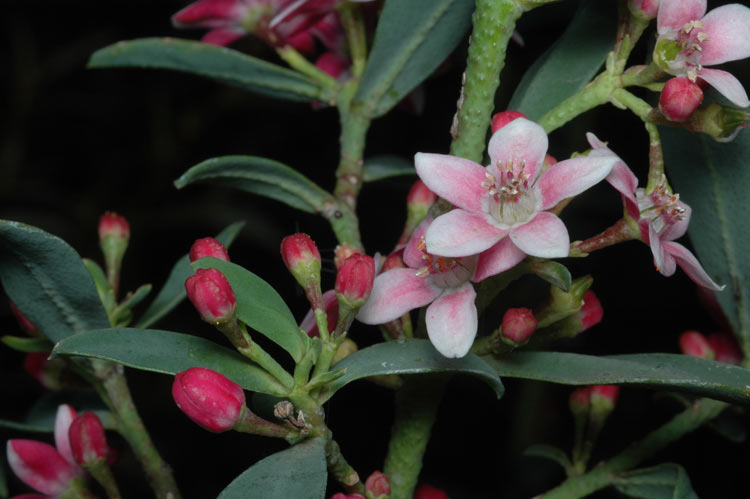

Kinds of Philotheca
About fifty species are recognised, spread through all Australian states. One early name, Philotheca australis, was later deemed invalid and merged into P. salsolifolia. Many species were moved here from the former genus Eriostemon.
Questions people ask about Philotheca
Where does Philotheca come from?
It is native only to Australia and grows in every state except the Northern Territory.
What do Philotheca flowers look like?
They usually have five sepals, five overlapping petals, and ten stamens that curve over the ovary.
Is Philotheca used for anything?
The sources do not mention any specific traditional, decorative, or practical uses.
How many species are there?
Around fifty species are currently accepted in the genus Philotheca.
Good reading and sources
- Plants of the World OnlineRoyal Botanic Gardens, Kew, Plant database
- Where it has been recordedGBIF, Plant database
- Sightings and photos by naturalistsiNaturalist, Plant database
The facts on this page come from the Wikipedia article "Philotheca", written by its contributors and used under the CC BY-SA 4.0 licence, and from its Wikidata record (CC0). Phool rewrote the text in its own words, with AI assistance, and compares every page with the article to make sure no passage is copied. It may be reused under the same CC BY-SA 4.0 licence with a link back.
It may contain mistakes. It is not medical or foraging advice: many flowers are poisonous, and traditional uses are reported, not recommended. If something is wrong, tell us. Last refreshed 2026-10-03.
Others in the family Rutaceae
The whole family Bitter orangeCitrus × aurantium
The citrus tree behind Seville orange marmalade and Neroli oil
🇨🇳 China and 6 more · Flowering tree
Bitter orangeCitrus × aurantium
The citrus tree behind Seville orange marmalade and Neroli oil
🇨🇳 China and 6 more · Flowering tree
 BaelAegle marmelos
A spiny tree with fragrant yellow-green flowers and hard-shelled aromatic fruit
🇮🇳 India and 6 more · Flowering tree
BaelAegle marmelos
A spiny tree with fragrant yellow-green flowers and hard-shelled aromatic fruit
🇮🇳 India and 6 more · Flowering tree
 Satsuma mandarinCitrus unshiu
A sweet, easy-peeling citrus fruit grown in Japan, China, and beyond
🇯🇵 Japan and 5 more · Flowering tree
Satsuma mandarinCitrus unshiu
A sweet, easy-peeling citrus fruit grown in Japan, China, and beyond
🇯🇵 Japan and 5 more · Flowering tree
 Tachibana orangeCitrus × tachibana
A wild mandarin orange found in the forests of Japan
🇯🇵 Japan and 1 more · Wildflower
Tachibana orangeCitrus × tachibana
A wild mandarin orange found in the forests of Japan
🇯🇵 Japan and 1 more · Wildflower
More from Australia
All the flowers of Australia AlmondPrunus amygdalus
A Mediterranean tree grown for its fragrant spring flowers and edible seeds
🇮🇷 Iran and 6 more · Flowering tree
AlmondPrunus amygdalus
A Mediterranean tree grown for its fragrant spring flowers and edible seeds
🇮🇷 Iran and 6 more · Flowering tree
 FennelFoeniculum vulgare
A tall, aromatic herb with feathery leaves and yellow umbels, used for food and spice
🇨🇳 China and 7 more · Herb or useful flower
FennelFoeniculum vulgare
A tall, aromatic herb with feathery leaves and yellow umbels, used for food and spice
🇨🇳 China and 7 more · Herb or useful flower
 RosemarySalvia rosmarinus
A fragrant evergreen shrub with needle-like leaves and purple, blue, or white flowers
🇪🇸 Spain and 5 more · Flowering shrub
RosemarySalvia rosmarinus
A fragrant evergreen shrub with needle-like leaves and purple, blue, or white flowers
🇪🇸 Spain and 5 more · Flowering shrub
 Eucalyptus
The tall, aromatic trees and shrubs known as gum trees or eucalypts
🇦🇺 Australia and 7 more · Flowering tree
Eucalyptus
The tall, aromatic trees and shrubs known as gum trees or eucalypts
🇦🇺 Australia and 7 more · Flowering tree