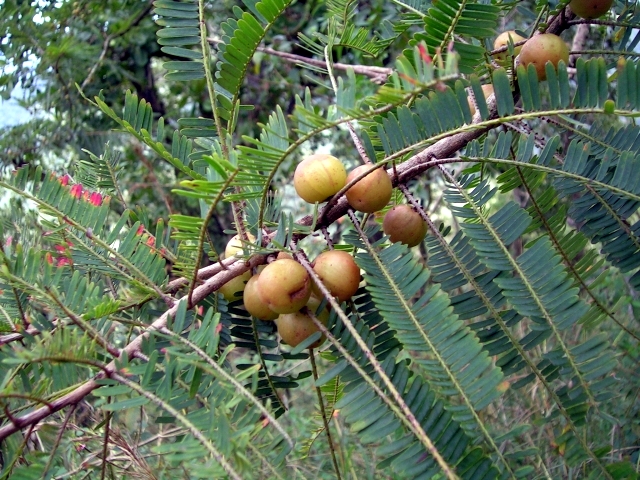
Indian Gooseberry
Phyllanthus emblica, family Phyllanthaceae
A sacred Asian flowering tree valued for tart green fruits and traditional rituals
Native to tropical and southern Asia, the Indian gooseberry is a small to medium deciduous tree bearing small greenish-yellow blossoms in early spring. Its tart, furrowed green fruits are eaten pickled or candied, used in Ayurvedic remedies, and venerated in Hindu and Buddhist traditions.
- Grafted trees start blooming in three to four years, whereas seed-grown trees take up to a decade.
- Cultivated gooseberry fruits weigh up to ten times more than the wild berries gathered from forest trees.
- Hindu tradition venerates the tree during Amalaka Ekadashi as sacred to Brahma, Vishnu, and Shiva.
- In Theravada Buddhism, Phussa Buddha is said to have achieved enlightenment under an emblic tree.
What does Indian Gooseberry look like?
Indian gooseberry is a small or medium deciduous tree standing between one and eight metres tall. Its trunk has mottled bark, while its slender branchlets are covered in fine downy hairs and shed each season. The pale green leaves sit closely packed along these shoots without distinct stalks, giving the twigs the appearance of feathery compound foliage. Tiny greenish-yellow blossoms appear in clusters along the branches. Later in the year, the tree yields hard, rounded fruits of a matching pale green-yellow shade. Each fruit features six faint vertical grooves running down its glossy exterior. Wild berries remain small and light, whereas cultivated varieties swell into much heavier spheres.
Where does Indian Gooseberry come from?
The tree is indigenous to tropical and southern Asia, where it grows wild in countries such as Myanmar as well as the Chinese regions of Tibet and Fujian. It belongs to the botanical family Phyllanthaceae under the genus Phyllanthus. Known formally as Phyllanthus emblica, the species has acquired many regional names across Asia, including amalaki, amloki, amla, and emblic. Historically, it has spread throughout the Indian subcontinent and across Southeast Asia, flourishing in warm climates where local communities integrated both wild-harvested and farmed trees into traditional cooking and spiritual rituals.
When and how Indian Gooseberry blooms
The primary blooming window for the tree takes place during early spring, mainly across March and April, when the small greenish-yellow florets open along the branchlets. Growers cultivate the plant either from seeds or by grafting. Grafted saplings establish relatively quickly, producing their first flowers within three to four years of planting. In contrast, trees started directly from seed take seven to ten years before they begin to bloom. Following pollination, the fruits develop over the warm months and mature for hand-picking by autumn, when harvesters scale the upper canopy to gather the crop.


How Indian Gooseberry is used
Every part of the harvest finds a purpose in regional households. The tart, fibrous fruits are eaten fresh or cooked into savory lentil preparations such as dal. Across South Asia, cooks pickle the berries with oil, salt, and spices, or simmer them in dense sugar syrup to create amle ka murabbah, a candied sweet served following meals. In the Batak region of Sumatra, cooks scrape the inner bark to add an astringent, bitter bite to a traditional fish broth called holat. Furthermore, both fresh and dried fruits serve as vital components in Ayurvedic medicine, including the herbal formulation known as Triphala.
Kinds of Indian Gooseberry
While all trees belong to the single species Phyllanthus emblica, significant physical differences exist between wild-growing specimens and cultivated farm stocks. Wild trees yield compact fruits that weigh only around 5.5 grams on average. By comparison, cultivated orchard varieties produce much larger, plumper berries that range between 28 and 56 grams each. The fruit contains high concentrations of natural vitamin C alongside complex ellagitannins and flavonoids, including emblicanin A and B, punigluconin, pedunculagin, kaempferol, ellagic acid, and gallic acid.
What Indian Gooseberry means
The tree holds deep spiritual significance across Asian religions. In Hinduism, where it is known as āmalaka, the plant is sacred to the Trimurti deities Brahma, Vishnu, and Shiva, and is honored during the festival of Amalaka Ekadashi. Hindu legend tells that the first trees sprouted from the tears of the goddesses Lakshmi and Parvati. In Buddhist tradition, the twenty-first Buddha, Phussa Buddha, attained enlightenment beneath its boughs. An ancient text records that the great ruler Ashoka gave half a gooseberry as his final offering to the monastic community.
Where Indian Gooseberry is used and seen


Questions people ask about Indian Gooseberry
Where does the Indian gooseberry come from?
The tree is native to tropical and southern Asia, including Myanmar and parts of China like Tibet and Fujian. It grows naturally in warm forest regions and is widely cultivated across the Indian subcontinent.
What do the flowers and fruits look like?
The tree bears tiny greenish-yellow blossoms during early spring. Its fruits are hard, smooth, pale green spheres marked with six vertical stripes, maturing in autumn to a sour, bitter, and astringent taste.
How is the fruit used in cooking and medicine?
South Asian cooks pickle the fruit with spices or preserve it in sugar syrup. The inner bark flavors fish broth in Sumatra, and both fresh and dried fruits serve as central ingredients in Ayurvedic remedies.
What religious significance does the tree carry?
In Hinduism, the tree is sacred to Brahma, Vishnu, and Shiva, celebrated on Amalaka Ekadashi. In Buddhism, Phussa Buddha attained enlightenment under it, and Emperor Ashoka gave half a fruit as his final monastic gift.
Good reading and sources
- Encyclopaedia BritannicaArticle
- IUCN Red List of Threatened SpeciesIUCN Red List, Article
- USDA Plants DatabaseUS Department of Agriculture, Article
- Plants of the World OnlineRoyal Botanic Gardens, Kew, Plant database
- Where it has been recordedGBIF, Plant database
- Sightings and photos by naturalistsiNaturalist, Plant database
- Phyllanthus emblica on WikipediaEncyclopedia
- More photos on Wikimedia CommonsPhotos
- Wikidata recordOpen data
The facts on this page come from the Wikipedia article "Phyllanthus emblica", written by its contributors and used under the CC BY-SA 4.0 licence, and from its Wikidata record (CC0). EveryPhool rewrote the text in its own words, with AI assistance, and compares every page with the article to make sure no passage is copied. It may be reused under the same CC BY-SA 4.0 licence with a link back.
It may contain mistakes. It is not medical or foraging advice: many flowers are poisonous, and traditional uses are reported, not recommended. If something is wrong, tell us. Last refreshed 2026-10-04.

More from Myanmar
All the flowers of Myanmar FennelFoeniculum vulgare
A tall, aromatic herb with feathery leaves and yellow umbels, used for food and spice
🇨🇳 China and 7 more · Herb or useful flower
FennelFoeniculum vulgare
A tall, aromatic herb with feathery leaves and yellow umbels, used for food and spice
🇨🇳 China and 7 more · Herb or useful flower
 Common flaxLinum usitatissimum
The slender blue-flowered plant grown for linen and linseed
🇨🇳 China and 7 more · Wildflower
Common flaxLinum usitatissimum
The slender blue-flowered plant grown for linen and linseed
🇨🇳 China and 7 more · Wildflower
 Sensitive PlantMimosa pudica
A touch-sensitive plant whose leaves fold up when disturbed
🇧🇷 Brazil and 8 more · Wildflower
Sensitive PlantMimosa pudica
A touch-sensitive plant whose leaves fold up when disturbed
🇧🇷 Brazil and 8 more · Wildflower
 Thorn-appleDatura stramonium
A poisonous, night-blooming plant with trumpet-shaped white or violet flowers
🇨🇳 China and 7 more · Wildflower
Thorn-appleDatura stramonium
A poisonous, night-blooming plant with trumpet-shaped white or violet flowers
🇨🇳 China and 7 more · Wildflower