
Silver senna
Senna artemisioides, family Fabaceae
A yellow-flowered shrub native to dry regions of Australia
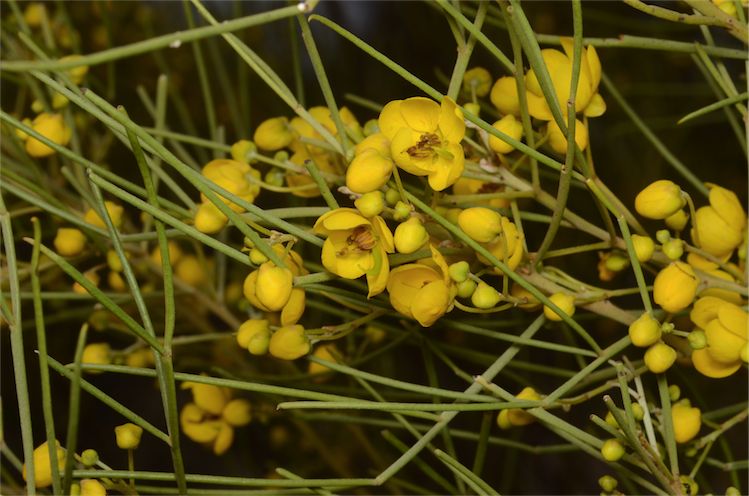
Silver senna is a shrub from Australia with clusters of yellow flowers and fine, divided leaves. It grows in dry, sunny places and is valued both in gardens and by wildlife. The plant is found across mainland Australia and has been introduced to several other countries.
- Native to all mainland states and territories of Australia
- Produces yellow flowers mainly in winter
- Supports butterfly and moth larvae as a food plant
- Introduced to several countries outside Australia
- Recognized with a major horticultural award
What does Silver senna look like?
Silver senna is a bushy shrub that can reach up to 3 meters tall. Its leaves are divided into pairs of narrow leaflets, sometimes with a silky or woolly texture, and often have a small gland between the lowest pair. The plant produces clusters of bright yellow flowers, each with five petals, mostly during the cooler months. After flowering, it forms long, smooth seed pods.
Where does Silver senna come from?
This species is native to the dry inland regions of Australia and is found in every mainland state and territory there. It was first described in the early 19th century and was later moved from the genus Cassia to Senna. The name 'artemisioides' refers to its resemblance to wormwood plants (Artemisia). Silver senna has also been introduced to places such as California, Spain, Cyprus, India, Iraq, and Zimbabwe.
When and how Silver senna blooms
Silver senna blooms mainly in winter, producing yellow flowers in small clusters along the stems. It thrives in well-drained, sunny locations and prefers dry conditions. Gardeners usually grow it from seed, which is soaked briefly in hot water before planting. The shrub is sensitive to frost when young but adapts well to a range of climates once established.



How Silver senna is used
Gardeners value silver senna for its bright winter flowers and its ability to attract butterflies and moths. It is often planted in home gardens for ornamental purposes, especially in dry or low-water landscapes. The plant is also important in the wild as a food source for the larvae of several butterfly and moth species.
Kinds of Silver senna
There are several subspecies and hybrids of silver senna, differing in leaf shape, size, and flower clusters. Some have woolly or silky leaves, while others are more glabrous. These forms are found across different parts of Australia, with some recognized but not yet formally described.
What Silver senna means
Silver senna has received recognition from horticultural societies for its garden value. In the United Kingdom, it is sometimes called wormwood senna, while in the United States it is known as silver senna. The plant plays a role in supporting native insects and is appreciated for its resilience and decorative qualities.
Where Silver senna is used and seen

Questions people ask about Silver senna
Where does silver senna come from?
Silver senna is native to mainland Australia, where it grows in dry regions across all states and territories. It has also been introduced to places like California, Spain, Cyprus, India, Iraq, and Zimbabwe.
What does silver senna look like?
It is a shrub that can grow up to 3 meters tall, with finely divided leaves and clusters of yellow flowers. The leaves are made up of several pairs of narrow leaflets, and the plant forms long, smooth seed pods after flowering.
When does silver senna flower?
Silver senna mostly blooms in the winter months, producing clusters of bright yellow flowers along its stems.
How is silver senna used?
It is commonly grown as an ornamental shrub in gardens, especially in dry climates. The plant is also important for wildlife, serving as a food source for the larvae of several butterfly and moth species.
Are there different types of silver senna?
Yes, there are several subspecies and hybrids, each with variations in leaf shape, size, and flower clusters. Some forms have woolly or silky leaves, while others are smooth.
Good reading and sources
- Senna artemisioidesRoyal Horticultural Society, Article
- USDA Plants DatabaseUS Department of Agriculture, Article
- Plants of the World OnlineRoyal Botanic Gardens, Kew, Plant database
- Where it has been recordedGBIF, Plant database
- Sightings and photos by naturalistsiNaturalist, Plant database
- Senna artemisioides on WikipediaEncyclopedia
- More photos on Wikimedia CommonsPhotos
- Wikidata recordOpen data
The facts on this page come from the Wikipedia article "Senna artemisioides", written by its contributors and used under the CC BY-SA 4.0 licence, and from its Wikidata record (CC0). Phool rewrote the text in its own words, with AI assistance, and compares every page with the article to make sure no passage is copied. It may be reused under the same CC BY-SA 4.0 licence with a link back.
It may contain mistakes. It is not medical or foraging advice: many flowers are poisonous, and traditional uses are reported, not recommended. If something is wrong, tell us. Last refreshed 2026-10-03.
Others in the family Fabaceae
The whole family Acacia
Shrubs and trees with golden or cream puffball flowers, native mostly to Australia
🇦🇺 Australia and 6 more · Wildflower
Acacia
Shrubs and trees with golden or cream puffball flowers, native mostly to Australia
🇦🇺 Australia and 6 more · Wildflower
 Sensitive PlantMimosa pudica
A touch-sensitive plant whose leaves fold up when disturbed
🇧🇷 Brazil and 8 more · Wildflower
Sensitive PlantMimosa pudica
A touch-sensitive plant whose leaves fold up when disturbed
🇧🇷 Brazil and 8 more · Wildflower
 Black locustRobinia pseudoacacia
A tall, fragrant-flowered tree native to eastern North America
🇺🇸 United States and 7 more · Flowering tree
Black locustRobinia pseudoacacia
A tall, fragrant-flowered tree native to eastern North America
🇺🇸 United States and 7 more · Flowering tree
 LupinLupinus
Tall, spiky-flowered legumes grown for gardens, food, and soil health
🇺🇸 United States and 7 more · Wildflower
LupinLupinus
Tall, spiky-flowered legumes grown for gardens, food, and soil health
🇺🇸 United States and 7 more · Wildflower
More from Australia
All the flowers of Australia AlmondPrunus amygdalus
A Mediterranean tree grown for its fragrant spring flowers and edible seeds
🇮🇷 Iran and 6 more · Flowering tree
AlmondPrunus amygdalus
A Mediterranean tree grown for its fragrant spring flowers and edible seeds
🇮🇷 Iran and 6 more · Flowering tree
 FennelFoeniculum vulgare
A tall, aromatic herb with feathery leaves and yellow umbels, used for food and spice
🇨🇳 China and 7 more · Herb or useful flower
FennelFoeniculum vulgare
A tall, aromatic herb with feathery leaves and yellow umbels, used for food and spice
🇨🇳 China and 7 more · Herb or useful flower
 RosemarySalvia rosmarinus
A fragrant evergreen shrub with needle-like leaves and purple, blue, or white flowers
🇪🇸 Spain and 5 more · Flowering shrub
RosemarySalvia rosmarinus
A fragrant evergreen shrub with needle-like leaves and purple, blue, or white flowers
🇪🇸 Spain and 5 more · Flowering shrub
 Eucalyptus
The tall, aromatic trees and shrubs known as gum trees or eucalypts
🇦🇺 Australia and 7 more · Flowering tree
Eucalyptus
The tall, aromatic trees and shrubs known as gum trees or eucalypts
🇦🇺 Australia and 7 more · Flowering tree